














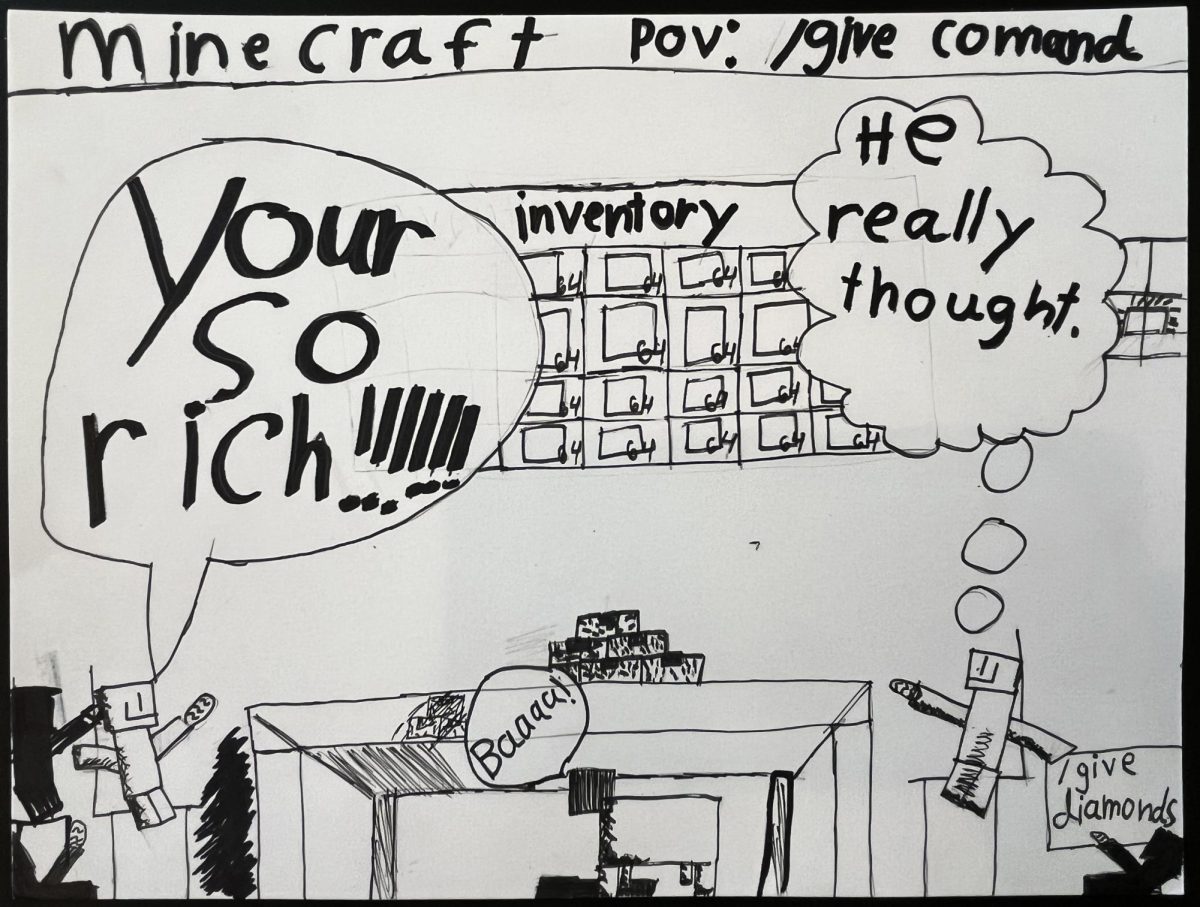


“I am going to end it now.”
“Go kill yourself.”
These phrases ring through Abington Friends School on a daily basis without fail, just like every other American High School. We have normalized these as common jokes, phrases, and teasing tactics. It isn’t okay, and it never was.
For many, these comments roll off the tongue like a simple hello. No thought behind it; it has become natural. I want to make it clear that although this article may seem like an attack against many of my peers, it is not their fault. We are surrounded by an environment every day at school where this is the norm; of course, we are extremely likely to follow suit.
It unfortunately took a tragedy for me to wake up to the disgusting nature of this norm.
I lost my oldest brother, Roman, to suicide on May 8, 2024. Having lost a loved one to suicide, it is horrendous; your whole world pauses while the rest of the world keeps spinning. It feels like you are being left behind. I don’t believe anyone can fully recover from the void it leaves, and yet I am reminded of it every day I attend school.
I am perpetually in a cycle of discomfort as my classmates resort to these common statements. I used to let out a little laugh or smirk, purely because I didn’t know what else to do. However, I realized I am just perpetuating the problem, so now I stay silent. I have tried telling friends not to say it, but then it creates an even more uneasy environment. NOW I CHOOSE NOT TO STAY SILENT.
I don’t have a solution, and nor should I. I am simply a younger brother of one of the over 49,000 people who die from suicide each year in America. Yes, one person dies every eleven minutes, and here we are making insensitive jokes every day.
Maybe what we need is real suicide education, not an assembly once a year to check it off the list. Maybe teachers need training on how to handle these comments that arise in their classroom. I know teachers try. I see it, I hear it, and they are just as lost as I am, at no fault of their own. These are all “maybes,” not definitive solutions, because maybe there is no definitive solution.
Nonetheless, I ask you to take this article into mind and reflect on how many times you hear or say one of these phrases a week, and, just maybe, with that understanding, we will have our solution.



Cadence Carson • Mar 10, 2026 at 11:01 am
A person should respond to a suicide joke by recognizing that even if it is meant to be funny, it can be extremely harmful to others. Many people have personal experiences with suicide that we could be completely unaware of. Whether it involves a friend, family member, or their own struggles, so hearing jokes about it can be painful. Instead of laughing along, someone could calmly say that the joke isn;t funny or that it makes people uncomfortable. Even a simple comment like “that’s not really something to joke about” can make people pause and think about what they said. Sometimes choosing the option not to engage or laugh also sends a message that the joke isn’t acceptable. The goal isn’t to embarrass the person who made the joke, but to help people understand how their words might affect others. Jokes can hurt people even when the person telling them doesn’t intend to cause harm. Because of this, it can be difficult to ask classmates to stop since many people worry about making the situation awkward or seeming overly sensitive. However, speaking up can still make an impact because it encourages more awareness and respect, and it helps create a school environment where people are more thoughtful about what they say.
Loren • Mar 10, 2026 at 8:29 am
Hello Harrison, I agree with what your saying in this article. These phrases that you mentioned and other ones have really become so normal and it is getting out of control. I think if someone has said to them its hard for them just to tell the person to stop because the person might get laughed at and possibly say they are too sensitive. I think that for me I have definitely felt uncomfortable before when someone has said something as a joke, but it is definitely hard to speak out against it to my classmates.
Rainy Korein • Mar 9, 2026 at 5:09 pm
Thank you, Harrison, for standing your ground and speaking up. In general, I think it is hard to express feeling hurt by a “joke” a fellow high schooler makes. In high school, most students don’t seem to take that seriously. Often, it feels that we are expected to act unbothered by whatever offensive humor is shared, lest we be accused of overreacting. You shouldn’t have to hear these things in school.
Olivia Giraud • Mar 7, 2026 at 8:03 pm
I totally agree with this article, and I’m glad that this was brought to light. Many times in school, I have heard similar phrases being thrown around casually, without a second thought. Usually, it’s to elicit a laugh from their friends or after encountering a dilemma of sorts. Or sometimes, I see people pretending to choke themselves for the same reasons, and these comments and gestures regarding suicide really do have weight on them, and it hurts to see something so serious be regarded so lightly. Suicide truly isn’t a funny topic, and many people who actually kill themselves are struggling with things much deeper than an everyday inconvenience someone may get frustrated with. Although I don’t know anybody who has committed suicide, that doesn’t lessen my sympathy towards those who know someone who has or towards those who are struggling with their mental health. I do agree that it’s difficult to speak up when a classmate makes a comment like that, and it’s often uncomfortable to confront someone about their mistakes and unfunny jokes. And I think if we improve our discussion of this topic, it will encourage others to be more aware of what they say.
Jenny • Mar 6, 2026 at 10:19 am
This article highlights something many people notice but rarely pause to think about. Phrases like “go kill yourself” or “I’m going to end it” have become so normalized in everyday speech that people often forget the real weight behind those words. Harrison’s reflection shows how language that seems casual to some can carry deep pain for others, especially for those who have experienced loss.What stood out to me most is the idea that this culture isn’t necessarily created by malicious intent, but by habit. When certain phrases are repeated often enough, they begin to feel ordinary, which makes the issue difficult to address. I also appreciate that the article doesn’t simply blame individuals but instead points to the broader environment that allows these jokes to circulate. Recognizing that culture shapes behavior is an important step toward change.
Sammy • Mar 6, 2026 at 9:31 am
I think a person can respond to a suicide joke by maybe just saying that it isn’t funny, and explaining that suicide is a really serious topic. My friends don’t make jokes that have ever hurt my feelings, and I don’t think I have been in that position before. I think if I was, I would probably wait until I could talk to that person alone, and I would tell them that I didn’t like their joke and that it hurt my feelings. Unless it was really intended to be unkind and was very rude or insensitive, I probably wouldn’t want to tell them in front of a big group because I tend to be more non-confrontational. I think if I was in a group setting and someone made a suicide joke, I would approach them afterwards and tell them that it’s not something to joke about.
Malea Musonge • Mar 5, 2026 at 8:56 pm
I have been someone who refuses to say certain things or words that can hold heavy meaning and have very negative connotations. In the past few months, I have fallen victim to the common phrase that people say that they will harm themselves or do something bad to themselves. As someone who has struggled with mental health in silence for many years, I feel disappointed and shocked when I catch myself saying these things because I have experienced the weight of them first hand or through other people. Mental health has become more of a spectacle in the past few years due to the willingness of people to address their mental health and the normalization of taking measures of getting treated for health issues they may face. I think it is a luxury to be able to have access to mental health professionals and people that can give you the help you need whenever you need it. In many POC communities, there is a stigma attached to mental health due to it making you seem weak or even “white”. Many adults struggle with mental health because they refuse to get the help they need due to this stigma. It is harmful to normalize saying things like you will harm yourself or other people because it can easily become engrained in someone’s brain, and it makes you feel like because it is so normalized then maybe it’s not such a bad thing. Thank you for sharing your opinion and experience Harrison.
Augusto Quinones • Mar 5, 2026 at 9:05 am
I agree that the normalization of suicide, and specifically the language we use surrounding it, has far stretched beyond what may be considered appropriate or healthy. In this instance, I feel my identity as a Latino student to be partially relevant, as to me, it summons the clear distinction as to the topic of suicide and furthermore how various cultures act towards it. Whereas I feel mental health and a whole, and to a lesser unfortunate degree, suicide, have weaved their way into the atmosphere and mindset of the United States, the same can not be said for Latin America. Certainly, in Latin America, like many other regions of the world, mental health and especially the topic of suicide remain a hidden, borderline shameful, topic of discussion. I mention this not as a criticism of either culture nor to drift from the topic at hand, but to build to the formulation of the question: to what extent has the adoption of mental health into American culture contributed to the language we use, especially that pertaining to casual mentions of suicide.
Anjali Tremblay • Mar 4, 2026 at 2:53 pm
Harrison, thank you for writing this article. I think it sheds light on such an important topic and facet of our culture that almost no one addresses in day-to-day life. I have often been really disturbed by the vast amount of suicide jokes, not just at AFS but also in other social scenarios with our generation. I see a lot of people making fun or making light of very serious, life-altering, devastating situations, and it really frustrates me. I think people have to understand that everyone is going through their own issues and you never know what people might be dealing with in their lives, so it’s crucial to not make jokes about things as serious as suicide. Personally, I am constantly working on speaking up when people make comments that make me uncomfortable or hurt. Honestly, it is not my strong suit, and I’ve often not addressed harmful things that people have said, but it is something that I am aware of and I’m trying to be better at. Reading this article, for me, underlines that I need to speak up more.
Liam Hilliard • Mar 2, 2026 at 8:26 am
I lost a dear friend of mine to suicide in April of last year. It’s something I don’t talk about all that much when it isn’t directly relevant, because “my friend died by suicide” isn’t exactly the most fun of conversation starters. It hurts, though. It really does. Suicide leaves a lasting impact on all of a person’s loved ones. And now, every time I hear someone joking about suicide, it cuts a little deeper. It pours a little more salt into the wound. I can take hearing these jokes to some extent, but it’s not pleasant. Every time I hear one of those jokes now, it feels like a direct insult to my friend. It feels like a mockery. Because, if you get down to the root of it, that’s what it is. It’s mocking the victims, even if those doing so don’t usually mean it like that. Suicide ruins people. Don’t joke about it.