












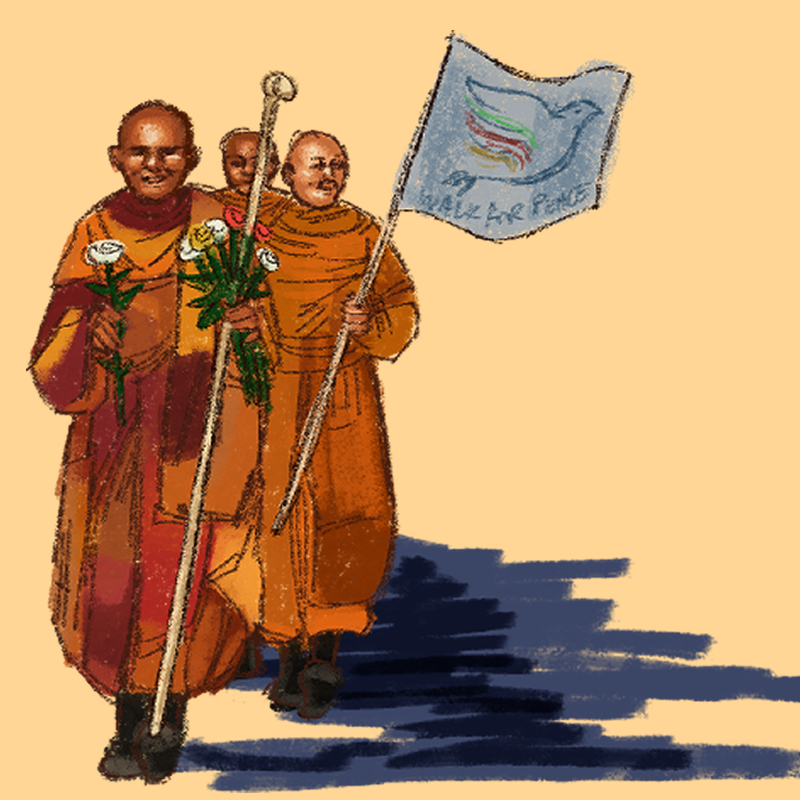
The “Walk For Peace” was a 2,300-mile journey on foot by 19 Vietnamese Theravada Buddhist monks, starting in October of 2025 in Fort Worth, Texas, and ending on February 10 in Washington, D.C. Along the way, they stopped at state capitols and were met by thousands of people awaiting, who handed them flowers as they walked.
However, the 108-day walk was met with hardships, such as the harsh winter storm, delaying their walk and stops at capitols, and an unfortunate car accident injuring one of the monks. Long-distance highways, below freezing temperatures, and physical exhaustion tested their resilience to keep the walking from continuing.
In a Facebook post, they state, “In the hardest conditions, peace still finds a way. In the coldest moments, the heart still warms with compassion. In the most difficult circumstances, blessings still flow between souls. This is why we walk. For hearts that wait, even in the cold.”
The Walk for Peace is not a political movement. But, “is a simple yet meaningful reminder that unity and kindness begin within each of us and can radiate outward to families, communities, and society as a whole,” says Venerable Bhikkhu Paññākāra, the leader of the walk.
This is not the first peace walk. Buddhist monks have been leading peace walks for years. Peace walks first originated in Cambodia. The purpose of the walks was to promote peace and reconciliation after wars, especially in affected areas.
Walking became a symbolic way to unite the divided land and to show that reconciliation is not an instantaneous process, but step by step. In fact, some monks walk in their socks or barefoot to be connected to the ground and stay present in the moment.
Historically, we have seen non-violent action through the Civil Rights Movement, as Martin Luther King put emphasis on non-violent protest, showing America that change does not solely have to stem from being radical. In addition, Mahatma Gandhi adopted non-violence as an ideal way of life and as a philosophy, promoting the pursuit of social justice through peace. From both leaders, society has learned that non-violent action is not passive or “weak,” but resilient and active.
Non-violent action is a bridge to bring people together in violent times. Although the Walk For Peace is not a political movement, its tranquility has strengthened the community nationwide, as a reminder that peace and love are stronger than hate and violence. The gathering of communities from a single act rippled through society. Our individual intentions for peace are what drive change.
When different religious affiliations came together to support the walk, it revealed that, despite our differences and the labels society confines people to, we share a common desire for peace. What makes us divided now makes us stronger as a nation.
ethan son • May 4, 2026 at 9:02 pm
I like how the monks were walking 2,300 miles for a peaceful protest in freezing temperature. It’s beautiful how the monks are really embodying peace through a silent, disciplined, and non-violent actions to show unity across communities. Even when the monks had to go against the very harsh weather, they still kept pushing through and when they had to go through the experience of losing another monk during the car crash they still kept going. A similar theme today is when people unite together for a cause.
Maddox Rems • May 4, 2026 at 2:02 pm
I feel that this article is a beautiful example of the impact of peaceful protests. Major changes for the better can take place even if protests are not radical and these walks for peace are a great example. Even when the monks faced adversity in winter storms, stops, and even an unfortunate car accident, they kept going and their message remained the same. Similar themes occur in our country right now with the current marches in Minneapolis being a good example. People are standing up to a cause in a non radical and peaceful way even when faced with hardship. These nonviolent protests are also having a big impact.
Nandi Abange • May 4, 2026 at 9:47 am
I think we all just need to take a walk sometimes. Personally, I definitely enjoy riding my bike way more than having to take a walk when my sister asks, or when she tells me to not listen to music while I go to calm down my brain. I always think it’s stupid and that music is not a problem, but I think just stopping it all for a moment would be beneficial. Just taking a walk with one another to truly release how much we have pent up. To do such a hard thing but to be with a neighbour through it all; being dependent on your neighbour Is not a big thing anymore. This peace walks undos the selfishness that this generation faces, not because we are mean or something but because we learn to just need ourselves. No one really wants to take walks. I think we should bring this back, bring back connection on this peaceful and deep level. I mean walking in a more figurative way, the way the monks walk alongside each other, spend time with no distractions, depend on each other. When people help people again I think the world will be a better place; if we all stop being strangers I guess.
RC • Apr 28, 2026 at 11:32 pm
I have actually heard very little about the Walk for Peace, and I am very glad to learn about it today. In my opinion, peaceful action is one of the most difficult things to accomplish. Not only does it take immense self-sacrifice in the form of your patience and dignity, but it is often framed in aggressive or polarizing ways. The quote from Paññākāra stuck out to me because it showed that protesting wasn’t even a main intention. The idea that this journey could serve as a reminder of the kindness within all of us feels incredibly encouraging in today’s environment, but also shows how much there is still left to do.
Paige • Apr 27, 2026 at 3:21 pm
I remember seeing the Walk For Peace all over my social media, but never knew the depth details of this beautiful and peaceful protest. This article brings past acts of non violent protests to the surface, which is especially important in the midst of so much violence going on currently, we tend to forget that there are peaceful ways to stand up for injustice. This act of walking as a community for four long months could not have been easy, but that itself is a testament to how important unity is in society. Something that somewhat connects to the idea of this is Stephen King’s novel, The Long Walk. This novel and movie is emulates the some of the core elements from the Walk For Peace, hopes, fears, and facing injustice while forming a very strong bond.
jah • Apr 23, 2026 at 11:12 pm
i like how the monks walking 2,300 miles in freezing weather proves how committed they were. What stood out most to me was how people from different religions came together to support. Even though people have differences, they can still share common values like peace and kindness. I also liked how the article connected this walk to the Civil Rights Movement.
chloe • Apr 22, 2026 at 10:51 pm
I love the perspective this article takes. I think the Walk for Peace was a really important symbol, especially in today’s polarizing political climate. With the war in Iran especially causing a lot of controversy in America, things like the Walk for Peace are really important to counteract the violence that is so present in society right now. Beyond the Walk for Peace, the non-violent No Kings protests going on around the country right now are another continuation of nonviolent American protests like those that began during the Civil Rights movement. These nonviolent themes continue to prevail, even in times when violence is given a spotlight, and this is really important in bringing about change in this area.
Kylie Firmin • Apr 22, 2026 at 7:46 pm
I think this article does a good job of articulating what the Walk for Peace was all about. It’s interesting to have more of a perspective on the purpose of the walk. I don’t think I realized before how it wasn’t for politics, but rather a comment on human connection. I feel like that gives it even more power. It reminds me of other peaceful protests, like walkouts at our school or recognitions of the Day of Silence, and how they’re arguably less about the political atmosphere, acknowledging the reality of our humanity. It’s interesting.