










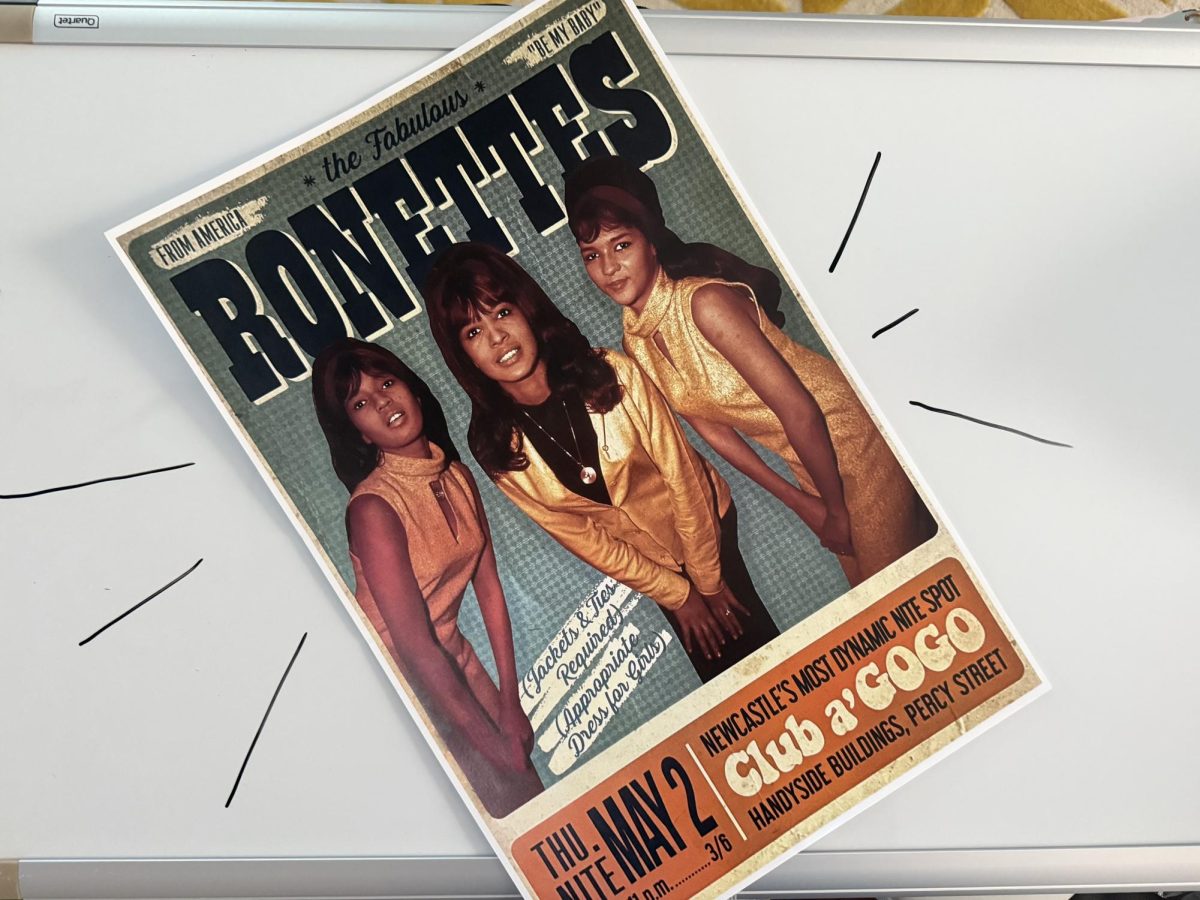














In February 2026, I was flipping through posters in a record store when my hand landed on one that made me scream in shock and excitement. When the customer next to me looked down to see the Ronettes 1963 concert poster in my hand, she conceded “yeah, that’s tuff.”
Just a few months after I’d taped the poster onto my wall, the group’s last surviving member, Nedra Talley-Ross, passed away. In light of her passing, now, more than ever, is time to give these women their props. That customer was right – they are “tuff” – and even if you aren’t as big a fan of 1960s pop as she and I are, much of the music and fashion you enjoy today – from that of the Beach Boys to Amy Winehouse – wouldn’t exist without them.
In 1959, three teenage girls in Spanish Harlem harmonized after school in a house on West 140th street. Their sound was an irresistible, unforgettable blend of fire and sugar, effortlessly elegant with a satisfying New York edge. It was only a matter of time before that gift flowed through the windows of their childhood home and down the streets of Harlem.
Being mixed-race – Puerto-Rican, Black, and Irish – during the last breath of Jim Crow meant that they had to work twice as hard as white singers to gain the recognition they deserved. The support that paved their way to mainstream success started within their own communities. The Apollo Theater – one of the country’s most prestigious historically Black venues – was quick to grant the girls an award. Soon, they were squeezing into formal skirts and onto the stage of the Peppermint Lounge, the favorite east-coast haunt of 1960s Hollywood. This gig had the girls performing for the likes of Audrey Hepburn and Frank Sinatra, earning the kind of clout that turns singing from a hobby to a career.
With the help of their mothers, one of whom was a beautician, their iconic image had already been cemented: huge beehives, tight silk dresses, and a cat-eye that could cut glass. They balanced it-girl mystique with carefully maintained propriety.
The Ronettes’ stardom had come before the later 1960s’ psychedelic shift, at a time when career survival for celebrities still often hinged on maintaining a public life that fit within the lingering strict social expectations of the 1950s. As a result, the majority of the lyrics written for the Ronettes preach domesticity, the most egregious being “going to the chapel and we’re / gonna get married / gee I really love you and we’re / gonna get married.”
Yet while their music never came to reflect it, they did participate in the earliest stages of the rise of counterculture. Beneath their flawless performance of “respectable” girlhood, contemporaries would later detect something just the slightest bit subversive. Why else would fellow sixties popstar Darlene Love call them the “bad girls of the ´60s”? Feminist scholar Hilarie Ashton wrote that their work “(re)inserts women’s perspectives into the histories of masculine- dominated musical realms” by subtly maintaining agency.
The Ronettes did comply with the mandate of a chaste “good-girl” image, yet lead singer Veronica Bennett was known for hitting the camera with a piercing, subtly “scandalous” gaze. At the same time, they equally resisted being resigned to an oversexualized image.
For famous women – especially women of color – in the 1960s, doing what you want with your own image while upholding your personal boundaries remained revolutionary.
Once the decade embarked on its famed ache for change, these subtle subversions lent the Ronettes a striking je–ne-sais-quois that caught the attention of such bohemians as the Beatles.
“They had seen us on Sunday Night at the London Palladium and they said, ‘We have got to meet these girls with the black long hair and slits up the side,’” Veronica Bennett remembered.
The Ronettes were soon invited to tour with the Beatles, during which they became the Brits’ first American contact, playing a behind-the-scenes role in supporting and influencing the band whose music would later champion the freewheeling “summer of love.”
¨I remember them coming to New York the first time, and John Lennon called me saying ´Ronnie, we don´t know what to do. We´re prisoners here.´” Bennett said. “They were either in the Warwick or the Plaza hotel. [He said] ´you gotta get us outta here’. They didn´t know anybody in America. He said ´please bring forty-five records´. We’d sit on the floor and listen..”
In an interview with EMI records, she continued; “I loved their attitude. I loved that they weren’t conceited…they were just like normal guys, you know, like ´I´m talkin´a you´…they would take us to the Liverpool bar … they really appreciated us, and they would take us to all the clubs.” In a separate interview, she continued; “when we got to the U.K., we felt like real stars for the first time. So I thought of the idea that I was … with the British Invasion when it was all happening for us.”
However, as their fame grew, all of that would be cut short by one Phil Spector. Already a bafflingly young bigshot in the music production industry via personal connections and moderate success in managing The Crystals, Spector would get his big break with the Ronettes. While his management did something to boost their fame, it came at the cost of their lead singer’s wellbeing.
The affair between Spector and Bennett started as soon as their record deal did, and culminated in an abusive marriage in which Spector temporarily banned her from performing , prevented her from leaving the house, and threatened to kill her if she ever left him. The abuse drove Bennett to alcoholism, at which point the only time Spector let her go outside was to attend Alcoholic’s Anonymous meetings. Bennett would remain trapped until 1972, when her mother helped her escape barefoot through a broken window.
While Bennett was grappling with abuse, her former bandmate Nedra Talley-Ross was trading sheet music for bibles. Talley-Ross said that she experienced a spiritual vision while attending a religious service with her husband’s family in 1967, and declared herself a “born-again Christian.” She largely put the Ronettes legacy behind her, taking the stage again only to record a religious album with the Christian Broadcasting Network, at which her husband had become a producer.
The details of third and final member Estelle Bennett´s life remain yet more obscure, although it was known that she died young and endured various hospitalizations for anorexia following the Ronettes era. Of this struggle, Talley-Ross said; “Estelle had such an extraordinary life. To have the fame, and all that she had at an early age, and for it all to come to an end abruptly. Not everyone can let that go and then go on with life.”
All three former Ronettes found different ways of “going on with life.” Of her turn towards religion, Talley-Ross told the Christian Broadcasting Network; “I remember that all of a sudden the sky was bluer. There was a clarity and a purpose that we had…”
She elaborated that while her surge in religious conviction conflicted with the expectation to continue her music career by transitioning to the rock world, she felt more or less ready to leave the spotlight behind; “we were all sort of at that point in our lives, because when you start at 14 years old, by the time you’re 21, you’ve been out there for a while.”
For Veronica Bennett´s part, she would eventually find her way back to the microphone following her escape from Spector. She toned down the beehive and traded the tight silk slips for bell bottoms and crop tops, touring with Bruce Springsteen and finally finding a real love story with her second husband, Jonathan Greenfield.
She released a debut solo album, Unfinished Business, which sported the aptly titled rollicking pop ballad “Say Goodbye to Hollywood.” As Phil Spector used his influence in the music industry to threaten Bennett during this early comeback, the Beatles stood up to support her. In recognition of their friendship, they produced a few of Bennett’s projects on their Apple label. Former Beatle George Harrison wrote three songs for Bennett; “Try Some, Buy Some,” “Tandoori Chicken,” and “You.”
By the 1980s, pop culture’s twenty-year cycle saw the Ronettes enjoying a sprinkle of resurgence. The hippie wave’s rampage against all things conventional had run its course, and the classic groups it had left behind were no longer boring relics but endearing, nostalgic, and compatible with the cultural return to good old girl groups and romance.
1987’s quirky romantic classic Dirty Dancing uses “Be My Baby” to establish its romanticized early-1960s setting, treating the Ronettes’ hit as an instantly recognizable cultural emblem of all that was right with the era. Couples whirl in rosy slow-mo as the narrator says affectionately, “It was the summer of 1963…before the Beatles came,” implicitly counting the lack of bohemia as a good thing and remembering the sixties’ underloved straitlaced phase as being special in its own way.
While the Ronettes´ happy-go-lucky love songs were logical choices for romcoms like Dirty Dancing, the nostalgia that allowed their cultural reemergence in the 1980s sprouted in more surprising places as well.
Punk icons the Ramones were everything the Ronettes were not – unkempt, raucous, slapdash – yet the pristine, elegant Bennett was among their greatest personal heroes. Paying consistent homage to their favorite girl group, the band abandoned their electric guitars to match the original soft, manicured sound of the Ronettes in their 1980 cover of “Baby, I Love You.” Joey Ramone would later get the opportunity to collaborate with his unlikely idol, producing Bennett´s album She Talks to Rainbows in 1999.
Bennett released her last project, English Heart, in 2016, six years before passing away. For this parting gift, the surviving Ronettes reunited to harmonize with Bennett on one last song; “I´d Rather Be With The Girls.” The track harks back to the instantly recognizable beat of “Be My Baby,” accompanied by lyrics such as “I hold my head up high…/ You’ve had all you’re getting from me / Cause I´d much rather be with the girls / And the girls, they´d much rather be with the girls / Than boys like you.”
For a woman whose youth was marred by a man´s abuse and whose legacy often remains tied to the male-centered songs he made her sing, what a note to end on.
The story of the Ronettes is one of undying cultural significance and personal resistance. Now that they are all gone, it is time to remember them correctly: not as relics of 1960s kitsch, but as intergenerational influences – not as one-hit wonders, but as female talents hampered by male abuse – and not as mere tools for some invention of Phil Spector, but as artists in their own right.