













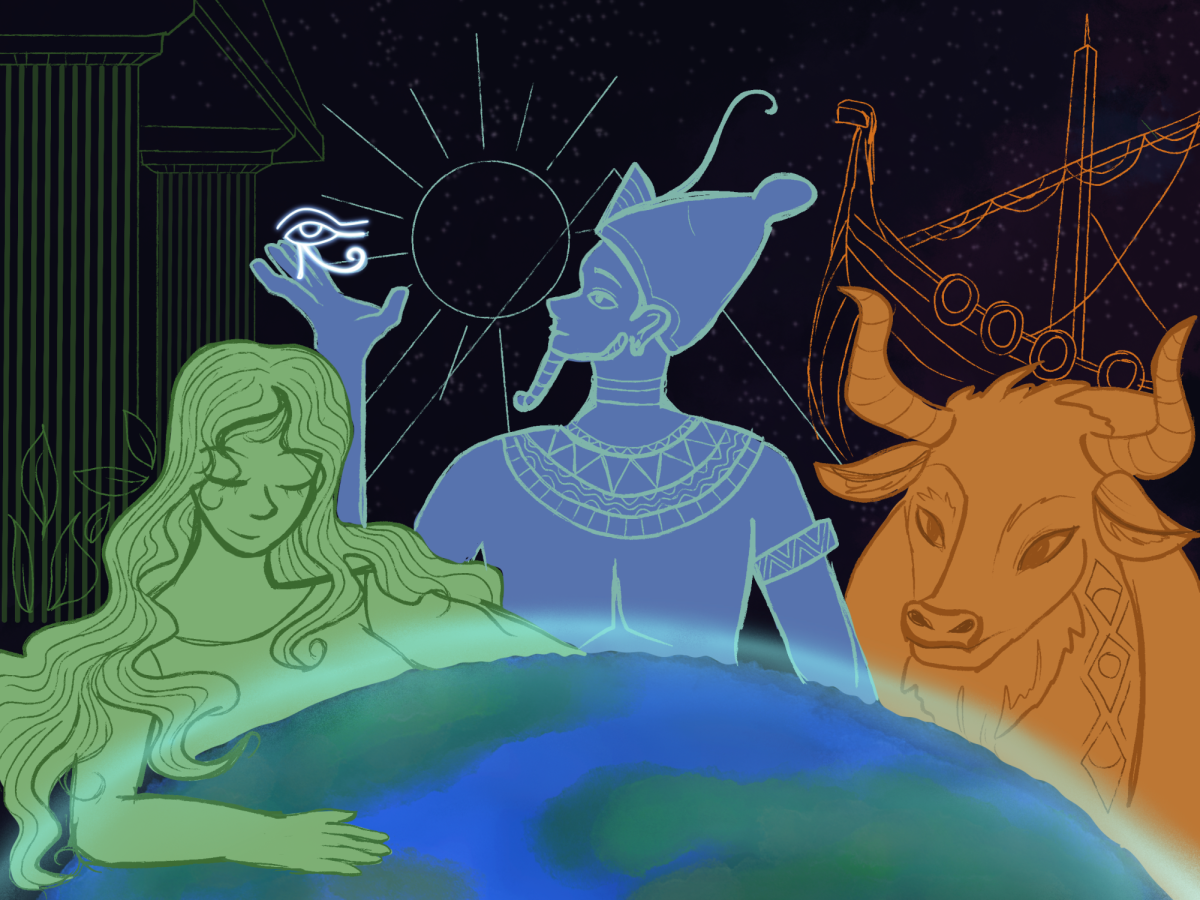







Humans have crafted many origin stories throughout history. Christianity claims that God was the one that created the universe as we know it, while the Ojibwe people believe that a giant turtle’s shell provided the backbone for life as we know it. With all of these creation stories circulating in the global consciousness, it begs the question: which creation story is the best of all creation stories?
Because analyzing hundreds of myths is impractical, three famous mythologies were chosen to participate in this origin story smackdown, and all three happen to be found in books written by the famous author Rick Riordan. The contestants for today’s battle are: Greek Mythology, Norse Mythology, and Egyptian Mythology.
The Greek creation myth is probably the most well known of the three, and so it is here we start. In the beginning, there was only Chaos, and from Chaos came Gaea (the earth), Tartarus (the underworld), and Eros (Love). Chaos also gave birth to Erebus (Darkness) and Nyx (Night), who slept with one another to give birth to Day and Air. Gaea birthed Uranus, who became her husband.
Greek Mythology gets a point detracted for all of the intersibling marriages, however, it gains a point for the rapid growing population of deities, more rapidly than the other two creation myths.
Egyptian Mythology is similar in that one god rose and caused the emergence of many. Atum, a self-created god, sneezed or spit Shu and Tefnut into existence, god of air and goddess of moisture. The two of them produced Nut (goddess of sky) and Geb (god of earth), who then birthed Osiris, Isis, Seth, and Nephthys. This generational progression of deities mimicked the Egyptians view on the complexity of the world: an “organized unfolding of the cosmos from a singular origin to the intricate, multifaceted world” they knew.
Egyptian Mythology gets a point added for their cool names and even cooler pictures; images often depict Nut arched over Geb with Shu standing between them, holding them apart. However, they lose a point due to the confusing name of the first primordial god, Atum, who is otherwise known as the sun god Ra.
Norse Mythology differs the most from the other two creation stories, as it doesn’t begin in complete emptiness. There exists an abyss, Ginnungagap, but that abyss is bracketed by Niflheim, a realm of ice, and Muspelheim, a realm of fire. The two interacting realms brought forth the tree of life, Yggdrasill. Sparks from Muspelheim melted ice in Nifleim to create Ymir, an evil giant whose night sweating spawned more giants.
True deities only came about when a cow emerged from the ice, named Audhumbla, whose milk fed the giants. Audhumbla started licking an icy rock, and her tireless licking revealed a god named Buri, then Bor, then Odin and his brothers who killed Ymir and used his body to create the Earth as we know it today.
Norse Mythology loses a point for the amount of violence involved in its creation story, yet it did include a primordial cow licking a salty block of ice, so they gain a point in creativity.
While the best origin story is subjective and largely based on personal opinion, Norse Mythology gets the most points for creativity, absurdity, and uniqueness. It is more than deserving of the completely legitimate title of Best Creation Myth.