
























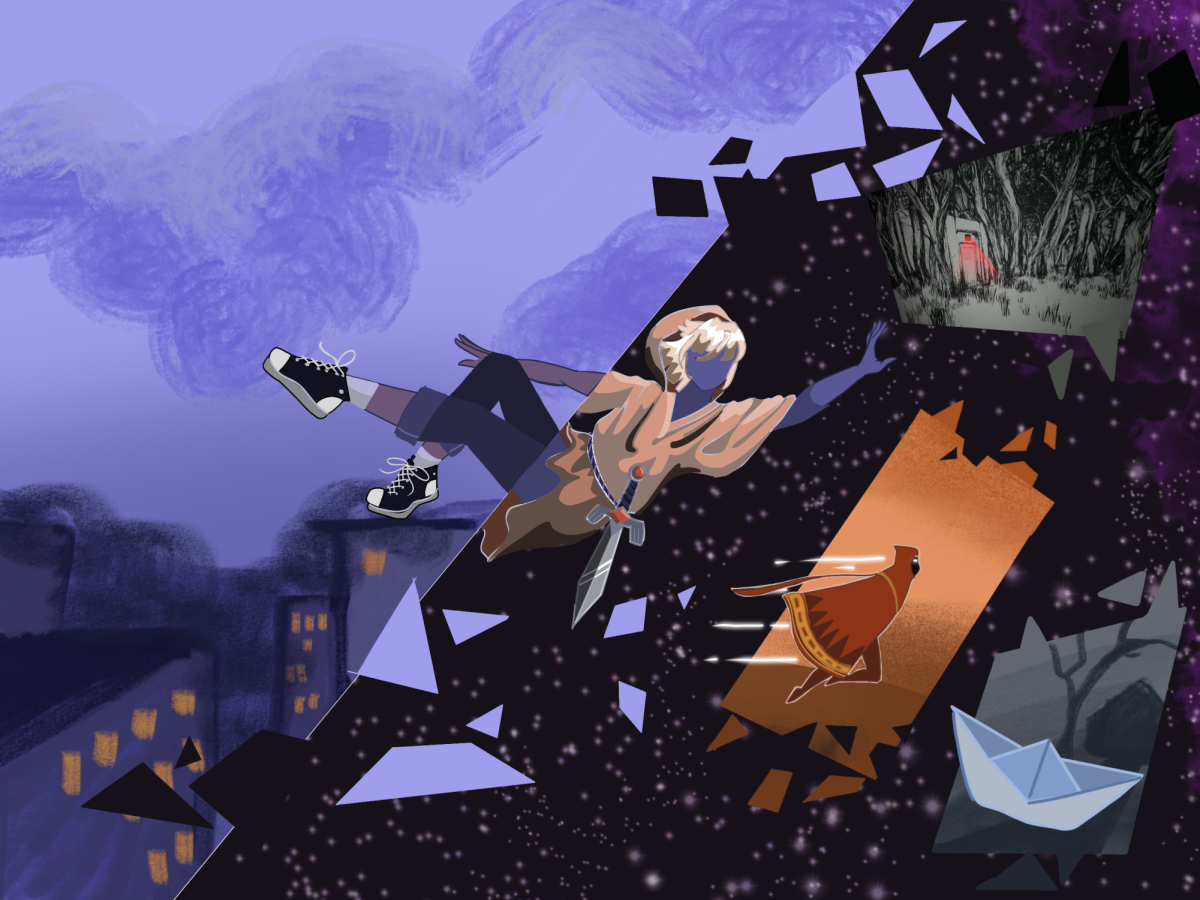
It must have been early 2024 when I first played Dear Esther: Landmark Edition by The Chinese Room. I had gotten it at half-price during the Steam Winter Sale shortly prior and played it as an excuse to put off doing anything of substance, but what I played was nothing if not substantial.
For context, Dear Esther is a game (or at least was made with the tools used to make games, but we’ll get to that later) released in 2008 and remade in 2012 about an island off the coast of Scotland, a myriad of biblical references, and the loss of a loved one. I won’t say more about its plot, as it’s something you should really play for yourself.
The sticking point that leads to argument about how much of a “game” Dear Esther is, though, is the mechanics, or lack thereof. Gameplay-wise, all you do is walk through admittedly beautiful scenery as you listen to the protagonist recount a story through a series of letters.
The story of Dear Esther is rather dense, so, as I tend to do with particularly dense texts, I went online after playing it and looked around for gameplays and analyses to help me get a more complete picture of what I just experienced. What I found was curious, though. I kept seeing analyses and gameplays showing a scene I didn’t ever encounter, where the player character winds up swimming through a submerged road with a crashed car in the middle of it.
I remembered getting a similar scene, but for me it was a hospital room rather than a car crash. It was only after watching Ian Danskin (better known as Innuendo Studios) analyze the game that I learned that this was planned. This was one of many things Dear Esther did to mess with the player’s head in a way that would only ever work in an interactive medium.
This was the moment where the whole “games-as-art” thing clicked for me. I had played my share of games like this in the past, but I’d played them with the thought in my head that the medium was just a product of what the creators were familiar with. Dear Esther was the moment where I realized what the medium of games had artistically that could never be replicated.
I still think about Dear Esther often. Same with Still Wakes the Deep, another game by The Chinese Room, Everything Unlimited Ltd’s The Beginner’s Guide, thatgamecompany’s Journey, and a number of other games. They have all burrowed their way into my mind and now refuse to leave.
Some people, though, take offense to some of these games. When Dear Esther comes up in conversation, it’s almost always coupled with discussions of how much a lot of people hated it, with a TheGamer article saying, “Ten years ago it inspired a flurry of conversations (read: discourse) about whether it’s a ‘real’ game or not.”
When The Fullbright Company’s Gone Home is revisited, it’s almost always in the context of how people responded to its LGBTQ+ narrative. For some reason, these games are only a talking point in discussions of the discourse surrounding them, rather than ever being about their actual narratives.
Why is this? Why is it so hard for some to picture something like the Source Engine as a tool for making anything but mindless entertainment? Why are these games such a hotly debated topic among capital-G Gamers?
Answers can be found through looking at the medium’s history. Before the turn of the millennium, video games were often regarded as little more than high-tech toys. It does make sense, given the technology of the time for making games wasn’t the best optimized for super artistic products, and the way they were made reflected that. Looking at a compilation of video game advertisements from the 1980s, it’s very easy to see that the games and their consoles were being promoted as little more than mindless fun, but there were still developers that tried to give the technology an artsy spin.
1982 brought the world Alien Garden, a game about… something. I haven’t played it, and I can’t seem to tell what it’s trying to do from screenshots and descriptions, but it was evidently more artistic than your average Atari 8-bit game. It’s significant in that it’s often considered one of, if not the earliest, example of an artgame.
The most famous artgame from before Y2K, though, was easily 1998’s LSD: Dream Emulator. Directed by Japanese digital artist and composer Osamu Sato, Dream Emulator was an attempt to take the technology of the Playstation and use it to make something artistic rather than simply entertaining.
In the modern day, Dream Emulator has accrued a cult following for its surreal and abstract visuals and music. It has been the subject of extensive conversation online in the past several years for its complicated underlying mechanics, but fundamentally Dream Emulator is very much a work of art that happens to use the technology of the Playstation.
The 2000s were a weird time for artgames. On the one hand, websites like Newgrounds and The Independent Gaming Source (TIGSource) forums were abuzz with new, weird games in the 2000s, but on the other, they weren’t really getting that much attention outside of their particular scene.
These sorts of niche game development communities are where developers who would later become big names got their starts: Celeste developer Maddy Thorson was in the TIGSource forums making the Jumper games in 2004, and Markus “Notch” Persson’s Minecraft had its alpha distributed on there! (Though, now, if you try to download the alpha version through the link he posted in that first thread, it just redirects to Minecraft’s website.) Though neither of these are necessarily artgames, it is an indicator of the breadth of games being put on TIGSource alone.
This doesn’t mean nothing else interesting went on in this decade, though. Remember Dear Esther? It was first made in 2008 as a Half-Life 2 mod, something I spoke about with its producer and writer Dan Pinchbeck. It turns out Dear Esther, along with a couple of other mods—Half-Life 2 mods Antlion Soccer & Korsokovia and DOOM III mod Conscientious Objector—were made as explorations of the video games medium done as research for the University of Portsmouth.
About Dear Esther’s development in particular, Pinchbeck said that “questions were coming up that no games currently out could really answer.”
Because of this, Dear Esther really took off among the Source community. It got its fair share of criticism, being considered by many to not really be worthy of the title of “game” and similar belittlings.
Therefore, when asked about where the line between game and art is, Pinchbeck said, “I think genre definitions are really practical tools, and every practical tool is open to negotiation. They’re very fluid, and often don’t make sense when you start interrogating them.”
Things started getting really good in the early 2010s. Twine, “an open-source tool for telling interactive, nonlinear stories,” had come out a year prior, and developers started getting really experimental with that.
In 2012, for example, developer and artist Porpentine released Howling Dogs, a text adventure about “someone not being able to take care of themself when they are broke and in a bad living situation.” The game is hard to find now, but it made quite a splash when it was released.
In 2013, according to an article by Leigh Alexander, Cart Life developer and Independent Games Festival award winner Richard Hofmeier spray-painted over his own booth for the game to instead show Howling Dogs, saying that the dread Howling Dogs makes the player feel is “a very special kind of territory. Pragmatic, mechanical games can’t touch that kind of territory.”
The Stanley Parable also had its full release in 2012, and though one would be hard-pressed to call it an artgame in the same sense as other subjects of this piece, it is very similar in execution to Dear Esther–voice talking in your ear and all–introducing more prospective fans of the “walking simulator” to the genre through something easier to get into.
Speaking of Dear Esther, it got a full rework in 2012 to be a standalone game rather than a mod in the form of Dear Esther: Landmark Edition. This is the form in which many would play the game, including myself.
Of course, works like Twine games and walking simulators were called into question a lot. How can these really be games? It’s text on a website with hyperlinks! There are no mechanics but walking! Arguments of similar inanity can be seen with basically any avant-garde game genres, but there’s no reason to discount their existence as games.
Artgames are something academics even got into. Take, for example, University of Toronto professor Felan Parker’s article “An Art World for Artgames,” about “the emergence of a critical discourse, collectively constitut[ing] an assemblage or ‘art world’ that establishes artgames as legitimate art.” I spoke to Parker about the subject briefly in an effort to understand better what it was about definitions that got people so hung up.
“Maybe the answer to the question, ‘are games art,’ is ‘sometimes! In some places!’” Parker said. “These are kind of amorphous concepts to begin with, and they are, from my perspective, largely social and cultural (as well as economic and political, in some cases). I sort of think about ‘games as art’ as two partially overlapping, messy networks of different things that we call ‘art’ and different things that we call ‘games.’”
The early 2010s were great for these kinds of games. In 2013 alone, Zoë Quinn’s Depression Quest and The Fullbright Company’s Gone Home–respective examples of those scenes–came out, each offering very interesting perspectives on different aspects of life.
A lot of gamers really didn’t like Depression Quest and Gone Home.
To say 2014 and 2015 were messy in the gaming scene would be an understatement. And, to be clear, that’s not because of the games themselves. Games like The Beginner’s Guide came out with a similar amount of not-gameplay to Dear Esther and Gone Home and it was received largely well, or at least with ambivalence. However, the years were most characterized by Gamergate, a harassment campaign against women in game development and journalism.
I was 7 years old for most of this, so I can’t pretend to know what actually transpired firsthand. To that end, I spoke with Ian Danskin, best known for his series of video essays The Alt-Right Playbook (and, of particular interest, an endnote to that series wherein he gave a talk for UC Merced specifically about Gamergate).
“It was a semi-organized, ongoing, sustained harassment campaign of a number of women, or at least woman-presenting people, who were either in or at least related to the games industry,” Danskin said. “It was originally kicked off by a particular game developer’s ex-boyfriend, who was fairly transparent that ‘I want to launch a harassment campaign of my ex.’ A bunch of people on 4chan said, ‘okay, I think the best way to disguise that is a consumer revolt against dubious practices in games journalism.’”
Gamergate was not about artgames. It was about the fact that there were minorities in the games industry (both in game development and journalism). However, Gamergaters needed a shield.
“[4channers] decided to spin the fact that this developer had briefly dated a games journalist into, ‘they slept with the journalist in exchange for a good review,’” Danskin said. “The fact that no such review ever actually took place, the fact that the game was free, the fact that the two people in question were not dating during the time period that any kind of coverage would have benefitted the game–none of that dissuaded anybody.”
Things sort of ballooned from there. What had started out as a campaign against the developer of a free text adventure became a campaign against the very concept of minorities existing in the games industry, and it had, in Danskin’s words, “a wide range of subtle impacts.”
“There were a lot of companies in the wake of Gamergate,” said Danskin, “who were making a big show of, ‘we’re gonna hire more diversity consultants, we’re gonna hire Anita Sarkeesian [a critic who was another primary target of Gamergate] as a consultant, we’re gonna hire Zoë Quinn.’”
While many companies were trying to come away from all that discourse (if you would be so kind as to call it discourse) better, Gamergate also led to steps back.
“You’ve also got the people who very clearly, as a result of all of this, said, ‘we’re gonna not court controversy among these core gamers unless we feel like we are doing it in a particular way that’s gonna make us more money.’” said Danskin. “So you also see people who have hired the consultants and not used any of their advice or people who, if they get any backlash to anything, they just drop it like it’s hot and they just don’t engage with it.”
I also spoke with Parker about Gamergate.
“I would theorize that Gamergate helped accelerate a withdrawal from whatever we might think of as the mainstream culture and industry of games,” Parker said. “I think that, if people weren’t already alienated by that mainstream space, Gamergate was the nail in the coffin for a lot of folks.”
“Are things better now than when Gamergate was at its height? Generally, probably, yes,” said Parker. “But are a lot of the same things, like horrible, abusive harassment campaigns, still happening to some people in the game industry and game culture? Also yes.”
Dox and death threats are only scratching the surface of Gamergate. My point is that this harassment campaign threw the games industry for a loop. So many people who were trying to make games that actually meant something were completely alienated and effectively thrown out of the gaming scene for who they were.
Journalist Jenn Frank, in a 2014 Slate letter, likened Gamergate to an ARG (alternate reality game), saying that Gamergate “borrows its narrative techniques from both ARGs and grassroots online activism; participants collaborate on intricate networked narratives, connecting both influential and incredibly tertiary industry figures to corporate interests big and tiny. The authors of Gamergate’s oral history are a decentralized collective, a conglomerate of modern-day bards with no single leader, who use real-world details from the lives of real-world people to give the mythos texture, verisimilitude and, probably most important, real-world stakes.”
That informed, in many ways, the way Gamergate ironed out. Ruining the lives of these people was effectively sport for Gamergaters, which shows in the way they approached it. They obfuscated their goals and came up with elaborate and incomprehensible dogwhistles all in an effort to push minorities out of the games industry.
The good news is that the artgame scene didn’t completely die with the people Gamergate pushed out.
The games distribution platform itch.io launched in 2013 and, according to Wikipedia, had “become established as a dedicated platform for indie developers” come 2015. Much like TIGSource’s forums had been a decade prior, itch.io became a haven for interesting and experimental games, many of which are completely free to download or even play in your browser.
I looked at the website for all of two minutes and immediately found two really interesting artsy games in Don’t Stare and take care of it that I’m probably going to play as soon as I finish writing this sentence.
In 2021, the band Radiohead released a game called KID A MNESIA EXHIBITION exclusively on the Epic Games Store, an Unreal Engine-powered museum of Radiohead music (provided it was off Kid A or Amnesiac). KID A MNESIA EXHIBITION is an incredible experience. Its visuals and music are utterly enthralling and feel like they were tailor-made for each other. This is, I would argue, just about the closest thing we’ve yet gotten to an AAA (a term used to classify videogames made by large studios) artgame.
These are all games and they are also all art. The question is, are they artgames?
“[Artgames are] a mode that, in some ways, has passed,” said Parker. “Or at least, the version of it that I was most acutely invested in and aware of in between the years of 2007 and 2014 or so. Indie games, as a commercial endeavor, come to kind of take up that cultural space for a while. The more experimental, creative elements of artgames turn up in other places that are no longer self-identifying as ‘artgames.’”
The idea of an artgame, all one word, is different from that of a game that is artistic. However, as Parker said, these have very much informed where the avant-garde games space, such as itch.io games, is now. Even as some scoff at the idea of a game that tries to be anything but mindless entertainment, games are being made and finding success that seek to be something more than that. I mean, The Chinese Room’s Still Wakes the Deep won three BAFTAs in 2024, and that game got a middling review from IGN for its “on-rails structure.” Clearly there’s something to be said for the continued relevance of games that put story and art first.
“The notion of an ‘art game’ is interesting to me because it presupposes that they are different,” said Pinchbeck. “I’m not entirely sure that’s true.”
What does all of that mean, though? Can games be art or not? Are they all art? Is there something that inherently keeps one from being the other?
I know that, on my end, I’ve come away understanding what I sort of already knew: “art” and “game” are not mutually exclusive concepts. More than that, though, games are uniquely situated to tell stories that simply could not work in other mediums, or at least are greatly aided by the medium of the video game.
Truly, why must these concepts be at odds when they can work together? What do games not have that art supposedly does?
“Games are older than art,” said Pinchbeck, “and you can tell because animals play, and they don’t make art.”
“Games and play, in general, are associated with childhood,” said Parker on a similar subject. “Even in the formal art world, I think for art that is playful, art that is engaging in some kind of game-like structure, sometimes there are hurdles to an acceptance.”
The public perception of the artgame and, both separately and similarly, the artistic game, is informed by how video games have historically been seen. Though this perception has shifted since, say, 2005, it still exists in some eyes at odds with the very word “game” as a playful endeavor. What really makes even the most playful of games any different, though?
“Art is, at root, an act of needing to create and share,” said Pinchbeck. “Some games will do things as before, some games will want to make change, and some games will want to be subversive. They’re no different from any other sphere of human activity.”







[email protected] • Apr 25, 2026 at 11:38 am
Although I’ve never been into video games, the amount of misogyny online is inescapable. I can say confidently I see at least one somewhat blatantly misogynist post or comment every day while scrolling on major programs like TikTok and Instagram, and I’ve received misogynist harassment online more times than I can count. Expressing dislike for Trump got me graphic and violent threats that used gendered language from random men – that’s just the most recent example I can think of. Men online will bully women for just about anything, but it gets worse when a woman occupies spaces they feel are theirs – like comedy and gaming. I’ve seen so many “women aren’t funny” posts and comments online, relating to female comedians. These men seem incapable of simply saying “I don’t find this comedian funny”. With how desperate some men seem to maintain ‘boys’ clubs’, you’d think they were the ones who were statistically most at risk of violence from the other gender.