


















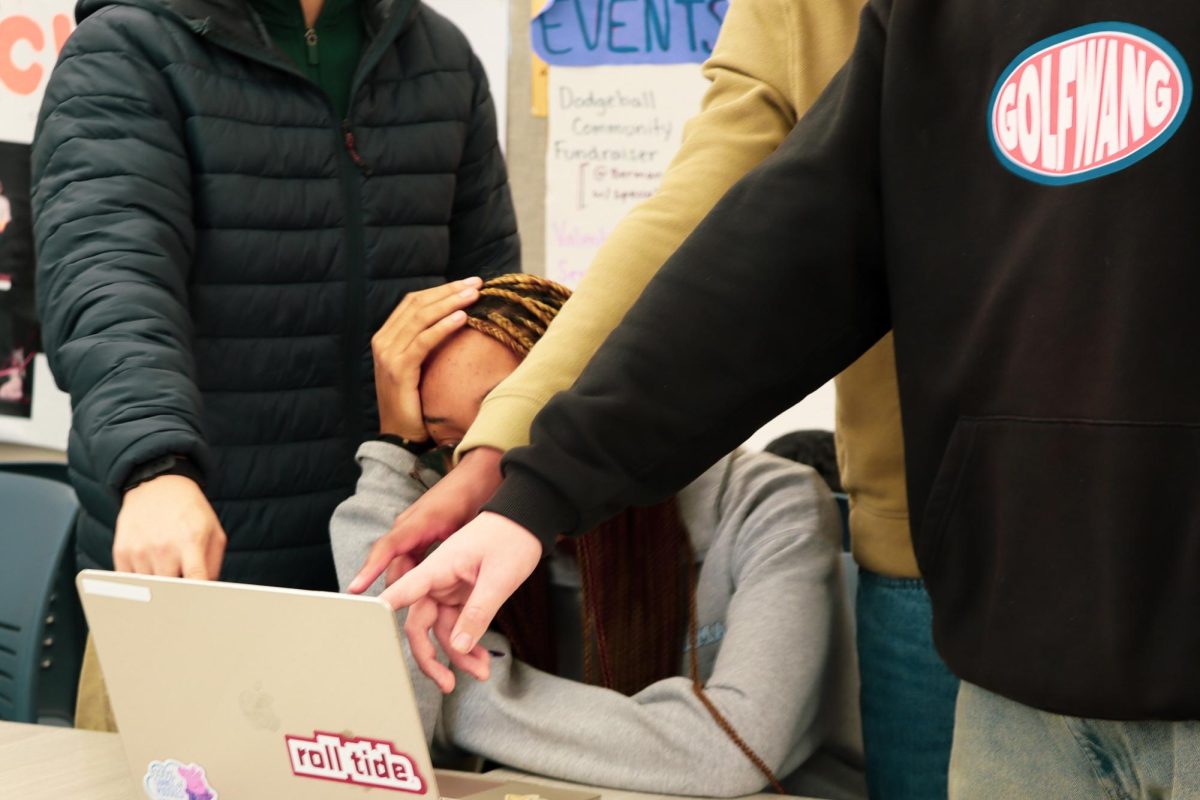
The Oxford Dictionary defines mansplaining as “the explanation of something by a man, typically to a woman, in a manner regarded as condescending or patronizing.”
While mansplaining is not a new concept, mansplaining within STEM fields is a particularly frequent issue due to the male dominance within the field, ultimately harming women.
In a world built on patriarchy, women face great pressure to excel in male-dominated fields to prove that they are worthy to be there. Mansplaining only adds fuel to the pressure, ultimately creating imposter syndrome. Overexplaining leads to deteriorating self-confidence because of the automatic assumption that a woman is “clueless,” thereby ignoring her hard work and intelligence.
Upper School math teacher Eugene Feeley, who studied chemical engineering in college, said, “There probably [was] some [mansplaining] in my study groups, and also some of the female students were the best: worked the hardest, knew the materials the best, so oftentimes they didn’t need help.”
According to Penn Today, Wharton management Professor TianTian Yang finds that young women in STEM fields typically switch after having negative experiences.
Yang said, “This contributes to lower numbers of women in STEM over time. Staying in these fields is challenging for many women, not only because of limited opportunities, but also because of self-perception. Gendered expectations can also make it especially difficult to persist in the job search after facing repeated rejections.”
STEM classes and spaces should not become an unbearable space, but a welcoming space. STEM has no gender assigned to it, yet male domination has adopted STEM. This limits diverse exploration; the pursuit of education should be for all people.
Erin Bengston, chair of the math department at AFS, studied mathematics and French during her time in college, and participated in a Research Experience for Undergraduates (REU).
Bengston said, “I never felt so dumb in my life… I feel like there wasn’t a support system…[T]hat definitely was a male dominated experience. I remember talking to people there making me feel like an idiot and I was like, ‘welp, I don’t wanna do math research,’ and if it was in a more supportive environment I wouldn’t have wanted to walk away… In some ways, I’m glad I didn’t.”
Along with mansplaining, he-peating stems from male-dominated spaces as well. He-peating is a term used to describe when a man repeats a woman’s ideas and gets credit and honor for it, after her ideas have been dismissed and ignored.
When a man has an idea, it is taken more seriously and with more value than if a woman had the same idea. People idolize and value male intelligence more than female because of deeply ingrained societal gender norms.
According to New York University, stereotypes portray intelligence as a male trait; brilliance is subconsciously associated with men more than women. STEM fields require high demands for intelligence and prestige, but stereotypes only hold women back from success, ultimately resulting in underrepresentation.
Intersectionality plays a significant role within feminism. Mainstream feminism comes from “experts,” white upper-class women, who are paid to write about feminism, lead feminist organizations, and make theories and policies. There is a division between women who get to speak about feminism and the women who live through a silent struggle. Trans women, working-class women, immigrants, impoverished women, and women of color live the everyday struggle but are hardly represented in the feminist world. Feminism has a multitude of layers to it, and oppression greatly affects experiences; no experience is the same.
For instance, in an article about women of color in STEM, EdTrust said, “Students from marginalized groups, especially women, still have less access to AP STEM courses in high school and lower STEM degree attainment rates than their White male colleagues.”
At AFS, Bengston said, “If you look at the demographic of honors and AP classes at AFS, girls are dominating, especially in humanities. People get into the classes for merit, but those are opt-in classes you apply to get into. In the case for AP math classes, it is closer to a 50/50 if not slightly more boys than girls. Are boys better at math? Are they more capable at math? I don’t think that’s the answer. I think it is about the choices they are making and where they feel comfortable.”
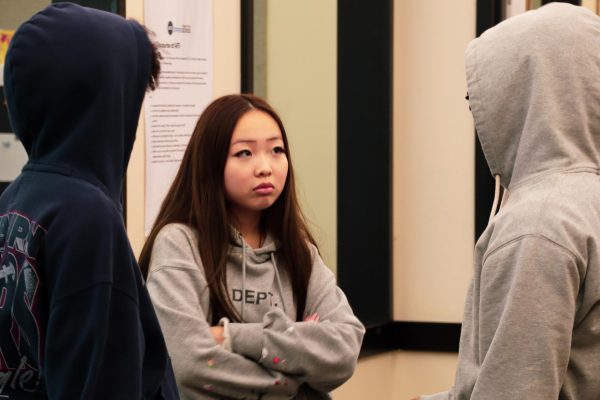
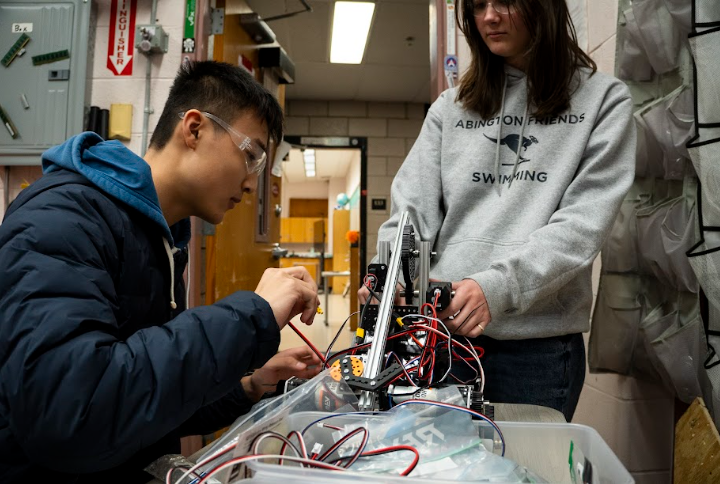
Pictured: Nika Kim ’26, Henry Sylva ’26, and Ezra Sileshi ’27
However, girls and non-binary individuals in STEM, you are not alone. Navigating through a predominantly male environment is isolating and suffocating. But building a support system is crucial to finding stability. Your presence, experiences, voice, and ideas matter and deserve to be heard.
Math teacher Mary Anne Wassel said, “I wish I had had a bigger support structure with people cheering me on, because I think it would have made it harder for me to internalize a lot of the microaggressions and overt sexism I experienced. It took me a really long time to realize how much damage had been done, and I am still processing, learning, and growing from some really difficult parts of my lived experience.”
Affinity spaces at AFS are a supportive and safe atmosphere to be recognized and uplifted for your unique individuality. Building a support system is crucial in a male-dominated environment.
Wassel also said, “It is really great that we have affinity spaces and clubs at AFS that support students, their identities, and their interests for this reason! You really don’t think you need support until you do – better to cultivate those layers now so that’s not a scramble when you actually need help!”
Without diverse experiences, you create mad scientists. As STEM continues to grow and develop, so should inclusivity and diversity within the STEM field. STEM makes change, but hearing from diverse experiences is essential to that change.





Natalia • Dec 17, 2025 at 1:40 pm
I definitely agree with this article! Although I’d say that I’m more of a humanities scholar, I’d argue that part of the reason that those are my core subjects is because I’ve always felt a little discouraged when it comes to STEM. It doesn’t always come naturally to me, but I find that I do relatively well in areas of science and maths most of the time. Another sad instance of this ‘mansplaning’ is that you could be the world’s smartest female who excels in STEM, but one wrong answer makes them lose all respect for you. It’s sad that this is what it’s come to, and I think that it’ll take a long time for this to change, but small progress is always better than nothing.
Adalyn • Dec 16, 2025 at 6:44 pm
I agree that mansplaning is harmful for women and girls who want to go into STEM fields, since all it does is lower confidence and cause you to not want to go into STEM. With movies like hidden figures that go into what it was like to work at NASA back then as a black woman is actually crazy. The amount of mansplaning that went on even though they definitely knew what to do since they were working at NASA was crazy. Many times in my own life man have explained things that I know how to do and because I want to go into a STEM field when im older, many men having tried to “test my knowledge” per say on a topic and just straight up ask me “if you want to go into Chemistry, name five elements” and things in that nature. It made me feel bad about myself especially if I couldn’t name or tell them what they were asking and it too made me feel imposter syndrome.
Sammy • Dec 10, 2025 at 10:06 pm
I agree that mainsplaining and toxic masculinity is harmful to women in STEM. It can make women feel like however hard they work, they won’t be taken as seriously as their male counterparts. That thinking could lead women to lose their motivation to pursue STEM in school and as a career. As a female student who loves STEM, I sometimes feel like I have to prove myself when I’m talking to men in STEM because I want to be taken seriously. This is probably because STEM has been historically so male dominated, that sometimes women in STEM are underestimated. Because of this, I also agree that representation is important.
Joseph Lee • Dec 10, 2025 at 5:20 pm
I agree with the points made in your article – STEM is historically male-dominated. Given how society has viewed gender roles, it makes sense that men will mansplain and find other ways to discourage women in STEM because they probably feel that their dominant position is being threatened. The idea of an idea being passed down from generation to generation in society is that people don’t consciously realize their error. Doing so, or accepting whatever, feels right because it’s cemented in the natural order of their environment, and one could face criticism for having “unusual” or “offensive” opinions. There are many underlying reasons for unconscious acceptance, and fear of persecution is definitely one of them.
The Salem Witch Trials are a great example of that “criticism”. John Proctor was executed for speaking out against the false accusations of the people.
Harrison • Dec 10, 2025 at 11:44 am
I agree, mansplaining makes women uncomfortable in the environments they want to be in. In my experience at AFS, I have heard of instances where women don’t want to pursue their passion because of the mansplaining around them. My friend last year did not want to go to robotics often because she saw constant misogyny from her male peers. It made her dread attending an activity she had joined, even one that piqued her interest, and she wanted to learn from. Mansplaining is more common than not and leads to women feeling diminished.
Malea • Dec 10, 2025 at 11:30 am
Alana’s take on mansplaining is one I agree with. A lot of time in school and as young girls grow up, the idea of taking on a career in STEM can seem far fetched or unachievable. This notion comes from the media, parents, societal norms, and in school. Many male students tend to go down the path of a STEM career and it is normalized for them to do so. At our school, students have a unique and special opportunity to be exposed to teachers of different genders pursuing careers that are/were once normalized for the opposite gender. We have a plethora of female math and science teachers, just as much as we have male language and arts teachers. Even though that is something that might not be on the top of everyone’s minds all the time, it is important to pay attention to it and understand how other schools may not be as fortunate.
Percy • Dec 10, 2025 at 11:08 am
I definitely agree with the opinions in this article. As someone who has experienced mansplaining a lot, particularly in some of my more STEM focused classes, it is still an issue at AFS. Mansplaining will be an issue regardless of what AFS does because it is so inherent to society and the only action that AFS can take is lifting up its female STEM teachers. From my personal experience, when I experience mansplaining in a science class, I find that the teacher is more likely to realize what’s happening and step in to help me if they are a woman or someone who has experienced mansplaining in the past. For example, in math class a guy was overwriting my correct ideas and the teacher stepped in and told him that I was correct, then let me switch groups to be with my friends.
Una • Dec 9, 2025 at 2:15 pm
I’ve never thought of myself as a “math person.” It has always been a struggle for me, and because of the school I went to before AFS, I am a year behind where the majority of my classmates are in math now, which has only led to my feelings of inadequacy in the subject as a whole. I completely agree with the idea that boys aren’t automatically better at math, but for whatever reason, boys feel more comfortable being “math people.” Even boys that might not be in the highest math class or have the best grades will most likely feel more comfortable with taking a class like computer science than girls in the same position. I’m not sure if it’s because boys lack that certain type of imposter syndrome or most girls have too much of it.
Your thoughts on intersectionality are what really caught my attention in this article. As one of the clerks of Women’s Empowerment, I’ve been struggling with how to create a space that truly feels like a place for all people. Obviously that’s the goal, but as a white girl, I lack a certain amount of understanding. As a clerk, its my job to do my absolute best to create the best club possible, while also balancing keeping my own experience and bias as part of what my club has to offer.
Lauren Washington • Dec 9, 2025 at 1:52 pm
Hi Alana, this is a great article about such a unique topic! I agree with all the perspectives that you shared in this article. I had experienced masplaining from time to time especially as a young Black woman who plans to go Pre-Med in college. I navigate this by deescalating the situation before it gets heated. Sadly, most of the time I see this trait coming from white men. I found support in these circumstances by clearly stating my opinion without being rude and trying to come to agreement. However, sometimes the easiest and best solution is to stop the conversation all together and not giving the person anymore engery.
paige • Dec 9, 2025 at 1:47 pm
I do agree with this article as well as the author’s point of view on mansplaining as well as how affinity spaces create space to not only combat that, but to provide a helpful and safe environment for those who feel singled out in a bad way. And I thought it was a great idea and interesting to include women STEM teachers at AFS, because it really highlights what they had to experience with sexism and manslapping to get to where they are now. I have experienced manspanning before, specifically in the classroom. I didn’t know what to say but I knew that I felt uncomfortable and underestimated by my male peers. I have found support by connecting with my friends about situations like that, and looking towards the Women’s Empowerment affinity group here at school.
Oonagh Moore • Dec 9, 2025 at 1:42 pm
I really agree with the perspective shared in this article. I have seen and experienced mansplaining many times in my life, just like almost all women have. I have always taken a lot of science classes and have often encountered mansplaining in those environments, especially when the science is related to robotics or any kind of engineering, in my experience. My dad has even been guilty of making me feel dumb by the way he has tried explaining topics to me. A lot of times when I experience this, I try to call them out so as to not feel so inferior in the situation. I try to turn the situation into learning opportunities and move forward instead of simmering in the uncomfortable feelings.
Dillan • Dec 9, 2025 at 12:25 pm
I agree that it is extremely important for diverse voices, especially those of women of all kinds, to be heard in STEM spaces. In school and other intellectual spaces, women and girls are often treated with a sense of condescension from both male peers and authority figures. Speaking for myself, I remember feeling a strong sense of pressure from the time I entered elementary school to excel intellectually so I could prove that girls were just as smart and capable as boys — a responsibility I nor any other woman or girl should have to take on. To remedy the imbalance of power between the sexes in STEM spaces, men must listen to the stories of the numerous women who experience intellectual sexism and learn to make more space for women in these fields. If they do not, the widespread issue of mainsplaining, he-peating, and other forms of sexism in the STEM field will continue for even more generations than it already has.
Helene • Dec 9, 2025 at 9:07 am
This is an extremely important topic that really shouldn’t be such a prevalent issue today. When young girls are repeatedly spoken down to and treated as innately inferior and less capable of solving difficult mathematical problems it adds a whole nother layer of difficulty to already hard challenging subjects. This can be seen in history with very few women being given opportunities in STEM and then commonly having their ideas stolen like in the case of Rosalind Franklin with her discovery of the double helix DNA strand. This will remain an issue as long as people don’t want to address it. As long as men write women off as being too emotionally minded or sensitive to take on objective subjects, women will continue to follow other non-STEM paths, men will continue to dominate, and as a result women will continue to feel uncomfortable and othered in those spaces.
Radha Airan-Javia • Dec 9, 2025 at 8:59 am
I agree that mansplaining and sexism in STEM negatively affect women. I think that in order ot start to fix this problem of sexism in STEM, men need to listen to and learn about other women’s experiences. People don’t know that things happen until they’re shared. Women in STEM should continue to speak out about their experiences. If more people, especially men in STEM, realize what most women have to deal with to get to where they are now, then increased awareness can be obtained. Not everyone will be supportive and aware, but if women in STEM continue to speak out and refuse to let their voices be silenced, then more people will be motivated to make changes. Empathy is only possible if you can understand what the other person is going through; it is so much easier to be discriminatory and hurtful if you are ignorant and unaware.
Ella • Dec 9, 2025 at 8:55 am
I completely agree with the view of this article. As a young girl who grew up very STEM-oriented, I experienced a lot of doubt and underestimation of my abilities. From a very young age, women are led to believe that they have to prove themselves to be considered intelligent. For example, when I told my family that I was interested in studying computational engineering and computer science in college, many of my family members seemed shocked that I even knew those big words. My brother even tried to talk me out of it, saying that he didn’t think I would like it, and even his (male) best friend, who started as a CompSci major, thought it was too hard and switched out. But he had no reason to believe those things. I — unlike his friend — had already taken a college-level computer science class and loved it, my teacher had even gone out of his way to tell me I had a bright future in STEM, so why did my brother think he knew what was best for my future? Even when I told him I knew what I was getting myself into, he spoke to me as if I were Karen Smith, saying those “just weren’t my type of people.” Even though I was offended by my brother’s comments, I knew he was only saying these things because I was a girl thinking about going into a male-dominated field, even though the majority of work fields are male-dominated. It’s moments like these that define a woman’s confidence in her intellectual power. These moments of doubt make women feel like they have to prove themselves to be considered intelligent, and push young women away from STEM early in their lives.
Nia H. • Dec 9, 2025 at 8:55 am
Mansplaning not only harms women’s self esteem, but also the advancement of technology. For example, NASA would not have made it to space without the contributions of Katherine Johnson, Mary Jackson, and Dorothy Vaugn. These three Black women were extremely intelligent and worked for NASA in the 1950s, a time where women, especially Black women, faced discrimination in the workplace. They were constantly belittled by their male counterparts. However, they did not let that discourage them, as they challenged the rules around them and made a name for themselves at the company.Without the mathematical calculations of these women, NASA would not have made it to space. In order for STEM fields to succeed, men must stop underestimating the intelligence of the women around them.
Anjali Tremblay • Dec 9, 2025 at 8:47 am
This is a wonderful article, thanks Alana! I agree that mansplaining is really detrimental and prevents girls from gaining confidence in STEM fields where they otherwise could thrive. As someone always interested in math, taking part in a lot of different math related activities and classes over the years, I have experienced this consistently. Girls don’t inherently have less knowledge or ability in math: my current Multivariable Calc class with Erin is majority girls. However, most, if not all of us have experienced mansplaining on the way to get here. I can’t count the amount of times a boy has explained to me a mathematical concept I fully understand without any prompting. Especially when I was younger, this would really frustrate me and make me feel like I shouldn’t even try. In addition, I have witnessed so many situations where a boy says something that a girl has already just explained in a math or science class, but the boy is given the credit or taken seriously. This sends the message that girls shouldn’t be taken seriously, decreasing confidence and support.
Nika • Dec 9, 2025 at 8:39 am
Alana, thank you for writing this article. I agree that mansplaining, especially in STEM fields, is extremely harmful and counterproductive because it limits people’s ideas and thinking. I’ve experienced this first hand when doing word problems in science and math classes. Oftentimes, I would voice my answer to the group of peers and be dismissed until my male counterparts completed the problem themselves and came to the same conclusion. Even though sometimes people don’t do it intentionally, it is still harmful because it hurts the confidence of women in STEM. Throughout the years, I was able to find my voice in these spaces and contribute regardless of my gender, but it is unfair that I have to work harder for it just because I am a girl.