




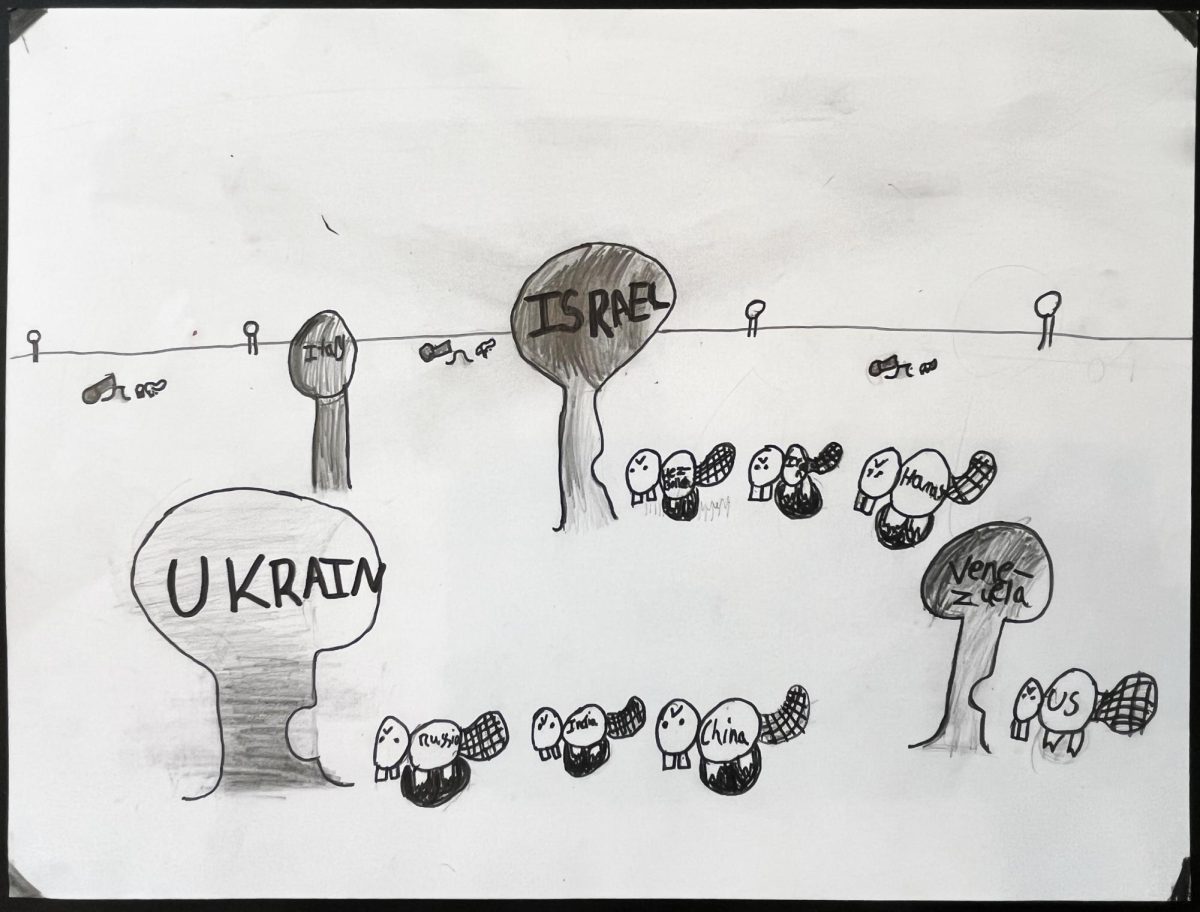



Propaganda in American History has functioned as the perpetuation and promotion of ideologies and partisan agendas through various forms of media – namely, visual art. Unlike art, which invites interpretation, propaganda directs thoughts, shaping perception rather than leaving space for uncertainty. Organic art itself does not usually carry such an intention.
When asked to define art, Luca Wood ‘26 neutrally describes it as “A depiction of something literal or figurative, leaving the meaning up to audience interpretation.”
If art is commonly understood to invite differing interpretations, then what about the images that leave little space for ambiguity? What about the pieces– such as wartime posters, political cartoons, or patriotic banners– that allow little freedom? By that point, are we analyzing art, or something else entirely: propaganda?
To accurately analyze the history and effects of propaganda, we must begin at its root. What exactly is it, and how did it start?
Hunter Rems ‘26 described propaganda as “Any form of visual or artistic … media that is supposed to promote a specific cause.”
Rems said, “I think good art tells a story in any way. And I think if you have a story worth telling, it should be saying something meaningful. And in turn, saying something meaningful, I would say, is inherently propagandist, if your cause for creating is to change people’s opinions.”
When looking at art through a historical lens, it is clear to see how many works of art were intentionally politicized and were able to further political schemes and values through artistry. Paul Revere’s drawing of the Boston Massacre is widely considered the earliest recorded work of American propaganda. Yet, by no means was Revere the first artist in the colonies, so what made his work so distinct?
Many sources cite the Boston Massacre of 1770 as a pivotal moment that fueled the colonists’ growing anti-British sentiments. The Massacre, where British soldiers killed five colonists, was a key event that inspired the American Revolution. Revere’s artistic documentation of the event depicted defenseless colonists being assaulted by British gunfire and weapons, essentially portraying the soldiers as ruthless aggressors and the colonists as innocent victims. Following the confrontation, Revere’s image was widely disseminated, appearing in virtually every colony.
What made Revere’s work propaganda, however, was the omission of several important situational details, which included the crowd’s incessant taunts towards the soldiers, as well as their potential usage of rudimentary weapons. According to historian Steven L. Danver, “What set Revere’s engraving apart was the editorializing function that it played, allowing colonists in disparate locations to have a more visceral sense of what had occurred in Boston and thus relate more directly to the Patriot cause.”
Furthermore, Revere’s clear embellishment of details (including his depiction of the event as a daytime occurrence, rather than it happening at night, or his complete removal of Crispus Attucks, a man of color) shows that Revere made decisions to distort the truth, ominously foreshadowing the reality of propagated art in the future. This was one of the earliest recorded examples of fear-mongering—the depiction of external threats as exaggerated threats to fuel anti-British sentiments and the desire for revolution.
As propaganda shifted from depicting a single event to shaping public sentiments, artists began to rely on satire and symbols rather than individual scenes. The emergence of political cartoons introduced a new style of easily craftable pieces that, combined with a short yet powerful message, are just as compelling as an intricate painting.
According to a 1944 analysis of propaganda, “political leaders in office must necessarily explain and justify their courses of action to an electorate. Through the use of persuasion, those in office seek to reconcile the demands of various groups in the community.”
A remarkable example, especially when compared to other elaborate wartime paintings, is Thomas Nast’s political cartoons about the Civil War. Often referred to as the “Father of the American Cartoon,” Nast’s work is predated by Benjamin Franklin’s ‘Join or Die’ woodcut cartoon of the 1750s. While Franklin relied on a single symbolic element—the severed snake—to promote unity across the colonies during a period of revolution, Nast expanded the scope of cartoons nearly a century later.

Using recurring characters, satire, idealized depictions of political figures, and visual details to influence public opinion and perception during the Civil War, Nast effectively demonstrated how political cartoons evolved from sparsely ornamented messages to artistic commentary. Through caricatures and embellishment, Nast was able to capitalize on fear, as his depiction of the Confederates as threats to democracy reflected how propaganda can easily manipulate anxiety and panic in times of division.
Nast used concise yet meaningful imagery in his cartoons to critique the opposing views of the seceded Confederate states, as well as to promote Union values. His drawings did not rely on abstract and personal interpretations, as every expression, symbol, word, and color was meticulously selected to further Nast’s narrative. Yet unlike Revere’s engraving, in which he relied on dramatized images to portray a single event, Nast’s images were produced for mass replication for newspapers, essentially created to reach many audiences through satire and repetition.
By the late 19th and early 20th centuries, the growth of print media and escalation of conflicts only amplified and inspired propaganda. During World War I, the US government formally commissioned over 300 artists through the Committee of Public Information (CPI). Posters such as the infamous Uncle Sam “I want you” showed that these artworks were not designed for interpretation, but for assembling.
Unlike earlier propagandist work—Benjamin Franklin’s woodcutting, or Revere’s engraving—these images were all mass-produced with the direct intention of shaping public opinion. The United States ultimately produced over 20 million war posters, more than any other nation at the time, reflecting a shift from art created to be interpreted, and art intended for recruitment, funding, and unity. Fear-mongering was now a government-run effort, as posters warned of invisible adversaries and framed participation in wars as the only way to avoid potential downfall.
As World War I expanded beyond borders, so did American messaging. Artists modified their symbolism to reflect political responses to external threats. While Revolutionary War propaganda highlighted colonial unity, and Civil War cartoons emphasized the Union and its strength, WWI imagery often glorified war and romanticized sacrifice and duty, portraying soldiers as the pinnacle of American bravery.
Unlike in the 18th and 19th centuries, propaganda did not stall between wars—it grew rampant during the interwar period. Senator Joseph McCarthy ran a national anti-communist campaign, weaponizing art such as films, posters, and other media to instill a collective fear of infiltration.
Artists and filmmakers alike were blacklisted for their assumed political affiliations, and the House Un-American Activities Committee (HUAC) forced Hollywood into creating works that aligned with their anti-Soviet sentiments. This period, called the “Red Scare”, transformed art into a weapon aimed to test the loyalty and political adherence of America’s constituents. This era demonstrated how propaganda thrived under paranoia and patriotism, showing Americans that fear was the biggest unifier.

The evolution in wartime themes became even more pronounced through World War II, especially through Norman Rockwell. His 1943 “Four Freedoms” artistic series—Freedom from Want, Freedom of Speech, Freedom of Worship, and Freedom from Fear—outlined a slower, softer version of American culture and morality. Instead of fear-mongering or propagating the draft, Rockwell framed the war as a protection of American life and democratic functions.
Like many others, his work was printed in magazines, books, bond campaigns, and posters. Rockwell was able to bridge fine art and mass propaganda. When compared to Franklin’s simple, fractured snake, or Nast’s ironic cartoons, Rockwell’s work represented a development of propagandist art—the ability for it to be emotionally persuasive, the ability for it to be produced on a large scale, and its intersection between national identity and political messaging.
The biggest shift for propaganda, however, occurred with the creation of the Internet and the integration of Social Media websites. In the early 21st century, political messaging centered primarily on printed posters or newspapers—it moved into digital spaces and communities. Instead of the spread of knowledge from select sources, propaganda became interactive, data-reliant, and easily accessible, yet easily faked. Applications such as Facebook, Twitter, YouTube, and later Instagram and TikTok platforms allow political groups, advertisers, and even select individuals to circulate persuasive images and rhetoric instantly.
Where wartime posters called for action through slogans and symbolic imagery, 21st-century propaganda targeted the public through algorithms that sorted people through existing posted beliefs. Political messaging is now centered mainly on emotional appeal, as well as logic and repetition, rather than formal government campaigns.
American propaganda has evolved along with the tools used to create it– from Paul Revere’s many anti-British etchings, to viral videos of No King’s Day protests. What has remained constant during post-colonial history, however, is the dependence on unified fear, emotions, and manipulation through imagery to manipulate public opinions. Across centuries, fear-mongering has served as a vital tool, one capable of uniting citizens under common causes or dividing them through paranoia.
Whereas earlier eras had defining artists—Franklin’s cartoons, Revere’s drawings, or Rockwell’s satire—the 2000s through 2020s lack any significant central artist synonymous with propaganda. This shift demonstrates the reality that few artists or groups fail to address the majority, as much of today’s propaganda is crowdsourced. Millions of individuals are now able to participate in the circulation of images and messages, and can modify persuasive imagery.
One of the most profound shifts in propaganda of the early 21st century followed the attacks of September 11, 2001. In the aftermath of the event, the US government quickly acquired a new tactic for persuasion to justify the military’s intervention abroad, as well as to expand surveillance nationally.
The images of the Twin Towers burning—immortalized by photographers such as Richard Drew, who took the infamous ‘Falling Man’ photograph—were circulated within days of the tragedy, becoming one of the most reproduced symbols in digital history. News outlets played the videos of the tower’s collapse on loop; the emotional impact of these visuals turned them into tools of persuasion.
Many artists responded as well, turning 9/11 into a representation of patriotism, yet also fear. Eric Fischl’s sculpture “Tumbling Woman” and many other works remarked on the traumatic nature of these events. Still, they were both targeted with backlash after many people considered them to be “unpatriotic.”
Meanwhile, the government commissioned imagery that emphasized heroism and national unity. Thomas E. Franklin’s famous photograph of the firefighters raising the American flag at Ground Zero paid homage to Joe Rosenthal’s 1945 photograph of soldiers flying the American flag at the Battle of Iwo Jima, linking 9/11 to WW2 patriotism. Various slogans and graphics were also created, featuring the New York skyline and phrases such as “Never Forget,” symbolizing the shift from a tragic event into a uniting cause.
Army recruitment and military propaganda began to incorporate 9/11 symbolism. Digital media, posters, and graphics featured the silhouettes of camouflage-clad soldiers, overlays of the American flag, and images of cities in flames. The Department of Homeland Security’s Advisory System turned into both a poignant reminder of external threats and a tool of propaganda in itself.

In the 2020s, propaganda has evolved beyond traditional, government-sanctioned campaigns and into more separated, individual messages. Political figures have been able to leverage both the anonymity and specificity of the internet, choosing apps such as X, formerly known as Twitter, Truth Social, and Facebook to create echo chambers of ideology. Memes, visual images relying heavily on humor and satire, AI-generated images, and short-form videos have taken their roles as new propaganda tools, effectively manipulating the audience through speed, emotional appeals, and repetition.
Fear-mongering is a dominating tool in these digital spaces, often centered around “threats to freedom” or “threats to traditional American values and culture.” Unlike the coordinated propaganda of the World Wars, modern propaganda thrives primarily on polarization and chaos. Misinformation has, in itself, become a tool of artistic expression. This modern take on persuasive art has indisputably reshaped how Americans perceive truth, ideologies, and one another.
Whether in McCarthy-era films or in 2020 TikTok posts, propaganda has consistently obfuscated the line between artistic expression and ideological control.
As Rems said, “I think good art tells a story in any way. And I think if you have a story worth telling, it should be saying something meaningful. And in turn, saying something meaningful, I would say, is inherently propagandistic, if your cause for creating is to change people’s opinions.”
If propaganda has been commonly described as the “art of persuasion,” then all art has propagandist potential. The difference lies mainly in intention—whether the story it tells is meant to open the mind, or shape it.



Sammy • Nov 20, 2025 at 5:17 pm
We can better recognize propaganda by considering a few things when looking at a piece of art, such as its source and its depictions. One thing to think about is, is this artwork created by or funded by a political organization or the government? If the answer is yes, then I think the art is probably meant to persuade and is propaganda. Another question to consider is how people are portrayed by the art. For example, if someone is being depicted in a very negative way, the artist clearly wants you to think about that person negatively, and I think that’s propaganda. The same can be true if someone is being shown in a very positive light.
Lilly D • Nov 12, 2025 at 9:34 pm
I really liked how you talked about art’s influence in propaganda. It brought to mind the recent street art outside a London court by Banksy, with a judge beating a protester. Propaganda is a way to get your point of view across. It can come in many forms, but art is more easily digestible for a wider range of people, which is why it can be so impactful. Humans are very visual creatures and in many ways, art allows propaganda to be spread very quickly and readily. Art can focus your perspective into one part of an idea or one part of a story. Art is accessible in a way for many people that words are not. In the past, many people were not literate and could not read articles, but could be influenced by cartoons. Nowadays, it is not that the public cannot read, it is that they do not care to. Our attention span is shorter. People rarely take the time to read a full story; they often read the title and move on. Short videos and images become our primary source of information because we can get a lot of information off of a quick glance. But art should not be discounted, well-done pieces of art like Banksy’s can leave an impact on the viewer long after they see the piece.
Samara • Nov 12, 2025 at 8:15 pm
This is a great article, Leïla. Although propaganda has a reputation of purely being an art of the past, that is far from the truth. Propaganda is seen everywhere in our day-to-day lives, especially around election season. Thinking about this past election, I definitely saw a good deal of propagandist videos, posters, and media in general. Propaganda artists use many tactics in their art, but the most important tactic is arguably their diction and tone. More often than not, propaganda features dramatic. serious words, as is seen in the famous “Join or Die” quote. This quote, while blunt and to the point, gives the reader a sense of dread and urgency, implying to them that if they do not join at this moment, they will die. Propaganda now, while not always having the same substance as that of colonial America’s, uses many of the same tactics. In a recent poster of Trump after getting shot in the ear, the photo is in red, white, and blue, and just a simple “Trump” is written on the bottom in large letters. This poster, seemingly plain, actually offers a lot. The choice of diction, or lack thereof, implies that the image should tell you all you need to know about this president. The lack of words give Trump the aura of importance, power, and instant recognition. Additionally, the sole word creates a serious tone, whilst the colors convey a patriotic one, mixing together to create a sense of power and excitement about this man. As seen in both examples, propaganda, while sometimes using little to no words, that choice is extremely important, as the diction directly affects the tone. Because propaganda is often used to skew facts greatly, its important to take every piece of this media with a large grain of salt, as the many different devices artists use can easily warp one’s thoughts.
Grace J • Nov 12, 2025 at 2:54 pm
This article beautifully articulates the evolution of propaganda. Not just how it became so mainline, but how it had been tied to art for centuries. This article taught me about the way that propaganda has been tied to fear-mongering, an influencing people to believe certain things. Also, I learned about how propaganda slowly crept into the government, before erupting into society as internet became our main source of information. I fully agree with the fact that AI is being used to create so much false information. I think that it’s scary what we can create with artificial intelagence, and what people will believe. We can make things look so real and it terrifying how quickly lies are spread online.
Rael Santana • Nov 12, 2025 at 2:54 pm
I feel like this information has definitely helped me discern art from propaganda, even though I have noticed it practically everywhere. It’s in every corner of the internet, and every crevice of the outside world as well. I feel that, if you see something that makes you feel too strongly especially politically without so much as a further glance or analysis, or if it clearly wants to get a certain idea across, then it’s very likely to be propaganda. It’s a shame that it’s everywhere, because nobody truly is immune to propaganda. With social media in the question, swaying the public’s opinions has gotten far easier, especially when the person has a big following behind them.
Elise C • Nov 5, 2025 at 10:13 pm
I really enjoyed the in-depth research that went along in your article of how art can induce propaganda. I think that the main source of propaganda in the visual arts was politically inclined, or induced a correlation to the nation’s strength (through military, patriotism, etc.) In the case of modern media, I do notice propaganda induced almost everywhere; the con of this is that I doubt that the information I have seen is accurate until I do further research on the topic. I feel as though especially now more than ever artificial intelligence creates generative videos that induce a surreal amount of realistic quality, which can be confusing for times when you want to differentiate what the facts are. Overall, I believe that if an effort is made by society to not immediately react to information that is likely propaganda, we can recognize when something is factual vs. an exaggeration and sharpen our minds in the process.
Serafina • Nov 7, 2025 at 9:51 am
I completely agree with you, Elise. I fear that with the rise of AI, it will soon be impossible to easily determine the validity of the information we receive online, and that will lead to the permeation of propaganda. That scares me because we might not even know that what we are seeing is propaganda. There seems to be a trend in our society away from critical thinking and reasoning skills, which will only worsen our ability to differentiate fact from fiction. I hope that schools can continue to foster those skills in the next generation, because we are all going to have to contend with misinformation, possibly sooner rather than later.