























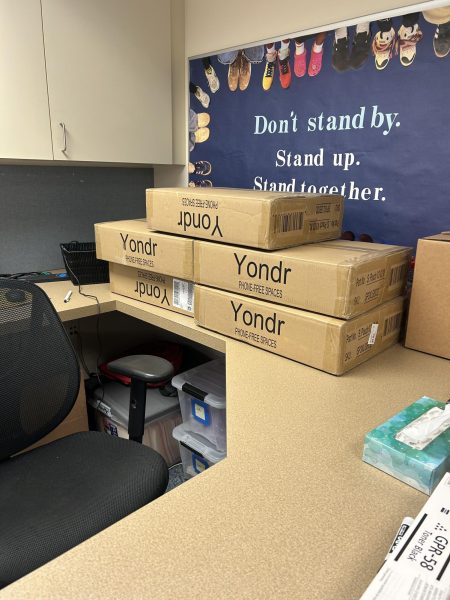
This October, Abington Friends School will roll out a sweeping phone ban for upper school students using Yondr pouches. Yondr pouches have become increasingly popular in recent years, with an estimated 2 million students now using them, according to NBC News.
AFS is following in the footsteps of local prep schools, like Germantown Friends School and Haverford School, in implementing a phone-free policy through Yondr. According to the same NBC News article, six of the 10 largest school districts in the United States have decided to use Yondr to go phone free.
The decision to go phone free was researched by the Fourth Century Center, said the Director of the Fourth Century Center, Adena Dershowitz.
Dershowitz said, “We read different academic journals and articles about… cell phones in schools. We also spoke with other schools, and then we did community research. Students received surveys, faculty received surveys, and then there were two cell phone free days that were organized as experimental days to get a sense of the issues that would come up, potentially, if we were to move in [a cell phone free] direction.”
Brendon Jobs, Upper School Director, said, “We decided to go with [Yondr] ultimately because it sends a clear signal about what the expectation is.”
Jobs said, “It also offers us [a] program to plug into… the program being the pouch itself, but also ongoing support from the Yondr team.”
The Yondr system does come with a financial cost. Pouches cost $30 each, according to NBC. With 295 Upper School students at AFS, the total comes out to around $8850.
This cost is one of the biggest issues with the program, says Hannah Elkin ‘26, in a sentiment echoed by many.
“I’m personally very ticked off about the fact that we’ve spent so much money on Yondr pouches,” said Elkin.
When asked where the school should put this money instead, Elkin said, “Literally anything else… sports, theatre, clubs, renovations, literally anything else would be more useful.”
Jason Holloway ‘29 said, “There’s so many things the school could spend that [money] on rather than banning phones.”
Jobs took a different opinion, saying, “I don’t know a better investment than investing in folks leaning into explorer mode.” Jobs also noted the school’s willingness to invest in community life and a better experience for students.
On the subject of goals for banning cell phones, Jobs said, “This is what we [want]: more engagement in clubs, more engagement in student life, more presentness between students on campus.”
Elise Graber ‘26 thinks Yondr pouches will work to the school’s goal of becoming more engaged in student life, saying, “we’re practically forced to talk to each other if [we] don’t have [our phones] on [us]… it’s more of a matter of ‘I don’t have anything else to do.’”
Khalil Jimenez ‘27 takes a different opinion. “There is going to be a little more focus, but I don’t think it’s going to be the major change that they want,” said Jimenez.
Jobs referenced a survey from Yondr of more than 1,200 schools using the service, showing that schools using Yondr saw an 83% increase in “student engagement.” Other sources back this, with The Nation Fund reporting Yondr pouches “increased [students] communication and interaction with one another.”
Because of the aforementioned costs of the Yondr pouch system, it will likely be at least semi-permanent, said Tina Yen, Assistant Upper School Director. Yen said, “[Yondr] is definitely not something where we’re going to try it for a year, and be like, ‘okay, that didn’t work out.’”
But Yen also didn’t rule out a possible change in the future, saying, “The idea of a policy is that a policy isn’t set in stone. It should respond to the needs of the community.”
On the logistical side, the Yondr system works with a series of lock boxes set up around campus. These lock boxes have a device inside that can lock and unlock the Yondr pouches. They will be open when students arrive for school, then they will be locked until the day. At dismissal time, they will be reopened. There will also be devices to open pouches at points of exit, such as the front office and Nurse Rachel’s office.
The Yondr program will start this Monday, October 27. It is a big change marking a new beginning of a phone-free AFS. Jobs said, “I’m really nervous about this. And I think that nervousness is also tinged with excitement for what the possibilities are.”





Adam Shabana • Jan 19, 2026 at 6:43 pm
Since the implementation of Yondr pouches at AFS I’ve noticed that students have had a lot less to do on their free periods. AFS is not that big of a school and there is very little to do during our frees. Taking away our phones just leaves us with less options to entertain ourselves with. I agree with Jason’s take on the situation, the money that went into Yondr pouches could’ve been invested in far more important things such a as new desks, seats, or for athletics. Overall, I do not believe Yondr pouches will greatly impact AFS, but I think that it is over-the-top.
Avery • Dec 1, 2025 at 5:38 pm
I haven’t noticed any major changes since the Yondr pouches have been implemented. I agree with the students who say it seems unneeded and a waste of money. I think going forward clubs maybe struggle to stay up because they cannot advertise through phones during school or anything when people are checking them.
Alana Jones • Nov 30, 2025 at 9:54 pm
It’s been a month since the Yondr pouches were implemented. I’d say a lot of the students haven’t been affected too much because we have other devices. Apple products such as IPads and MacBooks have pretty much the same attributes as phones excluding the size difference. So, I feel Yondr pouches were a waste of time and money. I agree with the other replies that state that the money should have been spent on something more important. I know as a person with ADHD and a short attention span, I get bored easily. Especially when someone is just talking at me. Which is what seems to happen in a lot of clubs and groups I’ve been to because they don’t have the funds to do anything that will keep us engaged. AFS has a smaller amount of students than the middle school I went to. So, even before the phone ban was officially put in place, I was already finding myself talking to everyone in my grade – also a good amount of upperclassmen.
Honor • Nov 13, 2025 at 12:56 pm
People seem to have grown used to it, but many still display anger. Some even throw the pouches, forgetting that their phones are in there. I think that each had a reasonable perspective on how it impacts them. I agree with the students who felt it was a waste of money. It could have greatly benefited many of the other groups that could use the money. It could have helped the clubs that want to bring in speakers or take trips. It also could have been given to the ROObotics club to help with anything they may need/want. I think that the impact may lead to a bit more students talking during free periods or in between classes, but I also think that it can be more difficult to find others during those free periods.
Maddie • Nov 13, 2025 at 10:40 am
My opinions on the youndr pouches are that I don’t really think they did everything that was hoped for. As someone who has a medical exemption and doesn’t have to use the youndr pouch, I was still provided with the velcro version. I honestly do not think that spending money for a velcro version was necessary but also the creation of one as well. It just doesn’t make sense to me to make a version for students who can get their phones because it defeats the whole purpose. Therefore since I have access to my phone, the implication of youndr pouches don’t really effect me.
ethan • Nov 12, 2025 at 10:07 pm
The implementation of Yondr pouches have been a big change. When we first got them the school day felt a lot more boring especially because I couldn’t choose my songs when I listen to music. Sure people have been interacting with people more but it’s nothing crazy like how the expects it to be. I also agree with Jason Holloway on how they could’ve used that money on better things than just something to restrict our phone even though we already had the phone hotels. I also have been very unaware with time and I’ve been very late to some classes because of it.
Carter • Nov 12, 2025 at 7:36 pm
The new Yondr pouch system has both pros and cons. On the good side, Yondr pouches are suppose help students be more focused and involved in school life. Without phones, students might talk to each other more, pay better attention in class, and join more clubs or activities. Some students think it will help people connect more because they won’t have their phones to distract them. However, there are also some downsides. People believe the money could be used for better things, like sports or theater. Some students also think the pouches won’t make a big difference and that it will just be annoying not to have their phones. Overall, Yondr pouches might help students be more present, but they also come with big costs and mixed opinions.
Zach • Nov 12, 2025 at 2:57 pm
Since the implementation of yondr pouches I have seen student life get better but maybe in a not so great way. One way I saw it improve is in the commons people were playing super smash bros on a Nintendo Switch. It involved lots of yelling but there were more people playing the game together rather than people separated. I like that guy Jason Holloways take. I also think the money could be used somewhere else. I really miss playing clash royale in the commons though. That was community too. Also people go around the rule by screen mirroring on their computers if they have a macbook.
Dylan • Nov 12, 2025 at 2:50 pm
I think that the yondr pouches have many pros and cons. I think that some of the better things about them is that it encourages students to talk more with each other and to stay focused on school. But some of the down sides to them is communication, for example, if we had phones then I could just text my friends and find them. Or if something came up, like practice for a sport was cancelled I could let my parents know. But I’ve seen the student working around these obstacles and I think that the yonder pouches could be good.
Nandi • Nov 12, 2025 at 2:48 pm
Adjusting to the new Yondr pouch policy has been a unique transition. At first, I expected it to be much harder, especially since I relied heavily on my phone and iPad throughout the school day. The first day without them felt strange, but I quickly found ways to adapt, like memorizing my schedule instead of checking Saturn. Although I still find the system inconvenient and miss having easy access to my devices, I can acknowledge that it has both pros and cons. Overall, while the benefits are clear, the challenges of being phone-free still feel greater to me.
Max Cassano • Nov 12, 2025 at 2:41 pm
I have noticed so far that people have talked to each other more and spending quality time together. I have also seen people more happy even though at the start they hated it, but it has made it better. I agree with with a lot people that talked about how banning phones will create better relationships, but I also agree with Jason Holloway about how the school could use all the money for something else more important rather than banning phones. I think that this policy will create a better community and make bonds stronger.
Jason Holloway • Nov 12, 2025 at 2:39 pm
I think the phone ban was fine. I really did care that I couldn’t play Clash Royale, though. I think that the phone ban makes people talk the same amount they did before. I don’t think it affected the talking. I think it made people more creative with bringing in switches and Nintendo DSs. Also, from what im hearing, the teachers did not like that. So io think that the yonder phone ban has affected some things but not others. Also, I agree with myself self I also think that the school could have spent the money on better things.
Gary L • Nov 12, 2025 at 2:38 pm
Having yondr pouches have been good and bad. I don’t think it’s that bad not having a phone for the whole day, but I also think that it dosen’t mean were going to interact more. Also for a athlete it’s hard because we have a long day of school, practice, transportation , and homework so it feels like we never get a lot of time on our phones and play the games we want to. Also during free periods it’s boring cause we don’t have our phones so it’s nothing to really do but work or sleep but what If you did both of that already. I wouldn’t be mad if the rules didn’t change because I don’t really care cause I think I’ll find something else to do but I would also love if they gave us our phones back. It’s not that different from when we had cell phone hotel’s but kinda is because of free periods. Then when we get our phones back , we be having so much notifications.
Cassiopeia Ballod • Nov 12, 2025 at 2:36 pm
I think the Yondr pouches are incredibly stupid, and they spent good money on the stupid things. if they wanted to send a message, they still could’ve done that with using phone boxes like they do in the middle school. last year I was in 8th grade, and the phone box was a non-event. but the Yondr pouches are only making more problems. they’re easy to lose, and expensive. not to mention they give us (students) something to rebel against and try to work around. this school is a preparatory school, its supposed to prepare you for college. no one is going to take our phones away in college, so the name is redundant. I don’t like the idea of no phones as a student, but I do understand WHY they are implementing this. but the blatant waste of money is ridiculous, many more valuable programs need that money and instead of bringing us together with putting more into the things we love, they’re only uniting us in rebellion against the thing we hate.
Mya R • Nov 12, 2025 at 2:25 pm
I particularly believe that the addition of Yondr pouches was the worst action that AFS could have ever taken. The sudden strictness from the upperheads in AFS has left students starstruck due to the abruptness of how, all of a sudden, any mishap and a dentition email is thrown your way. No eating in public spaces, lanyard wearing implemented, no gum, and now no phone usage during school hours. When I came to AFS, it was introduced to me as an independent school that allowed the students to also be independent, but since I’ve been here, I’ve only seen the opposite. I believe the implications of these rules have only caused more backlash from the students, even though school staff claims that the new rule implications are beneficial.
Chase • Nov 13, 2025 at 12:12 am
I agree with your claim that Yondr Pouches are not beneficial to the upper school students of AFS. I’m more nuanced to the argument because I’m still in shock, but I believe the pouches are limiting student interaction. Since receiving my pouch I’ve personally been limited to only seeing and communicating with my friends and people I have classes with. Without my phone it’s difficult to find the smaller connections, the ones you only see once in a blue moon in the hallway unless you text them “where are you?” I do worry though, of how bad our generation looks to our elders that they would think we are so socially underdeveloped that we desperately needed to have our phones taken. But regardless, the loss of my phone is one more hurdle to jump in being a functioning member of the community.
Emmett Kubersky • Nov 12, 2025 at 11:43 am
I think that Yondr pouches were a terrible idea. First of all, letting us have our phones for two moths and then taking them away was in my opinion, not the right move. You got students acclimated to a world with phones, and then abruptly took them away. As far as I can tell, they have been nothing but a hindrance, I talk to my friends the same, and the only difference is not being able to tell the time or check my schedule. Not to mention the whopping 30$ replacement fee, which occurs even if it is lightly scratched or damaged. It is bulky, hard to carry, and sometimes a pain to open. It only leads to people gathering in the commons, talking the same amount they used to, and when people tired to bring in Nintendo switches, it was swiftly suppressed. There was nothing anywhere p[prohibiting the use of said devoice, and yet the teachers said no.
Mya R • Nov 12, 2025 at 2:25 pm
I second your opinion on this, Emmett. The pouches have just been a terrible idea implemented by the school. Between the expense of the pouches and the fact that, despite student opposition to their use, they are the ones who have to replace a pouch with a $30 fee, despite already paying tuition to attend AFS. Frankly, having the pouch constantly in a bookbag allows it to take up space that could easily be used for a novel or folder to bring home instead. It hasn’t been effective in the effort to decrease electronic usage due to the fact that students now use devices more since their phones have been banned. The implementation of Yondr pouches only caused confusion, headaches, and pain for students.
caroline • Nov 12, 2025 at 10:25 am
Ever since the implementation of yonder pouches here at afs, I have seen people more talkative and cheerful then before. I think it is interesting because they only banned phones so people still use computers, watches, iPads, etc. to communicate, but people are also on those much less. Im unsurprised about the fact that the teachers are saying that it’s good ands something that the community needs. Im similarly unsurprised by the fact that the kids said they don’t like them and they are useless. but the opinions that I resonate with the most are the ones about how the pouches are useful but not worth spending so much money on and I agree that the school could be doing better things with their money.
John Breen • Nov 12, 2025 at 9:16 am
I think yondr pouches are a great, and terrible addition to our school. The most prevalent fact of the matter is the outstanding cost in monetary terms. From what I’ve seen a lot of people are mad because so much money was spent on taking our phones rather than things like clubs and sports. I think it also brings issues that come from phones being used as our most valuable tool. Phones tell time, keep our schedules, help us contact friends easier, and so much more that became a bit less accessible when phones were taken. I also would like to point out the fact that more often than not the lock boxes are still locked by the end of the day which complicates getting our phones back. Although yondr pouches can in a way disengage communication by making it impossible to message friends to find them, they make one to one engagement more meaningful. We now don’t have our phones to get lost in, and i’ve noticed a lot more conversation rather than getting lost in our phones, so that is definitely a positive. Overall I feel the implementation of yondr puoches is more negative than positive, but I can see thought behind it and understand why it happened.
Alana Conway • Nov 11, 2025 at 2:02 pm
I’ve noticed since we have started using the Yondr pouches people are talking a lot more, but there is also a lot of students wandering the halls looking for friends. The hard thing about not having a source of communication is that if plans get changed it is ard for the whole group to be informed. I agree with the students that the money could have gone to other things. I do understand Brendans point of view for the whole thing though. I personally have noticed myself not getting as distracted while I’m working during free periods, so hopefully we will get into the right groove with the Yondr pouches and can make the most out of the situation.
Harrison • Dec 16, 2025 at 8:38 pm
I agree with Alana‘s point that phones can be a distraction in school, and the implementation of Yondr pouches has allowed for greater student focus and time management. Phones have been proven to be distracting for students and negative in an educational setting. However, Alana mentions that “hopefully we will get into the right groove with the Yonder pouches”. I do believe this is hopeful thinking, and I do not think we will achieve it, as students will work around the barriers placed in front of them to access their phones. We are a generation that grew up with our phones implemented in our education, and are going to seek our normality.
Gia • Nov 11, 2025 at 11:10 am
I haven’t seen much change with the implementation of Yondr Pouches and I don’t see the reason for such an investment when I’ve seen plenty of interaction already, the only noticeable difference is that there are no phones in anyone’s hands. Now that others are bringing alternate devices or just using their laptops with the same apps and functions the pouches feel slightly obsolete as the phones could’ve been put away at a lower cost with more funds to things the students want and advocate for. There’s a chance I’m not noticing the changes others see, but from what I’ve observed, there could’ve been better ways to encourage student engagement.
may • Nov 11, 2025 at 11:06 am
I have noticed a significant increase in detentions for eating. I also have noticed though more talking with people while being on computers. I think that no matter the device people still talk but I think that taking the phones is not solving the problem because no matter what you do they are going to find a way to bring something else. I don’t disagree with some of the things said but at the same time some of them are just not true and things won’t move forward because the problem is not getting solved. I think that for the younger generations they will be upset that they waited so long and now can’t even have their phones. I think that the upperclassmen will be fine with it because they have just adjusted to it.
Kenzie • Nov 11, 2025 at 9:20 am
I, personally, haven’t seen any benefits from the Yondr pouches since they have been implemented. Before coming to AFS, I’ve always had my phone with me, and my mom has always texted me throughout the day. In addition, I have been able to correctly check the time when classes start, when lunch ends, and efficiently send emails and texts while on the go. Unfortunately, with the new phone restrictions, I haven’t been able to do that, only having the time whilst I’m stationary in an area. I feel that if the school simply wanted another way to deal with phones, they could’ve implemented some rules that aren’t as drastic and costly as the Yondr pouches. It’s tedious at the opening and closing times of the school day to do a phone check or find a station to unlock the pouches. It wastes valuable time for students who have extracurricular activities outside of school, and it can also get in the way of workflow for teachers and students alike for requiring phone checks. Without my phone, I’ve completely lost a structured way to adjust to my labyrinth of a schedule as a new student here.
miles • Nov 10, 2025 at 7:52 pm
Something I have noticed is that I feel less connected to my phone and don’t always want to use it anymore. But I’ve noticed that the connection and bonding level of students hasn’t really changed which was what the goal was for these pouches. It’s also a lot harder to find people if they’re not in the lunch room or commons. I agree with what Jason said about spending 10,000 dollars for banning phones. Also with Elise because we’re now forced to talk to each other for entertainment but it’s not really boosting any bonding. I feel bad for the students who will not get to experience phone at all because that was what I was excited for when I graduated middle school.
Anthony • Nov 10, 2025 at 2:18 pm
I feel like with the Yondr pouches coming to AFS is going to help other people connect more with people than their device. I feel like Yonder will bring more connections to others because of our phones being locked away. I also like that we can always have our phone on us and locked away aswell. Yonder will make a great impact of the future of AFS and the community of it being a Phone- Free Campus
Mila • Nov 10, 2025 at 12:31 pm
I agree with the main ideas of this comment section. After some time with Yondr, I have noticed minor changes in specific places, but overall not a huge difference in social interaction. I would like to say that I am not that connected to my phone, however, it has been increasingly hard to find my friends during free periods and lunch. It would also be so helpful if there were some kind of bells in the hallways to alert students when classes are transitioning, due to our newfound lack of our most trusted timekeeping device. I also agree with the fact that the school could have just continued the same system used in the middle school, with the phone lockers. Overall, I don’t see much difference of the effects between this and middle school. Because of this, I don’t understand the benefits of Yondr compared to this other system; with the fact in mind that Yondr was much more costly.
Nathaniel • Nov 9, 2025 at 7:21 pm
The phone-free policy will likely accomplish the administration’s goal of promoting face-to-face communication; however, I believe this will be limited by technological problems that the Yondr pouches are unable to address. Since the phone ban was implemented, I have noticed a sharp increase in the number of people using computers during their free time. Students not only use computers to do work, but also to check texts and social media. The fact is, computers can do essentially everything a phone can. The benefits ace to face connection and engagement, which the administration claims is the main reason for the phone ban, are limited to times when students don’t have access to commuters, such as lunch and clubs. I have definitely noticed an increase in community engagement during these times, but this has not extended to free periods, when most people who aren’t doing homework are playing video games or scrolling through social media on their computers. Furthermore, students still have access to Apple Watches, which can be a source of distracting notifications that prevent students from being present in the moment. If the administration truly wants to commit to the values underlying the new phone policy, it needs to address the problems presented by computers and Apple Watches as well, and the solution may not be as simple as the Yondr pouches were.
Sam GIilman • Nov 9, 2025 at 3:58 pm
I have not seen a significant difference in school with or without the Yonder pouches, except for fewer people making TikToks in the hallway. However, I have noticed improvements in one area and difficulties in another during free periods. I feel it is much easier to do work instead of periodically checking my phone and wasting time. I have an issue with finding where my friends are at lunch, mostly because this is a big school and there are multiple places they could be, and instead of just texting them, I have to walk around for a bit until I find them. I am still indifferent about the yonders and am still wondering do the pros outweigh the cons.
Eden • Nov 9, 2025 at 12:36 pm
Like many of these comments have talked about, I personally have not seen much change at all from the Yondr pouches. Despite what I’ve heard many faculty say is happening, there hasn’t been a noticeable change in student interactions, and I feel that it’s unfair to say that there has been. The social interactions were the one, main thing that was the reason for Yondr in the first place, and I sometimes feel like saying that there has been an uptake in interactions is just trying to justify Yondr. I think that it was a large waste of money, since the pouches are so expensive, and said money could’ve been used elsewhere for the school, or just saved for something else that might come up. In terms of pros, there also haven’t been that many (like I said earlier, nothing has really changed). I feel that the phone hotels were working fine, and could’ve also just been improved upon with tighter security to them instead of the waste of money that is Yondr.
Lia Khoury • Nov 8, 2025 at 4:30 pm
Now that it’s been about 2 weeks into the Yondr pouches I have realized both pros and cons to it. During my free periods I have realized that I at least can get more work done without getting distracted but not a significant amount. A less positive part I have discovered is that during lunch or other free times I can never find my friends and end up wandering the hallway a lot for them. Another reason is that I find myself late to classes more because there aren’t enough watches or devices to tell time with. Socially wise, I have become aware that while my friends weren’t too attached to their phones, many were and there have been more interactions with different people which is nice. I think that we could have done with a simpler solution by just using the phone hotels more strictly or something less costly and complicated than a Yondr pouch. However despite the odd transition I don’t think I mind the Phone ban that much and once I obtain a watch I think things will be more manageable.
Avila Widestrom • Nov 7, 2025 at 2:00 pm
I was not in support of banning phones in the first place, not because I need my phone at all times, but more so, it would cause a level of inconvenience throughout our daily lives. And my suspicion has been affirmed Since the implementation of Yonder patches I have found myself more frequently wandering in the hallways aimlessly searching for people and not having the adequate resources to accommodate my reading disability. as someone who uses their phone for taking pictures of a textbook when reading or audiobooks making the transition over to only using my computer and iPad it has been hard. Phones, due to their level of convenience in life, whether it’s trying to find a friend or a comedy person, are beneficial, and taking away that vital tool has added a level of difficulty to my day, as well as to completing my homework during free time or working during class.
Neiko • Nov 7, 2025 at 9:56 am
Since the Yondr pouches have come to AFS, I haven’t noticed much of a difference. Honestly, if our school were more strict about the phone hotels you use before class, then I think we could’ve saved a lot of money rather than buying the Yondr pouches. I think AFS being too soft about things leads them to try different things or to change instead of being strict and determined to change the opinions and actions of the students. One thing they’ve been strict about is eating in the hallways, and I think that the amount of detentions that have been given out for eating in the hallways has made the actions of the students change, so they know that if they eat in the hallway, they get a detention. If this amount of pressure was put on the phone hotels last year, then I think we wouldn’t have had to spend this much money on Yondr pouches that could’ve been used for, as Ella said, “Literally anything else… sports, theatre, clubs, renovations, literally anything else would be more useful.”
Harrison • Nov 7, 2025 at 9:54 am
Yondr pouches are an extreme waste of school resources; they are not worth the time or the money. As a community, there are many issues that need to be addressed, and spending a year researching a phone ban seems to be a waste of time. I am not against the goal of Yondr pouches, but they simply don’t work. Students are tech savvy, we know how to work around our phones being locked. I see many students in class linking their phones to their laptops and accessing the same functions only displayed on their laptops. Those who attribute increased student engagement to the Yondr pouches are wrong; it is due to a school’s change in club policy. Students are able to access their phones whenever they want, so how could it be thanks to Yondr?
Nika Kim • Nov 7, 2025 at 2:10 pm
Harrison, I agree with your point. To achieve student engagement, the school should find ways to encourage students to participate rather than limiting what they can do. Freshman year, I remember eating lunch with my friends in the hallway, laughing at different Instagram Reels. I remember studying with my friends in the Wilf and spending time with my basketball teammates in the lobby. Now, I am a senior, and instead of having more autonomy and responsibility over my choices, I can’t do any of the things I did before. So how does this help our community engage? I understand that we value stewardship and want to keep a clean space, but students haven’t even had an opportunity to eat in the hallways and keep it clean. The lobby was a space for students to talk to each other and sit on the chairs to study during frees. Those seats were literally replaced with uncomfortable benches to prevent students from occupying the space. The Wilf was taken away altogether. Now, I can’t even text my friends to ask them where they are. Taking away these freedoms does not improve student engagement. It limits it. Spaces such as advisory, clubs, affinity groups, family groups, and athletic events allow students to truly connect with each other, and should be the primary focus rather than limitations.
[email protected] • Nov 7, 2025 at 9:49 am
I understand both sides of the Yondr Pouches. But, yondr pouches are not just about an increase in student engagement, but it is an inconvenience on the academic side because they are a resource that supports my academic learning and increases efficiency. I noticed how much my phone is a tool I use during my school day. I frequently used it to take pictures of my work, my friends’ notes, if I missed a class, and for time-keeping. Yes, we have clocks, but when I am inside the farmhouse or outside, clocks are not present, so I find myself out of touch with my schedule. It feels inconvenient because using my phone for time has become a habit I adjusted to for so many years, but now I have to rewire my habits to fit into the new lifestyle with yondr pouches. When I miss a class, I usually take a picture of my friend’s notes to catch up, but I can’t now because my phone is inaccessible. With the rigorous AP class, staying on task is important, but it is more complicated to stay on task now because more time is spent on physically writing down everything that was missed, when it could have been solved in seconds, and the time spent on rewriting notes could have been used for other schoolwork. On the other hand, I have seen an improvement in student engagement, and more students have been participating in clubs. Students are more attentive and focused on what is going on than on their phones in the middle of club meetings. As a clerk, I feel more respected, and the attentiveness gives me more confidence that the club members are entertained. I find myself being more focused on my school work during my free time because my phone is not distracting me. Although there are pros and cons to the Yondr pouches, I personally can not change the rules, so I hope to learn how to adapt comfortably to the changes
Cadence Carson • Nov 7, 2025 at 9:44 am
I argue that the implementation of Yondr Pouches, while controversial, ultimately encourages students to engage more meaningfully with their peers and develop healthier technology habits. Since the implementation of Yondr Pouches at AFS, I have experienced both positive and negative impacts on the way I engage at school. Although it is difficult to make an accurate claim about the overall execution, I have noticed that I have interacted in many more conversations with individuals I was not familiar with, especially those with whom I share classes or afterschool activities. Conversely, I have observed that many of my peers go out of their way to seek the dopamine they have become accustomed to from popular social media apps such as TikTok, Snapchat, Instagram, and many more. Students began bringing in devices including Nintendo Switches, Oculus/VR, iPads, and others. Teachers started to notice this concern and began enforcing consequences for students who did so. Examples like this make the decision to become a “phone-free campus” complicated, as strict rules may encourage students to find ways to bypass them. I feel that going forward, students will begin to adapt to this new environment and develop healthier habits around technology use while still finding ways to connect and engage meaningfully with their peers.
Makayla Littles • Nov 7, 2025 at 9:34 am
In the AFS community, I have noticed that there has been more social engagement, yet there has also been a sense of disconnect. People are disconnected because they are unable to find their friends at times due to the large size of the campus. Before it was easier to meet up with friends because you could just easily text them. People now have to use more creative methods to find their friends such as meet up spots or texting them on email chat. As time goes on, people will adjust to the system of Yondr pouches because they will have no choice but to. Initially, it is going to be tough because students will have to learn how to operate not at the last minute. For example, people can not post a club meeting two minutes before the meeting is supposed to start because some students may not see that the club is meeting.
I do believe this Yondr situation is going to force people into becoming more attentive and checking their email. I truly appreciate how Tina Yen acknowledged that the continuation of the Yondr policy will respond to the needs of the school. As an AFs student, I want AFS to acknowledge if this Yondr pouch system becomes inefficient, and if it has a negative impact on our school.
When school leaders decided to implement the Yondr pouch system, they took the lead of many other Quaker schools, yet in STAC, we consistently acknowledge that our school is not like others. So essentially, it should not be handled as such. I am nervous to see how this Yondr pouch situation will actually play out.
J Wu • Nov 6, 2025 at 9:30 pm
It’s incredibly interesting that there’s so many perspectives on the ban on phones and implementation of Yondr Pouches. While I haven’t been heavily impacted by the lack of phones, I’ve noticed that some activities done with phones previously have gotten more tedious to do, such as finding friends or texting my parents when to pick me up after school. I feel as in terms of engagement however, I’ve felt pretty much the same. However, it’s interesting to read about how other student’s lives have changed as a result of getting rid of phones. I do agree that the school spent way too much money Yondr pouches.
Percy • Nov 7, 2025 at 9:33 am
I agree that the school spent too much money on the Yondr pouches and that is has become more tedious to do a lot of the things I used to do quickly on my phone. I also wonder about the teachers’ reactions to Yondr because for a lot of the science teachers – data for labs is taken on cell phones which means students need to unlock them – which if a lot of classes need to do that, mean there will be a traffic jam in terms of how students receive phones to do schoolwork. In addition I also wonder about administrations role in Yondr and who is in charge of unlocking them and how as a community we can support people in charge of running them to make the transition smoother.
Maya Peskin • Nov 6, 2025 at 12:14 pm
I honestly have not noticed a change in social interactions. I have noticed that many more people are showing up late to class because of the schedule on their phones. I agree with most of the comments about Yondr and how there is not much of a difference, except for having trouble reaching friends. I think the community will probably adjust going forward. I think that the phone hotels were a better phone policy for our phones, because we still had access to the necessary resources we need to show up at school. I have been more productive during lunch, but I do not think that pro outways the cons.
Neiko • Nov 7, 2025 at 10:28 am
I agree that there has not been a difference with social interactions without the Yondr pouches; with the Yondr pouches, it may even be making social interactions worse. Without having the privilege to text your friends to find out where they are, you are left chasing and running back and forth between locations trying to find them, which can leave you with little to no time left between office hours and lunch when you do find your friends. I have also noticed the number of people who have been late to classes because of the Yondr pouches. Without Saturn, or just a simple clock, the schedule was a bit hard to navigate at first. During the first days when the Yondr pouches were implemented, I almost missed my Jazz Band class because I was so used to going to class when people started moving, and since there was no movement in the crowds of people, I thought it was still office hours and got to my music class at about 10:35, which was about 15 minutes late. The lack of clocks and the blockage of not being able to contact your friends is a big and noticeable disadvantage to the Yondr pouches.
Cadence Carson • Nov 7, 2025 at 11:24 am
I agree that phone restrictions in the classroom improve focus, but I believe students also need brief breaks to recharge during free periods or lunch. I agree with the argument you are claiming in your comment, the more noticeable lateness to classes, having trouble reaching friends, and especially the first action with the phone hotels. While I agree that it is more difficult to connect quickly with your friends through a quick phone call or text message, I find that in a situation like that, people will learn how to quickly adapt. Regarding the phone hotels, I believed that the implementation of including those in every classroom was more than enough. I agree that phones should not be in use when in the learning environment because school is a place of education and growth. On the other hand, during times when school is in session like a free period or during lunch, students should have the ability to take a few minutes to relax and destress themselves, especially if their schedules are packed with back-to-back classes. I know from personal experience when the phone ban intentionally started I would feel so brain dead during mid to the end of the school day because my brain needed a brief break to recharge, and having a few minutes to scroll through videos on my phone would help me reset and feel more focused for the rest of the day rather than cramming my brain with over six classes of material.
Avila Widestrom • Nov 7, 2025 at 2:05 pm
I agree. I have not only noticed an increase in tardiness to classes, but there has also been an increase in the usage of iPads, which have almost replaced phones. Now that we are approaching our third or fourth week with Yondr pouches, I’m noticing a lot of iPads, which are larger than phones and therefore take away from social interactions because they’re more distracting and are being used much more frequently. And there are still TikToks being made in the hallway, videos being recorded throughout the school day, but with the added cost of a lack of communication throughout the school day, so I 100% agree that the pros do not outweigh the cons.
Aarohi • Nov 5, 2025 at 7:24 pm
The school’s phone policy, where teachers collect our devices before classes and only return them after the school day is over, has honestly become a major concern. It feels like the policy, intended to reduce distraction, has had the opposite of the intended effect. My original worry was that collecting phones for the whole day would simply push students toward other distractions, possibly encouraging them to text or play games on their computers during class. Now, I’ve noticed more kids distracted overall, not fewer. Beyond class, the social cost is massive. You most literally cannot find your friends on campus anymore, and that makes casual interaction and planning so much more difficult. We feel more isolated. To top it all off, we’ve lost our personal way to keep track of time. Since the hallway clocks are often a few minutes ahead or behind, this lack of reliable timekeeping frequently causes students to arrive late to class. The entire system seems counterproductive.
Aila • Nov 5, 2025 at 4:06 pm
Although it’s only been a week of using Yondr pouches, I haven’t noticed a significant positive difference in day-to-day student life. Not having my phone was not something I was worried or anxious about; rather, I was more upset about the way we were going about banning phones (using Yondr). However, some of the goals of implementing Yondr pouches were improved social interaction and more student engagement. In my experience thus far, I have not seen more student interaction, and at times, I feel disconnected from my peers because I am unable to contact them to eat lunch with them. There have been many times when I spent almost my whole lunch looking for my friends in order to eat with them. Overall, my reaction is not positive, but rather annoyed at the existence of Yondr pouches and how I now have to account for my phone in public spaces, but can’t actually use it. Going forward, I think it will not improve student life at AFS, and I have not seen any change in my own interactions.
E'vah M • Nov 5, 2025 at 2:36 pm
I don’t know if I’ve noticed a huge difference since the implementation of Yondr. Although coming into and leaving the building has sometimes proved to be a struggle, students’ reception to the program has been neutral. I am still annoyed by the use of funds, however. Since Yondr was proposed, I was against the idea. I didn’t mind going phone-free–we already didn’t have our phones during class–but the sheer amount of money going towards locking out phones in a pouch was disheartening. We could invest in so much more: new furniture, bussing for clubs and extracurriculars, the arts, extraneous activities, etc. Going forward, I don’t think much will change, as nothing, really, has changed thus far.
Tsukki • Nov 5, 2025 at 2:25 pm
Although I fall into the handful of students who aren’t thrilled about the phone ban, I have noticed a few positives that the faculty was banking on seeing as the Yondr pouches rolled out. I wasn’t surprised by the opinions of the students or faculty, but I’ve seen a lot more student engagement with each other, clubs, and CC affinity spaces, which I think, of course, is great because I know the slow dying out of these spaces was a huge issue that STAC and faculty have been discussing for a while.
Divya B • Nov 5, 2025 at 10:40 am
I am overall not thrilled with implementing Yondr into our school system because it was nice to have my phone, but I think so far in the few weeks that we have had it, I have definitely seen an impact on all of the high school students. I think all the perspectives on this change in this article are 100% valid and I agree with all of them, and it is a very hard adjustment for us all and it will continue til the end of the year. For the future upper school community, I think this will be good for them, but at the same time, every day in middle school we had to lock our phones, and so it is quite frustrating having to do a similar thing in high school. We should be at the point where we are trusted to not do any tomfoolery at our mature age, but im trying to see the light in this change.
Kemper Bramblett • Nov 5, 2025 at 8:22 am
Since the Yondr pouches rolled out, I have actually seen a lot less change that I anticipated. I initially expected that the policy would change the student’s mood, whether that mean it would make people calmer and more engaged, or angry and rebellious. However, from what I have seen so far, there has not really been a shift, with things moving along just as before. I like how the article touched on the financial aspect of Yondr pouches, as many feel like the students are paying for a policy that they do not want with their own tuition. I thought it was interesting how many students were outright against this policy, and also what Jobs said in response, that being that they were investing in students activating “explorer mode”. As somebody who is leaving AFS next year, I have given little thought to how I think Yondr pouches will play a role in the coming years, however with AFS’s history of policy’s being changed year-to-year, I think that in the near-future we will probably see Yondr pouches continuing to be used, this time maybe with more enforcement than now.
Meadow Campuzano • Oct 24, 2025 at 11:21 pm
I understand why they would want to go phone free, but why Yondr? I don’t understand why they would spend all that money when they could just do what we did in middle school. In middle school we would just turn in our phones in the beginning of the day into these “Phone hotels” and then get it back at the end of the day. I think it is so unnecessary to spend so much money on Yondr pouches when you can get the same result with something much less costly. They could have put the money into something else. Or nothing at all. Maybe just save it or whatever schools do with money, (which we can tell is usually totally random and unnecessary). In my opinion if they want more student engagement use the money to make more things available to students. More spaces and or opportunities where students can pursue their interests or hobbies rather than another rule/ something to think about. Not trying to be disrespectful but I think there is a much easier and cheaper way to do this. Sometimes the easiest way and less complicated way, is the best way. I guess we will see how this goes on Monday.
Rael Santana • Oct 23, 2025 at 9:25 pm
I actually just left a school with yonder pouches, so I’m quite familiar with them. They didn’t really add to anything, as phones weren’t allowed in the first place, but rather, became a huge unnecessary cost for the school. It’s a shame all that money was spent on the pouches when they could have been used for other things that are now coming out of the student’s/parent’s wallets. The locks also caused a lot of traffic when exiting the building, as organized as they try to make it. Everyone was so desperate to unlock their phones; there was a lot of pushing and a whole lot of waiting. Leaving school, I’d make it 5 whole minutes late to the entrance. Truly a shame that the money was used like this.
Justin Solonynka • Oct 23, 2025 at 7:09 pm
Solid reporting on a contentious issue. Nice work.