














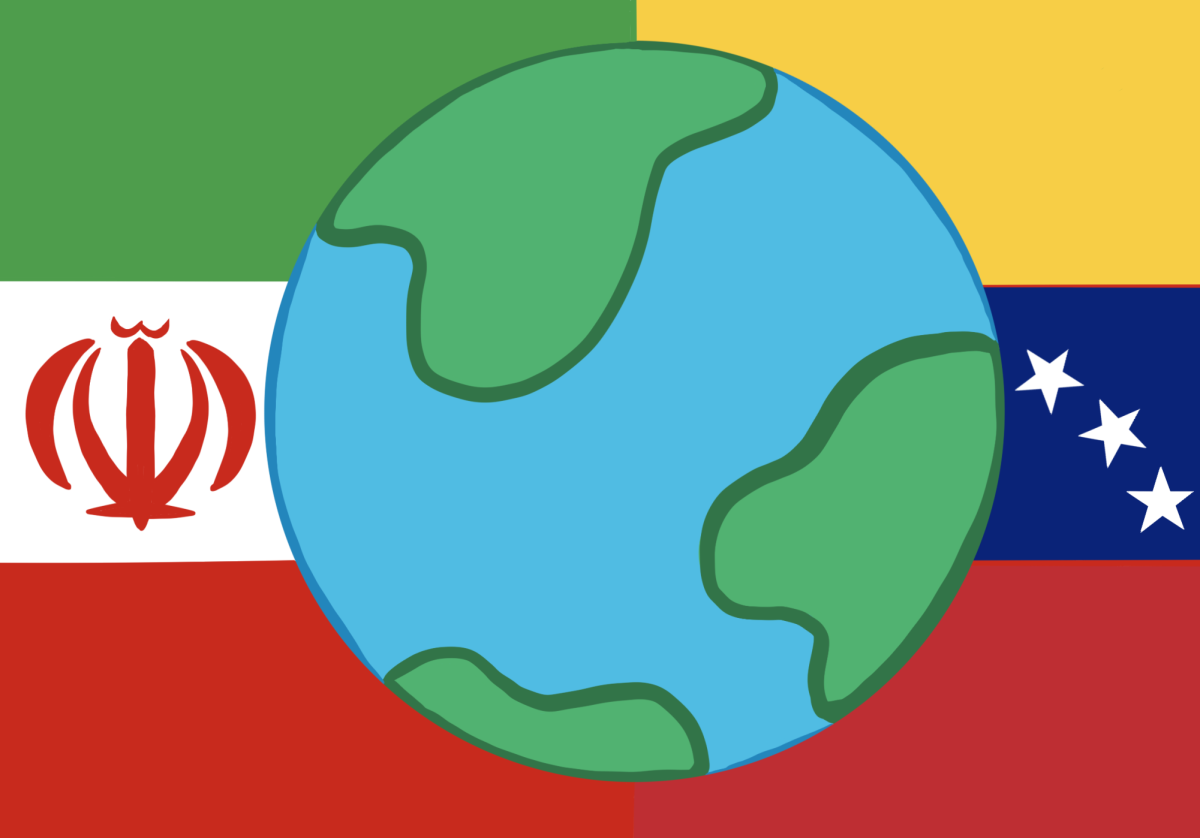






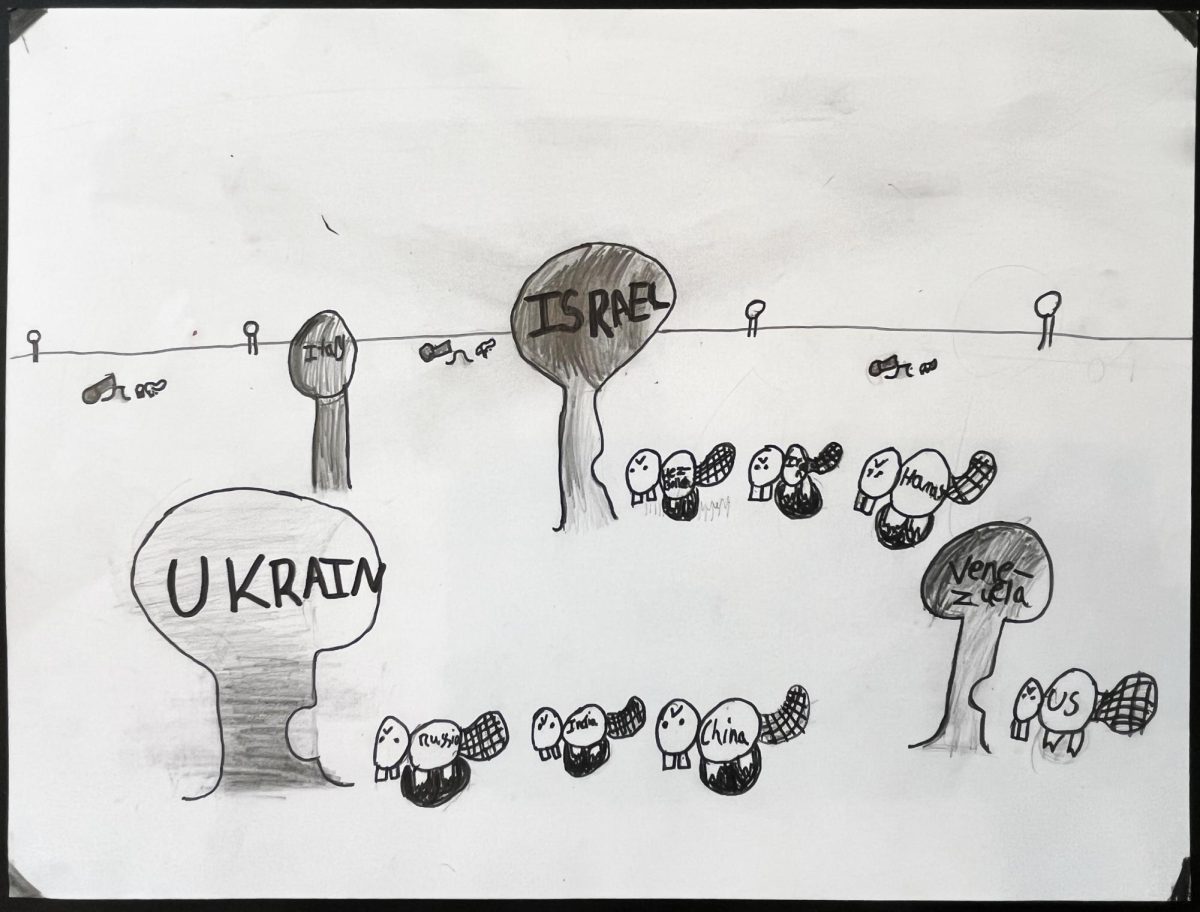



On February 28, 2026, the United States’ and Israel’s militaries attacked Iran. This was particularly alarming in our country’s case, as the USA didn’t have much of a direct involvement in this conflict beforehand. In fact, according to the BBC, this was Israel and Iran’s business before we threw ourselves in with a “‘pre-emptive strike’ to ‘remove threats against the state of Israel.’”
This is just one example in what seems like an endless list of our country flinging itself into conflicts that we have nothing to do with, both in the military and in other government agencies. Our own Congress, for example, has on its website a list of hundreds upon hundreds of examples of such moments from 1798 to 2023. I couldn’t hope to count exactly how many.
The New York Center for Foreign Policy Affairs, for one, cites the Cold War as a cause of our current culture of aggressive intervention, saying, “The concept of interventionism was a direct reaction to the international menace of the Soviet Union witnessed during the cold war. It was the period of geopolitical separation of capitalism and communism and led the United States into a trail of calculated interventions in the world.”
The end result is clear: our country has really come to love throwing itself at others’ problems. We’ve seen it recently with Venezuela’s president being captured and, as mentioned, the invasion of Iran.
This is fundamentally not good. It turns out that, when your country inserts itself in everyone else’s business, it takes a hit to a reputation. 2025’s Democracy Perception Index shows on page 41 that our net reception is currently negative five—one of only ten countries in the negatives.
Correlation does not equal causation, but I don’t think it’s a stretch to say that our global reputation is directly tied to our interventionism. After all, who would want some entity across the Atlantic sticking its nose in your business?
Something that doubtless emboldens us to involve ourselves in all manner of international affairs is that we have more military budget than we could ever know what to do with. In 2026, according to the World Population Review, the USA is spending the most money on the military of all countries ($968 billion) and second-most per capita ($2,895). With all that defense money, what else is to be done but to use it on someone else’s affairs?
In looking for another way, it could be helpful to take cues from Switzerland. Switzerland is unique in the sense that the country is a strictly neutral party in all international affairs.
According to Presence Switzerland, “Neutrality is a cornerstone of Swiss foreign policy and prohibits Switzerland from participating in armed conflicts and joining military alliances.”
Neutrality and cutting military expenses are probably hard sells for many Americans, true, but it’s still worthwhile to at least consider these ideas. Maybe we need to cut some funding. We certainly don’t need this much emphasis on the military. And how about we only help our allies when it seems like they really can’t handle things on their own?
That seems, to me, like a much better option than throwing ourselves at any country that breathes in the wrong direction.


Emmett Kubersky • May 4, 2026 at 2:07 pm
I think that this article brings up and important issue in America which is the fact that we insurge ourselves into too many wars. I agree and disagree with this perspective, yes the U.S. goes into too many wars, but also trying to keep global peace is important. I think that AFS should approach these topic with pure facts and not biases. It is a very touchy subject, but an important one. We learn about wars in history classes, so why not go over these. One needs to learn about global politics and politics as they will be affecting our everyday lives.
Casio • May 4, 2026 at 9:36 am
The United States has a massive problem with trying to play hero in geopolitics (as highlighted in this article) even if it’s one of the most powerful nations in the world. I think interaction like this is both helpful (in SPECIFIC CASES) and harmful. Such power should remain neutral, but it can also be used to unite countries and communities all over. In today’s cases, we’re doing nothing but harm, charging into foreign countries and “freeing” them. I believe insertion of oneself as a country is only problematic when not agreed upon by other nations governments (preferably not corrupt, but hey). For example WW2, nations united to take out a power invading other countries, creating bonds. But we as the US are the problem, we are the nation invading. Anyway, make it stop please.
RC • Apr 28, 2026 at 11:41 pm
While I am by no means an expert on how the US interacts with other nations, I agree that the US’s current strategy is not the right way forward. As of right now, it feels as if the US is solving “problems” through blunt force, and will/has inevitably create more issues of possibly greater magnitude. Solving threats with violence can only ever lead to more violence and more suffering. This interventionist ideology has never really seen much success for the US, and the recent military actions have only compounded that fact. Yes, I understand that the US likely needs to maintain its status as a global superpower through military spending, but I do know that military spending or actions can’t ever replace the trust that comes with equal cooperation with other nations.
Adalyn • Apr 28, 2026 at 9:53 am
I strongly agree with the perspective of this article. It always seems like we seem to be somehow involved in various different conflicts around the world that aren’t even close to us at all. And with the amount of money we are spending, (almost a trillion dollars!!), we could be using that to boost education, or create housing for the unhoused, or even get food to those who need it. It almost to me seems excessive to be using that amount of recourse, especially for conflicts that we really don’t need to be a part of. On a different note, I feel like AFS doesn’t really discuss that many sensitive topics. Most of the time they aren’t even brought up or discussed unless a student or faculty member wants to talk about it and that keeps us in our bubble, which can be not great.
Anais Melzer-Surkan • Apr 23, 2026 at 2:14 pm
I agree with this article in that the US should not have engaged Iran just because we are scared they are building a nuclear weapon. The Unites states is the only country in History to have dropped not one but two atomic bombs and now we are worried about Iran doing the same thing (ironic). It is so easy for rich US citizens to stay in their personal bubbles and not bat an eye at whats going on but people need to learn about whats happening. I feel like AFS could also take a part in this by educating students about current events and connecting them back to historical events in the past. Not too much has changed. I don’t think that being neutral is the best option either however. I think the US should support it’s allies and not bomb schools and innocent people who have nothing to do with the war. The US cares so little about foreign affairs until it directly affects them. This was true with Japan in world war 2 as well. If you follow along with history you will realize how much is still the same and continues to stay the same.
Augusto Quinones • Apr 23, 2026 at 7:10 am
While critiques of American interventionism often emphasize its moral costs, as outlined is say this article, I do feel as though they tend to overtly overlook its central role in building U.S. global power and economic dominance — the same from which we benefit each and every day. From a realist perspective, as outlined by Hans Morgenthau in his work regarding International Studies, states act primarily in pursuit of power and security rather than abstract ethical ideals. Therefore in this light, U.S. interventions during and after the Cold War were not mere random overreaches but very strategic efforts to contain rival systems and secure favorable markets, particularly in regions like Latin America and Southeast Asia among others. This interpretation is echoed in Confessions of an Economic Hit Man, a novel where an ex-professional explains how the U.S. established a global system of debt, which argues that American influence often extended through both military and economic pressure to shape global markets. While yes, such actions frequently produced instability and resentment, they also helped construct the international order that underpins U.S. prosperity today. Thus, rather than condemning interventionism outright, it is much more accurate to view it as a calculated, if ethically fraught, instrument of national power.
[email protected] • Apr 21, 2026 at 2:05 pm
I strongly agree with the perspective of this article. Historically, it seems that American interventionism often leads to bloodshed and disenfranchisement in the communities where it takes place, which directly leads to the damage of our international reputation. For instance, I saw a video of Venezuelan protesters saying something to the effect of “we will die before we become American” after Maduro was kidnapped. That kind of resentment can’t come from nowhere. After all, the U.S. manufactured mass poverty, violence, and a decades-long brutal dictatorship in Chile under Nixon. It also seems that some of America’s attempts to crush Latin American drug cartels in the 1980s came with unintended consequences. Yes, Maduro was a dictator, and yes, drug cartels are atrocious, but can two wrongs make a right?