




















You’re late for class when you realize you have an unwritten essay due next period. After a moment on ChatGPT, you submit the assignment. Harmless, right? Absolutely not. AI is amplifying the power of governments, corporations, and armies. Scholars and scientists who work with AI every day understand this, and it is imperative that we understand too.
AI can alter the balance of power anywhere in a single moment. If left unchecked, the rise of AI will widen the global power gap, exasperating the issues of war, pollution, and tyrannical governments.
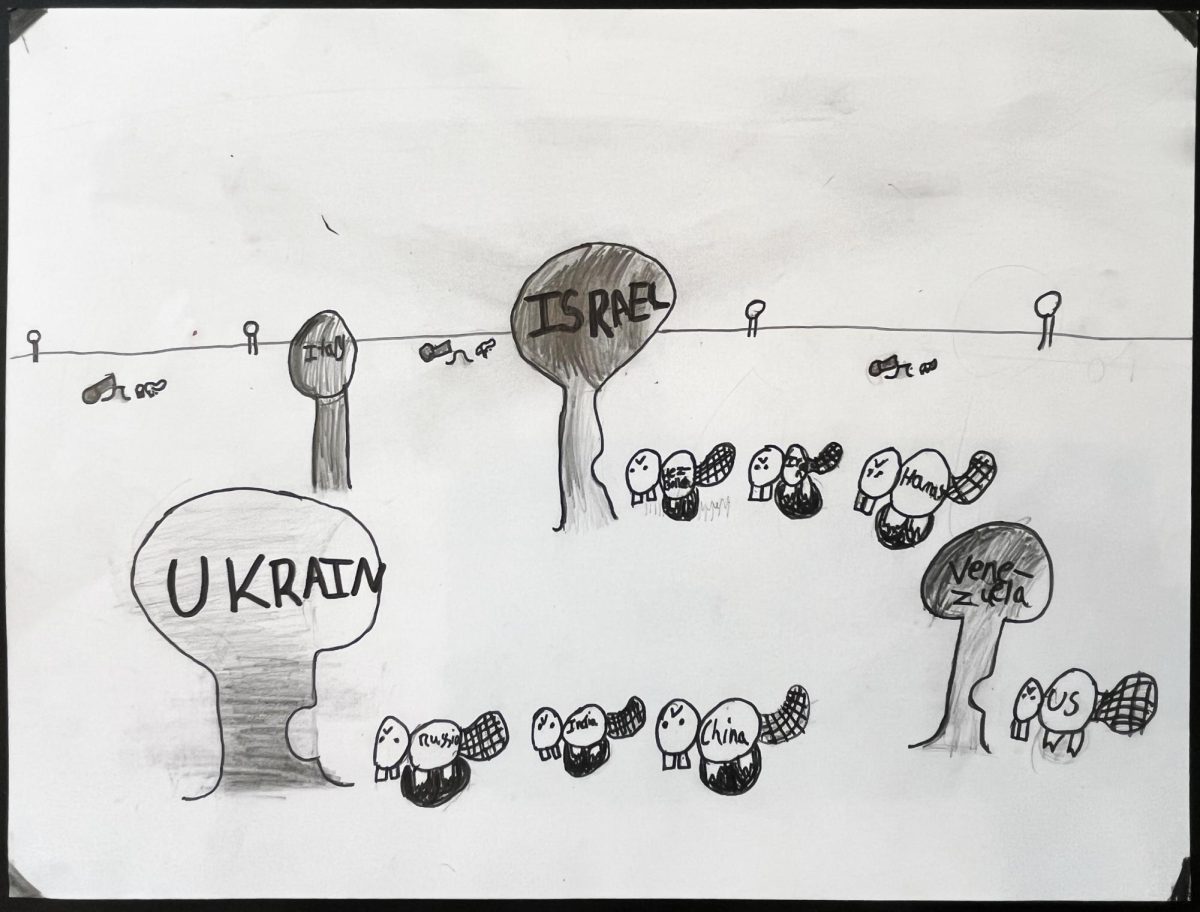
In Ukraine, AI turned the tide at the Battle of Kyiv. According to Mustafa Suleyman, a “ragtag volunteer band of …amueters design[ed], buil[t], and modifi[ed] their own drones in real time”, blowing up a critical Russian supply base.
In this way, it seems AI democratizes access to weapons. However, Suleyman writes, “when technology confers a[n]… advantage like this, it will… inevitably proliferate and be taken up by all sides.” Further development of AI weaponry will radically escalate the bloodshed and destruction of the wars our generation will soon be fighting in.
Governments use AI in the form of CCTV cameras to control citizens. China is a prime example, with half the world’s billion CCTV cameras. In the Xinjiang Autonomous Region, AI fuels the ethnic cleansing of the native Uighur people. Authorities use iris-scanning technology that hold up to thirty million images coupled with checkpoints and camps to repress the people.
AI underscores tyranny, and not just in China— over 100 U.S. towns have illegally acquired the technology developed in Xinjiang. CCTV cameras allow governments to easily repress opposing viewpoints, control marginalized groups’ actions, and store an astronomical amount of information about their citizens, which is extremely destructive to basic human rights.
AI’s environmental damage affects people of color first, furthering the inaccessibility of clean air and water in Black and Brown communities. In Memphis, the historically Black neighborhood of Boxtown is paying for AI’s growth every day. According to Tech Policy Press, “Massive gas-powered generators installed by xAI…are poisoning their air.” xAI is one of the most prominent pollutants in the county, where cancer rates are already 400% the U.S. average.
Although AI may democratize opportunity in the short term, assisting with education and career growth, it ultimately deepens the dangerous divides between those with power and those without. It is urgent that our young generation focuses conversation and policy on the large-scale impacts of AI, not its day-to-day usefulness.
Without decisive legislative and social action by our young generation, AI will continue to amplify wars, nourish tyranny, and destroy the environment. What will you do with your power before AI takes it away?


RC • Mar 9, 2026 at 10:54 pm
In my opinion, AI right now is a dangerous gray area. I would love to see a set of rules put into place to monitor the excesses of AI, but unfortunately, that feels out of reach right now. Another example of AI’s power besides the affects stated in the article is the humanization of it that we see every day. When “talking” to a chatbot, it can often feel like you’re just having any other conversation with another human being. This leads us to give AI more credit and respect than it is due. We have created a human mask for AI in a way when in reality we should see it as an advanced array of computers and code.
AI is often seen as a tool, but what is a tool? Can a weapon capable of killing possibly millions ever really hold the same meaning as an Allen wrench or a shovel? I personally believe that AI should never be weaponized and I am extremely concerned about its usage in warfare today. The average person has very little individual say in how AI is used or where its data is from. Instead, we are being set up as consumers and possible victims of our “tool”.
Loren • Mar 9, 2026 at 9:52 pm
I agree with this article because I believe that AI has taken a step to far. I think that people should be trying to be more creative and not just take the easy way out and use AI. I also think it is making people more lazy with what they need to be doing whether its work or other things. I think that its hard to set perimeters around AI because it is so easy to access, but I do think that people in charge whether from a bigger stand point or even just a principle should try to limit the use of AI.
E'vah Myles • Mar 9, 2026 at 11:03 am
Although I am anti-AI, I can acknowledge some of its benefits. Its recent developments, however, are increasingly concerning. Between the technology’s excessive water usage, its environmental (and economic) impact on minority communities, and the blurring of ethics regarding war and safety, there is a lot to think about regarding how we are using AI. In our daily lives, we (as civilians) are funding billion-dollar AI companies and AI’s integration into government and military. AI can only be used semi-ethically if the technology is not replacing human minds and, even then, we have to consider the money used to keep the tech running and the community environments it’s affecting.
Hunter Rems • Mar 5, 2026 at 8:59 pm
I agree with the article as AI has taken a toll on creative processes and critical thinking of many young people across the globe, which are two facets of independence and fighting against leaders and other groups in power. As AI feeds everyone the same answers, it homogenizes people who once all thought uniquely to all answer the same, which makes it easier for leaders to order and tell people what to do and who to be. I think this article gets that point across very well and introduces new ones, which all point to the idea that we as young people need to move away from the usage of AI in order to still be able to maintain a sense of autonomy and rebellion.
zhoaye wang • Mar 4, 2026 at 11:49 am
i might not have enough evidences to argue other things, but there is one thing i am confident enough to talk about: xinjiang. i used to live there for two months in the countryside so i know the words about the monitors in xinjiang is totally wrong. firstly, the passage say there is too many monitors. i could say the monitor is almost everywhere in china–not for controlling somebody but the security. chinese population is7 times larger than america so you know the difficulty to be safe and catch the crime as soon as possible. the rate of criming in china is so low because of these monitors. also, i bet most of people who talk about xinjiang never been to xinjiang. without doing the survey, people shouldn’t make comments so easily.
secondly, let’s talk back to ai. recently, open ai just sign a paper to let the military to use their models but claud reject to provide theirs. as we could see, this is what we should really talk about: if ai could attend to the war, what is the future of the world?