



















As a society, we blur the line between free speech and hate speech under the guise of the first amendment. We can avoid misinterpretations and miscommunications by properly educating ourselves and peers and accepting the fact that two truths can coexist. Free speech encourages empathy and awareness, strengthens democracy, and overall has more benefits than drawbacks.
The First Amendment to the U.S. Constitution reads, “Congress shall make no law respecting an establishment of religion or prohibiting the free exercise thereof; or abridging the freedom of speech, or of the press; or the right of the people peaceably to assemble, and to petition the Government for a redress of grievances.”
Free speech is expressing yourself through a topic or ideal that you believe in. On the other hand, hate speech is directly attacking somebody’s character on a belief and portraying it as incorrect or false. People should have the confidence to express their true opinions, while recognizing that diversity in thought is not only normal but valuable and adds more to the conversation.
Under the “Our Community” tab on Abington Friends School’s website, there is a page dedicated to equity, justice, and engagement.
It says, “Diversity, equity, and inclusion are not separate initiatives at Abington Friends School—they are essential to who we are and how we learn together. Rooted in our Quaker values, we believe that each member of our community carries both the responsibility and the opportunity to contribute to a more just and equitable world. This is shared work, and it begins with a commitment to seeing and honoring the full humanity of every individual.”
Everyone has freedom of speech. Although we have the right to say something, that does not mean that it is positive, uplifting, or hateful. Both are not mutually exclusive.
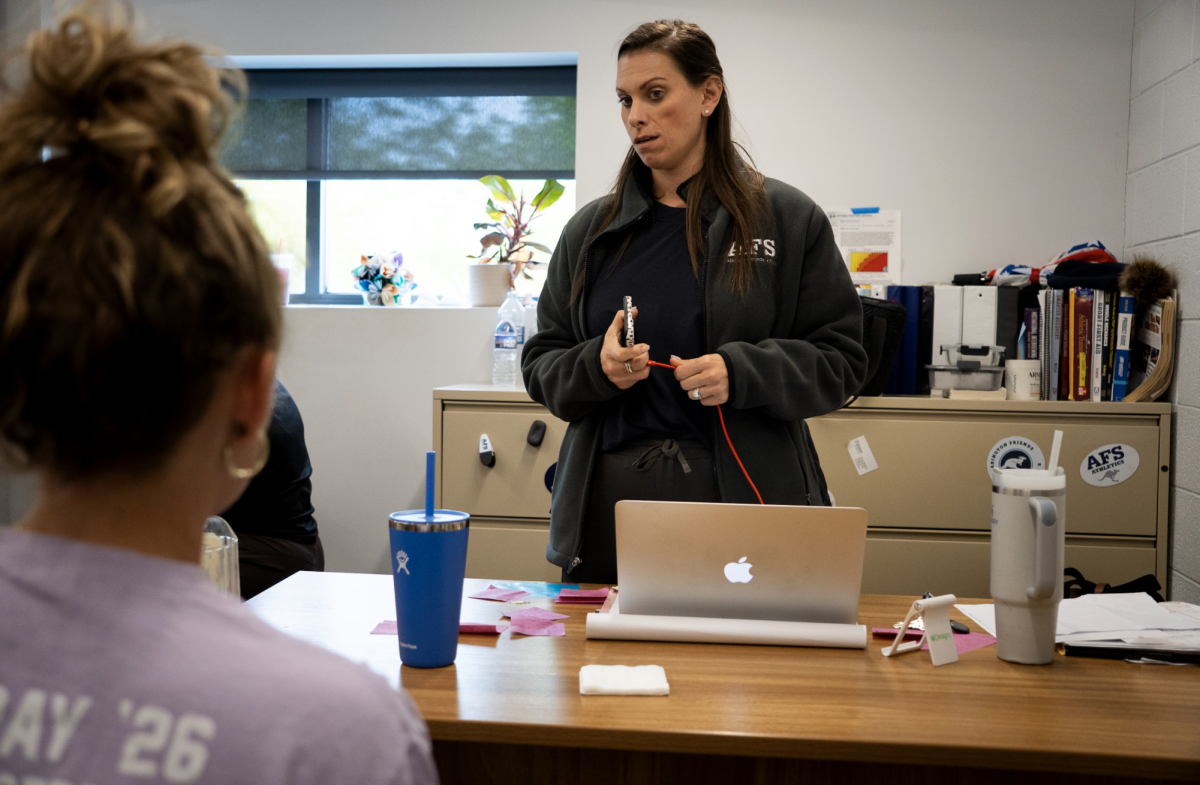
Mikael Yisrael, Director of Equity, Justice and Engagement, says, “There is a difference between dialogue, debate, and discussion. It is not what you say, it is how you say it. When you say things in a nice tone, it will be received more in a positive light because it was said in a softer manner.”
Diversity is a part of free speech, which means coming together with one another from different backgrounds, perspectives and opinions. As a result, you are going to run into having difficult conversations because you are not all the same.
However, this does not mean freedom from consequences. This includes when someone else calls you out when they feel like they have been impacted by your hateful words on topics such as race, religion, and identity overall.
Race is a major topic when discussing hate speech because racist language and stereotypes have a long history of causing harm, discrimination, and division in society overall.
Amaya Manigault ‘26, Clerk of Black Student Union, said, “The person that the dialogue affects the most should determine what counts as hate speech. However, sometimes it can be taken out of context and things can be misunderstood. But, whoever it is affecting has the right to categorize free speech versus hate speech.”
Another key part of differentiating free speech from hate speech is allyship.
Liam Hillard ‘26, Clerk of Anti-Racist White Activist for Racial Equity (AWARE), said “As the White affinity group we try to support the group that is dealing with the fallout in every way we can. We understand that our job is to support to the best of our abilities.”
Also, religion is another major topic when hate speech is discussed because religious beliefs and identities are personal and tied to people’s sense of self and community. As a result, forms of Islamophobia, antisemitism, and anti-Christian hate can be particularly harmful.
Jarius Ford ‘26, Clerk of Genesis: Bible Talk, says “AFS does a good job with expressing the fact that multiple truths can exist. We often discuss how silence is key in building community and trying to bring everyone together.”
Students can practice free speech by becoming more comfortable outside of the classroom to speak freely about what they believe. They need to have more courage to be authentic about their personal opinions, and most importantly, understand that difference is okay.

Ruhi • Dec 10, 2025 at 10:09 pm
I agree that those affected most by the hate speech should get to identify what is and is not hate speech, because I’ve encountered multiple situations where the person who is being affected doesn’t view it as hate speech, but others do. Not to mention some things could be inside jokes between people of the same race or religion, and it can be misunderstood by someone not of that race or religion. This has happened to me multiple times. Sometimes I don’t feel comfortable sharing my perspective on certain topics because I feel like someone will mistake it for saying something else, and it’ll escalate from there into a situation that shouldn’t have even been there. Things can be taken wrongly or viewed differently, and that really affects everyone involved in the situation.
Jenny • Dec 9, 2025 at 8:58 am
I do agree with the main idea that we, as Quakers, should accept differences in opinions, but I don’t believe that there’s necessarily any speech that is a “hate” speech if we truly assume all good intentions in others. Most of the so-called “hate speeches” are regarded so because of the subjective sentiment of the person hearing it; however, the speaker might be just articulating their own beliefs that seemed no harm to them. For example, in politics, when a person in one party says something sensitive and takes their stand (such as abortion), the opposing party might perceive this as a personal attack. What if that person did say something insulting or harmful? One might ask. Well, not to play wordy games, but those kinds of speeches do not fall into the scope of “speeches”, as mentioned in the article. Speeches are only the ones that are not explicitly about commenting or disparaging, so if we assume good intentions in others, every speech is not a “hate speech”.
E'vah Myles • Dec 10, 2025 at 2:09 pm
I don’t think the article alluded to all speech being hate speech. If anything, it did a good job navigating such a touchy subject and acknowledged that words can be perceived differently depending on who hears them. Many times, people say ignorant things because they have no prior knowledge of the given subject. It is society’s job to treat those with grace and attempt to understand where they are coming from. As Amaya stated, the reception is dependent on the community it affects. Abortion is a harder topic to speak on since it doesn’t refer to a human being; it’s a procedure. Offensive language can be used when talking about abortion, but hate speech, however, is only encroached on when speaking on women or afab people in relation to the topic. While we should never immediately assume someone is trying to be hateful, it is useful to create these boundaries as a society to protect people, especially minorities.
Liam H • Dec 9, 2025 at 8:52 am
As this article says, being able to say whatever you want on the legal level doesn’t mean you can do the same socially. It’s an entirely different issue. One can certainly get into the weeds about when facing social consequence because of one’s words gets out of hand, purely moral debates are outside of the scope of free speech debates. Drawing the line here is important, because if that line is blurred, it becomes incredibly easy to lose sight of what actually matters. This calls to mind to me a recent incident at a university (which for the life of me I cannot remember the name of, but you likely heard about it too). A professor at the school failed a student for an essay because she failed to cite any credible sources when writing about the complexity of gender, and the only thing she cited was the Bible (not even quoting it, but just vaguely eluding to it). The professor did not take issue with the student’s beliefs, but the offensive and poorly-supported execution of sharing them. The teacher, bewilderingly, got put on leave for this, even though it was not an issue of free speech at all.