





















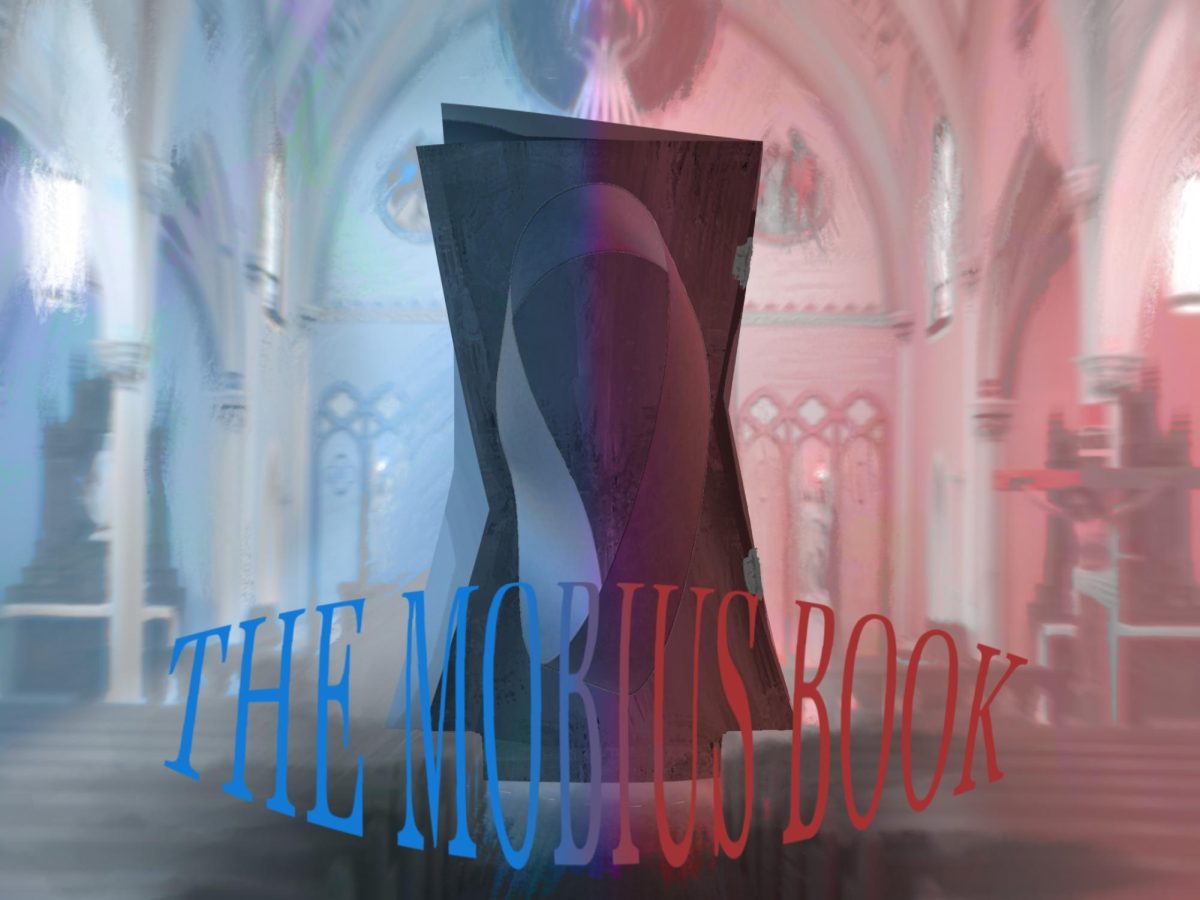
When I was given The Möbius Book by Catherine Lacey, I didn’t quite know what to think of it. It didn’t give me much at all to think about from a cursory look. There were no reviews or descriptions on the back. Just a repeat of the front cover, upside down. There was minimal information in the inside cover, too, though enough to understand that it was written after the author experienced a particularly messy breakup in 2021.
That’s not remotely the whole story.
Yes, a bad breakup in 2021—with someone who Lacey only calls The Reason—is important to understanding The Möbius Book, but it is only one of two threads that tie the story together. The other is an experience Lacey had in her teenage years that led to the loss of her faith in God.
“Isn’t there a smug indifference to the way Jesus hangs there on the cross?” Lacey writes on the subject, “as if he knows precisely what is going on and has already risen above it.”
These two threads are explored through a series of smaller anecdotes, some of them seeming completely disparate on their faces, but all of them helping the reader to understand the impact of Lacey’s loss of both faith and love on a more extensive level.
However, in all of these stories, for some reason—and this was my primary gripe with The Möbius Book—Lacey seems to have a vendetta against quotation marks. When quoting (or even paraphrasing) someone’s words, Lacey seems to turn up her nose at using quotes, instead opting for italicizing the words. It’s a very strange decision, and although it did not make The Möbius Book all that much harder to read, it routinely confused me.
Regardless, The Möbius Book is paced exceptionally; I couldn’t put it down. I read the memoir in about two days, which is an impressive speed for someone like me, who tends to get distracted while reading by so much as a bird flying past my window.
It’s definitely worth giving a read, because its deeply personal story is something that can be applied to a whole host of other fragments of the human experience, even if you’ve never necessarily lost your faith or experienced a messy divorce.
Then you turn the book upside-down and start to read it from the other end.
***
When I started The Möbius Book by Catherine Lacey, I felt like I already knew what I was getting into. I had already read 125 pages about the book’s inception, after all. Understanding the circumstances of the book’s creation did not mean I would expect the direction it would take.
The Möbius Book is a novella wherein long-time friends Marie and Edie chat in the former’s apartment after she gets in some very hot water with one of their mutual friends. It’s also about a pool of blood spilling out of the neighbor’s door that they don’t talk about much for some 70 pages, and a dog that gives Edie cryptic but potent advice like “humans have needs and when their needs are met, sometimes they call it love.”
The novella is mostly structured as a single conversation. The two spend all 88 pages in the apartment, talking about what went wrong with Marie’s relationship (and Edie repeatedly butting in to talk about her sex life). Through this structure, a myriad of anecdotes from a myriad of places are explored, making the whole novella simultaneously one scene and several separate scenes.
There is also a puddle of blood pooling out of the door of the next apartment over. Neither Marie nor Edie mentions it for some time, despite Marie observing it before she enters her apartment.
In fact, the blood pooling out of the apartment is described incredibly viscerally: “Blood. It could be nothing else. The body recognizes its filling with no effort. A smell. A heavy sheen. Maybe even a low-frequency sound picked up by her body hair.”
Despite the ever-present blood, Marie’s breakup is the looming threat that actually underscores the story. It’s the thread that ties everything together, making The Möbius Book about more than a winding conversation about nothing in particular.
The Möbius Book doesn’t solve all of the problems posed from page one. This is a risky tactic to use, as many authors before have tried it and probably most of them have not pulled it off well. Given The Möbius Book’s themes, though, perhaps it’s better that way.


[email protected] • Dec 2, 2025 at 2:02 pm
I don’t think that I can give an informed statement as to whether or not I agree with Liam’s perspective on this book because I have not read the book, but his thorough explanation of his reasoning lends credibility to it in my mind. I really liked the quote about Christianity from Lacey’s book that Liam included – that and the book’s commentary on love make me want to read it. On the other hand, I often dislike books that contain as many absurd elements as this one does.