
















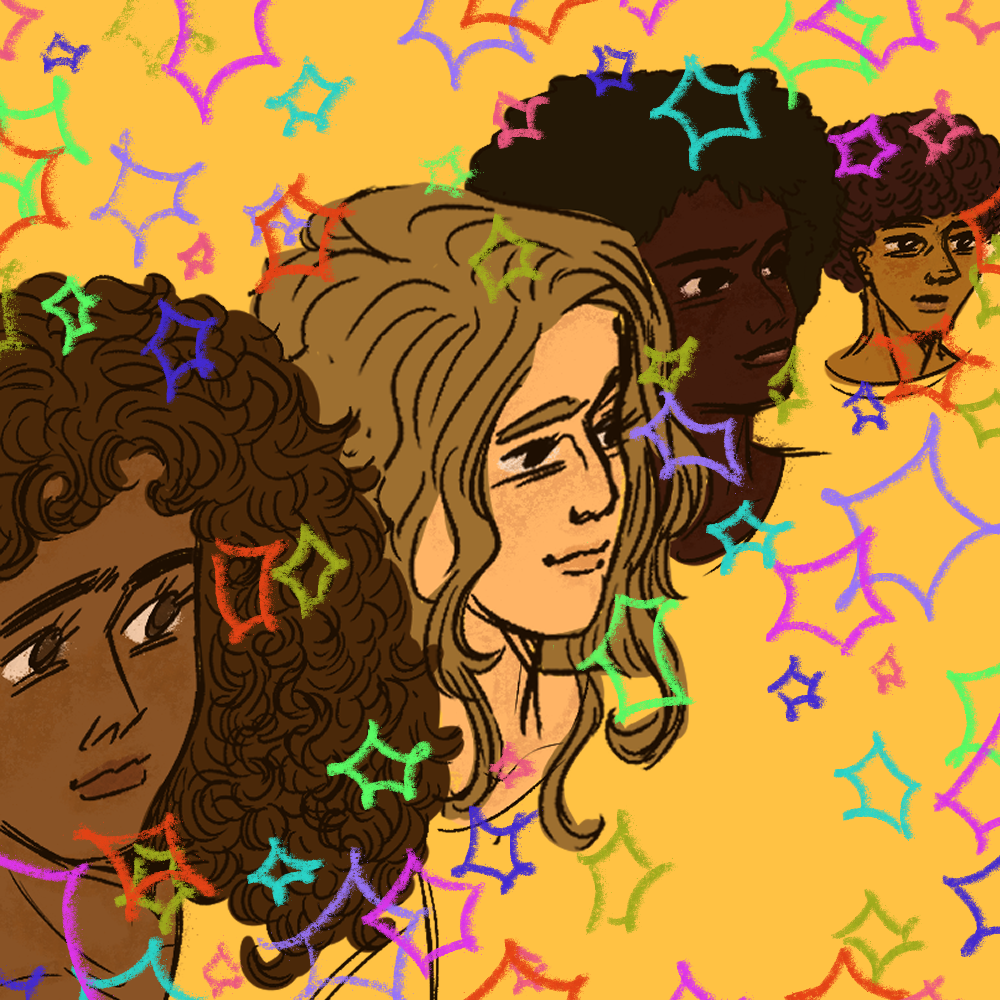
Texturism is defined by Forbes as discrimination based on the texture of someone’s hair. More often than not, texturism is targeted at individuals with coarser hair types, such as 4a, 4b, and 4c hair. While texturism can affect people of many racial backgrounds, it disproportionately impacts Black individuals and people of color, whose natural hair textures are often deemed “unprofessional” by Eurocentric beauty standards.
At its core, texturism operates on the belief that hair textures closer to “whiteness” –meaning straight or loosely textured hair, commonly referred to as type 1 hair–are more desirable, acceptable, or beautiful.
Discriminatory action based on an individual’s hair is what led to the CROWN Act in 2022, which prohibits discrimination in the workplace based on the appearance of someone’s hair.
The idea that certain hair textures are inherently better than others is not a new or modern issue. It is deeply rooted in historical systems of racial classification and oppression. The modern day hair typing system, which was popularized by Andrew Walker, has its roots in the practice of Eugenics, a wildly problematic system of racist pseudoscience.
The Andre Walker Hair Typing System has its origins in Nazi Germany and was originally adapted by Eugen Fischer as a way to gauge an individual’s proximity to whiteness. Fischer was a leading researcher in the field of eugenics, a now-discredited school of thought that gained popularity in the late 19th and early 20th centuries.
Eugenics promoted the idea that intelligence, morality, social status, and even physical attractiveness could be genetically inherited traits. As a result, people tried to select for these traits through selective breeding to create a “superior” human race.
This ideology was used to justify horrific human rights abuses. Under eugenics-based policies, marginalized groups were subjected to sterilization, marriage prohibitions, segregation, institutionalization, and in Nazi Germany: mass murder. Eugenics framed physical traits as moral indicators, reinforcing the idea that people who looked different were inherently inferior.
Although eugenics has long been discredited as both scientifically false and ethically wrong, its influence lingers in modern culture in different ways with varying degrees of subtlety.
Eugen Fischer’s hair classification system was clearly flawed and problematic, but it was reinvented by renowned hair stylist Andre Walker as a way to identify someone’s curl pattern and choose hair products accordingly.
Walker’s intentions were not rooted in discrimination, but rather accessibility and practicality. He was able to take something with a terrible historical past and rework it to be a helpful tool. However, the structure of the new hair typing system does still reflect an implicit hierarchy that mirrors older ideas about desirability and “manageability”.
The Andre Walker Hair Typing System divides hair into four main categories: Type 1 (straight), Type 2 (wavy), Type 3 (curly), and Type 4 (coily or kinky). Each of these categories is then divided into further broken-down subcategories labeled A through C. A represents looser or finer textures, while C represents tighter or thicker textures. In theory, this system is helpful to people in finding products and routines that work best for them and their specific hair type.
In practice, however, the system is often misused. Hair types closer to Type 1 or Type 2 are frequently praised as “easy,” “soft,” or “ideal,” while Type 4 hair is stigmatized as “difficult” or “high maintenance.” Even hair care brands that market themselves as being “for” textured hair sometimes show prejudice towards straighter hair types.
For example, the brand Shea Moisture sells a hydrate and repair shampoo marketed towards straighter hair types for $10, and a curl stretch shampoo for $12. This may not seem like a significant difference in price but it is small details like these that reinforce texturism, even when people do not intend to.
Finding a curl routine that actually works for your hair can be extremely challenging, and often emotionally exhausting. Hair is deeply personal to an individual; it is one of the first things strangers notice about you and it plays a major role in how people develop their own self-image.
Everyone’s hair is unique and has unique needs; some people require heavy moisture and frequent conditioning, while others need lightweight products to avoid buildup and weighing down their curls. There is no universal “best” hair care routine; there are tons of great products out there and everyone can find their perfect combination through trial and error.
However, this trial and error process can be challenging and can lead to frustration, insecurity, and even shame. Amy Newman, upper school art teacher, recalls her own experience growing up with 2b hair. Newman said, “I grew up at the beach, and you know what humidity does to hair with a little curl in it. I lived with extremely frizzy hair for a long time and didn’t know what to do with it; people made fun of me for it. Someone freshman year of high school even called me ‘hair.’”
Experiences like this are unfortunately rather commonplace. Many people with textured hair grow up believing that their hair is something to be “tamed” or controlled instead of embraced. Straightening, brushing out curls, and hiding volume can seem like the only solution to someone with no resources for learning how to properly take care of their curly hair.
Despite how overwhelming the process can feel, finding a routine that works can be incredibly empowering. Learning how to properly care for your hair often leads to a sense of confidence that goes far beyond appearance. It can feel like reclaiming and embracing a part of yourself that you were once taught to hide.
In recent years, TikTok has played a major role in this shift to embracing curls and voluminous hair. TikTok is a widely popular social media platform built around short-form videos, making it an ideal medium for tutorial-style videos. Users, especially teenagers, turn to TikTok for help with skincare routines, makeup techniques, study tips, and even hair care.
Ashya Farahi ‘26, who has long 2c curls, said, “I use TikTok when I need new products or I am struggling with a current [curl] routine.” For many students, TikTok has become a primary source for beauty education, something previous generations often learned through family members or hairstylists.
Addison Copeland ‘28 and Logan Copeland ‘26 both said they rely on their mom for advice about their curls. However, not everyone has access to someone who understands curly hair care. For those individuals, TikTok can fill a significant gap in hair education. Natalie Kovalenko ‘26 said, “Healing my hair and learning how to care for it on TikTok encouraged my mom to grow hers out again and embrace her own hair.”
Around 2020, a niche on TikTok commonly referred to as “CurlTok” exploded in popularity. The timing was not coincidental, as during COVID-19 lockdowns many people stopped using so many heat tools and had more time to focus on experimenting with new hair routines and products. CurlTok became a space where creators shared routines, product reviews, styling techniques, hair-healing journeys, and encouragement.
TikTok has helped a lot of people embrace their natural hair by being knowledgeable about their hair type and proper methods of care. Paige Johnson ‘26 has 3c curls and said, “I felt insecure about my hair when I was younger because I was mainly home with my dad while my mom was at work, and he would try to do my hair but he could never do it properly. My mom has had to straighten her hair a lot for work so I never learned how to properly do my hair or take care of my curls, because she never wore her curls.”
Johnson said, “Honestly, I follow a lot of curly hair influencers; TikTok has had a pretty big impact on how I treat my hair. They have taught me what products to avoid and what techniques to use. I’ve found a lot of different routines there.”
Several viral trends emerged during this time. The “Bowl Method” became widely popularized by @curlyzia.xo and involved dunking the hair into a bowl of cold water after applying the product in order to evenly distribute moisture and reduce frizz. @kianadalleave introduced “finger curling” as a technique where individual strands of hair were wrapped curled using two fingers in order to create defined ringlets.
Kovalenko said, “I learned how to finger curl from a TikTok.”
Influencers also played a major role in promoting specific curly products. @itsgretawilson created a viral curl routine using only Not Your Mother’s hair products, which many viewers recreated on themselves. Merian Odesho, founder of the popular brand Bounce Curl, used TikTok to demonstrate products like her EdgeLift Brush and satin bonnets.
The cultural impact was undeniable; people began embracing their natural hair textures. Even in just the last 120 days, the phrase “for curl hair” saw a 181.82% increase in popularity on TikTok, highlighting the platform’s influence on beauty standards. While TikTok is far from the only learning resource available, its accessibility makes it especially powerful and impactful.
Popular culture even began to idolize certain celebrities for their hair, such as the Kalogeras sisters, who are known for their long, voluminous curls. Old images of Julia Roberts have been recirculating as well, specifically circa the early 90s when her curls were big and loose, seemingly like a 2b/2c curl pattern.
One of the most positive aspects of CurlTok is the idea that there is no single “correct” routine. Logan Copeland said, “I shampoo three times a week and conditioner every day. I use a leave-in conditioner most days and a paste for more formal events.”
Meanwhile, Malea Musonge ‘27 said, “I braid my hair at night and moisturize it.”
Newman explained her routine as, “…wash and condition, towel dry, curl cream, scrunching, then diffusing…” while Jahz Gray ‘28 said, “I use Skala in my hair because TikTok said it was good.”
These routines all differ widely, yet all are valid and yield good results. That diversity is what makes CurlTok valuable.
However, like most trends, CurlTok has a darker side as well. The rise of the so-called “curl police” has introduced a new form of gatekeeping. Curl policing refers to the act of criticizing someone, typically online, for using the label “curly hair,” particularly when they have looser textures such as 2b, 2c, or even 3a hair.
These comments often accuse people of “forcing curls” by using curly hair products. However, this argument holds no authority because no amount of curl cream, mousse, or gel can create a curl pattern in hair where none exists. Products can enhance existing texture, but they cannot alter the structure of the hair follicles.
Hair texture is determined by genetics and biology; curly hair is considered to be a dominant trait while straight hair is recessive. The shape of the hair follicle plays a crucial role in hair texture: round follicles produce straight, while ovale or asymmetrical follicles produce waves, curls, and coils. Keratin also matters; uneven keratin distribution causes the hair to bend and spiral, while even distribution leads to straighter hair strands.
Curl policing often resembles cyberbullying, taking the form of rude comments, dismissive videos, and judgemental rants. While there is a legitimate distinction between wavy and curly hair, the hostility surrounding that distinction raises the important question: why does it matter so much?
Kovalenko summed it up simply: “I feel like girls should be embracing each other’s hair, not putting them down by depicting whether or not they have the ‘correct’ curl.”
I personally have 2b hair and consider it to be wavy rather than curly. When I was younger, I brushed my hair out every morning, not realizing that I was just causing excessive frizz and volume. I didn’t know what my hair type was or how to care for it, until I learned through TikTok.
CurlTok has been able to create and spread a lot of positivity to people with curly hair. So many individuals have shared their “hair healing” journeys of how they have used different products and routines to not only repair damage done to the hair by excessive heat and trying to fit into Eurocentric beauty standards, but also their personal stories of growth and learning how to love their curls.
The curly hair community already faces enough external pressures because of Eurocentric beauty standards, creating division within the community only perpetuates more harm. Why are we criticizing people for learning to love their natural hair, when we could all be celebrating and helping one another?
The slight distinction between curls and waves should not be enough of a hot press issue to create such a divide between people; especially when we are all using the same products, trying the same hair routines, following the same influencers, and facing some of the same challenges with our hair. Farahi put it best: “Why does it matter?”
Precilla Tapia • Mar 9, 2026 at 9:07 pm
This article makes me feel connected to others with curly hair. My curly hair journey was a long, bumpy road, and I finally figured out the key to healthy, bouncy curly hair. After endless TikTok hacks and tips for curly hair and different products i finally came up with something that suited my 3a hair. I did see a lot of judgment with people without curly hair on TikTok on how “finger coiling” was forcing your curls when in reality if the curl stays and remains shape thats not forcing a curl thats enhancing it. My hair routine starts with Camille Rose hair milk, followed by Skala and brush styling, and lots and lots of water. Curls need hydration. After that i diffuse my hair until at least 50% dry, and when it is dry i plop it up in a scarf and bonnet overnight, and in the morning i go in with an oil to break my gel cast. The way my hair looks when I wake up does depict my day because if I put in all that hard work just for it not to look good, it makes me upset.
Aila Carvalho • Mar 9, 2026 at 9:48 am
I think the “curl police” can be extremely damaging to the confidence of many young girls and women who are just trying to do their hair the way they please. I, for one, have experienced every kind of curly hair origin story, like straightening too much, wetting it every day, and getting haircuts that didn’t suit my texture. Sometimes my hair is too curly for one “hair type,” and sometimes it’s not curly enough. Because the way to identify curl types isn’t consistent everywhere you look, varying answers are bound to pop up. My hair completely impacts how my day goes, because I have thick, dark, coarse, curly hair. If my hair is bothering me, I’m upset for the rest of the day. I was never taught how to manage hair that weighs the same as a small dog, and for the most part, I’ve had to learn on my own. Sometimes I get weird looks when my hair is frizzy, big, or parted wrong, and it makes me want to hide it even more. It’s hard to accept that curly hair can look a million different ways in one week: some days it might be short and defined, and others it might be long and frizzy. It’s been a challenge learning to deal with stares when my hair doesn’t look “normal”. Overall, I think the curl police is just another way of putting women in a box.
Nalani • Mar 10, 2026 at 9:40 am
I completely agree Aila. As someone who doesn’t exactly of a “curl pattern” I have experienced people coming at me for saying that my hair is curly instead of using the words coil/kinky. I find it completely disgusting how people put worth behind the type of hair you have. This “curl police” is just one example of how the media turns people against each other. Not only does it foster false beauty standers but it can be completely racist/prejudice. I think that the “curl police” definitely put girls down and needs to be stopped.
Lauren Margarette Washington • Mar 9, 2026 at 8:30 am
How does the article make you feel? Do you see judgmental discussions about hair types on TikTok and other social media apps? What is your hair routine? (Sam and Rainy) Does the way that your hair looks impact whether or not you have a good
Hi Oonagh! This is a great article. It makes me feel educated about your unique topic after reading it. Often, I do see judgmental conversations about hair types on Tik Tok specifically pertaining to African American women usually. The comments tend to tell them what products they should use and what curl pattern they have (4a, 4b, 4c). Plus, I really liked how you cited tik tok comments as your evidence to back your opinion.
Una Davis • Mar 6, 2026 at 3:19 pm
I think I have been through every stage of the curly hair discovery process: frizzy and frustrated, a high ponytail every day, overly moisturized, and acceptance. Or, of course, the attempt at acceptance. Every woman on my dad’s side of the family has hair like mine, yet i am the only one who treats it the way I do. My aunt and grandmother blow dry their hair after every wash. My aunt even used to perm her hair to get it to be curly, when I am sure, with the right routine, she’d have a similar wave pattern as me. I used to feel I was defined by the definition of my curls, (or waves really, if we wanna talk about the curl police). Recently, I have been trying to accept my hair on day 2 and 3, letting the waves do what they will even after the initially styling has faded.
Neiko Savior • Mar 6, 2026 at 10:01 am
I see judgmental things about hair on TikTok all the time. I feel like TikTok has honestly helped me with my hair. It kinda helped me form my curly hair routine when I wear my hair curly, or helped me find different hairstyles to wear. I think that curl police on TikTok take things a bit too far. But I do agree that if your hair can hold a curl, it’s curly. There has also been a lot of talk about bonnets. Bonnets have just become known to protect hair, specifically curly hair, when sleeping, and the argument against bonnets being “ghetto” is always discussed. Many conversations are about how, when black people and women started wearing bonnets, they were called ghetto, but when it became a trend on TikTok, it was liked and supported by people of all colors and hair types. I think it’s all stupid and people should just do what they want.
Dillan • Mar 6, 2026 at 9:08 am
I greatly appreciated the insight this article offered into the history of the hair typing system, as well as the representation of people with a wide range of hair types and their unique experiences. I blow-dried my hair after every wash until I was eleven years old. My hair became thicker and curlier as I got older, and I began to wear it naturally more often to save time. TikTok provided me with tons of information on how to style my hair and what products to use according to my hair type; to this day, I rarely straighten my hair, and I continue to improve upon my curly hair routine through tips I pick up on social media (as well as trial and error). I have also noticed the prevalence of the “curl police” on TikTok, and I agree with the article’s perspective that it is counterproductive. I do not see a reason to shut others out of the online curly community. Instead, we should be lifting each other up and providing support.
Anjali Holloman • Mar 5, 2026 at 1:15 pm
I like this article’s discussion about the recent rise in acceptance of curly hair. I see lots of judgemental discussions about hair types on social media, and I don’t understand why people are always in other people’s business. Most of the time, because its easy, I straighten my hair. But, because people have started promoting wearing hair naturally, on rare occasion I will wear it curly. I shampoo and condition my hair, and then add leave in conditioner and let it air dry. I do think the way my hair looks impacts whether I have a good day. When I wear my hair curly it overstimulates me, and I always wish I had straightened it. When my hair is freshly washed and blown out, I feel more confident which then in turn makes my day better.
chloe collet • Mar 5, 2026 at 9:57 am
This article makes me feel very engaged because of its writing style. I think the topic of hair is very topical, but not talked about enough. Social media has definitely become a huge help for people with a variety of hair types, as many wouldn’t even consider the methods found on TikTok, especially for themselves. I liked how you wrote about the bigger conversation this creates, particularly the external pressures on the curly hair community due to Eurocentric beauty standards, as I think a lot of people just gloss over this part because it doesn’t affect them. The article’s detailing of the personal journeys many people have taken with their hair makes it more engaging as well, thanks to the emotional detail.
Aarohi Sanathara • Mar 4, 2026 at 8:34 pm
When I wore my hair natural to school for the first time (in middle school), a person in my class asked if I’d curled it. When I said no, they didn’t believe me. It felt strange to have people doubt that my own hair had history and culture, both of which belong to me, but that’s the reality of growing up with a “confusing” pattern. I originally had tight curls (3b-3c), but after shaving my head for a religious practice, it grew back straighter, finer, and lighter. My mom, who has type 3 curls but always straightened her own, treated my hair the same way, blow-drying it weekly without heat protectant. I’m lucky it isn’t fully damaged, but my pattern is definitely stretched out. Some days it’s curly; others, it’s barely a wave. This “in-between” state makes me hesitate to use the word “curly,” especially with the “Curl Police” gatekeeping on TikTok. While I love the new spotlight on Indian haircare, the policing of hair types needs to stop. Just as Moore describes the harm of texturism against coarser textures, my experience shows how gatekeeping also hurts those of us trying to reclaim a curl pattern lost to heat or cultural expectations.
Natalie Kovalenko • Mar 4, 2026 at 2:52 pm
The article makes me feel like I am not the only one who feels pressured at time sot embrace my hair. I have personally struggled not only with feeling comfortable in my natural hair but also with maintaining it. I constantly see judgmental comments online about whose hair isn’t curly, whose is, whose routine is good, whose isn’t, and all this pressure greatly affects a large portion of the curly-haired community. There are times when I feel immense pressure to have my hair completely defined, with no frizz, perfect coils, and just the right amount of volume. Having these constant worries doe sin fact, significantly impact my day, because if my hair is not up to par that day, I might as well go home and redo my hair.