











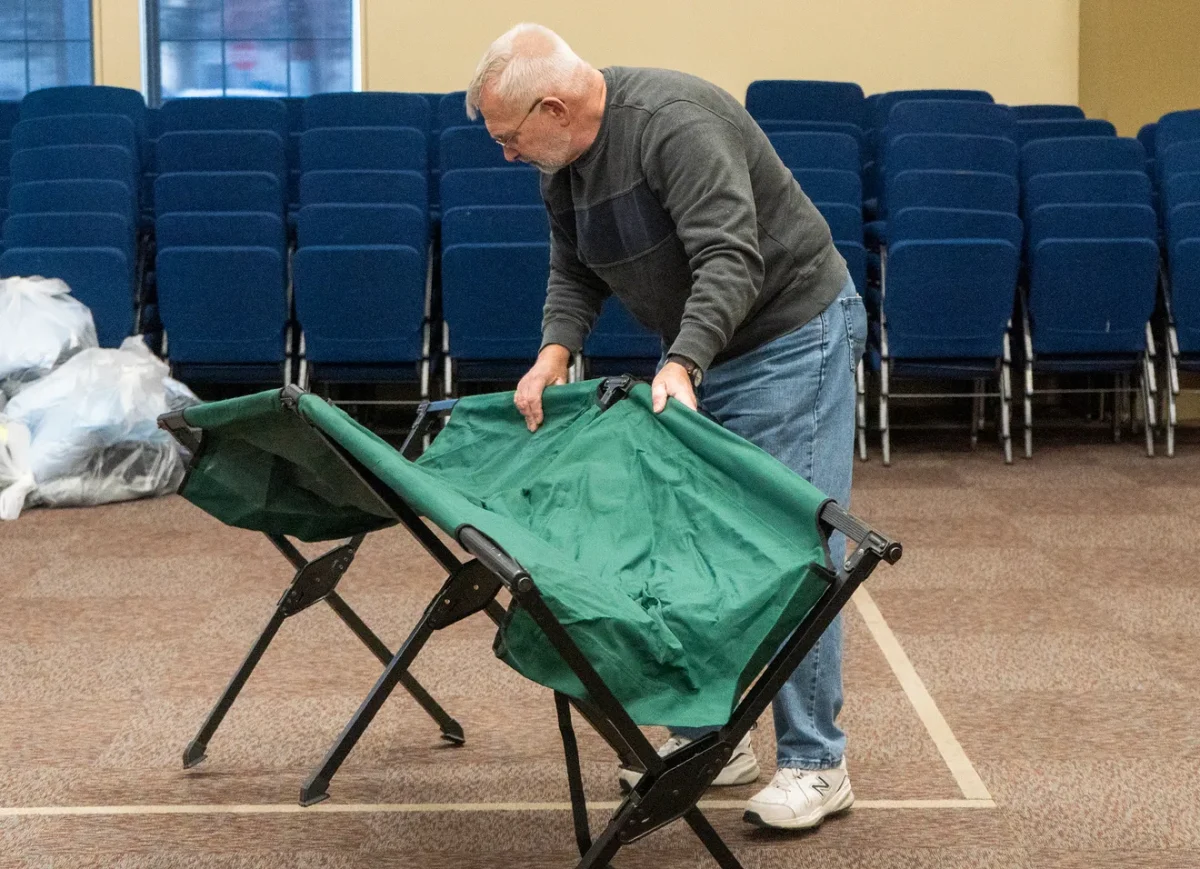
By the time the doors open at the Norristown Hospitality Center, it is already dark out. Volunteers file in carrying folded cots and plastic bins, moving furniture out of the way and lining the walls with the temporary beds. One by one guests file in.
Amongst them is a woman. She pauses just inside the doorway, still seeming unsure of her presence in the building. She hands over two plastic bags, both stretched thin enough so the store’s label is distorted beyond immediate recognition. When asked what she wants to keep with her for the night, she hands over her beaten purse for inspection before making her way over to her cot, tucking the handbag under her pillow before lying down, without ever saying a word.
The wind coming off the Schuylkill has a way of finding every gap in your jacket. In Norristown, it is the kind of cold that makes you unwilling to readjust your jacket, and freezes your throat just by breathing. It sinks in slowly, working its way into fingers and joints before you realize how long you have been standing still. Hot chocolate is often the solution to these freezing times, but people usually forget or do not realize what it means for someone who does not have a door to close behind them.
On nights when the forecast drops and stays there, the question is not how cold it will get, it is who gets inside in time.
At the Norristown Code Blue shelter, that question often turns into a logbook stationed just inside the door. Names are written down. Arrival times are noted. Volunteers filter in wearing winter boots and heavy coats. Cots and mats are unfolded and lined up across the floor. Valuables are collected and locked away. Coffee is brewed as the night stretches on. When the system works the way it is intended to, the result feels simple. Warmth. Light. A place to sit without being told to move along.
But the system that makes it appear simple is anything but. A shelter can be fully prepared and still not open for the night. A church can have space and supplies but not enough people to staff it. Outside, the bitter conditions do not care whether the final volunteer shift got filled or not.
In Montgomery County, a Code Blue cold weather emergency is officially declared when the overnight temperature is expected to feel like 32 degrees Fahrenheit or below for two or more hours. That threshold exists because those conditions can quickly become dangerous, even deadly, for people with no other option but to sleep outside.
When a Code Blue is declared, the county publishes instructions online detailing where people can find shelter and urges residents to act if they see someone in immediate danger. The system is designed to move quickly, but it still relies on coordination, staffing, and people being available at the right time.
Across the region, Code Blue does not always mean the same thing. In Philadelphia, the declaration is tied to a lower “feels like” temperature, near or below 20 degrees Fahrenheit, and triggers a broader response with additional city run shelters and outreach teams. On paper, the distinction makes sense.
In practice, both systems face many of the same problems. Reports of insufficient bedding, limited transportation, and a persistent lack of volunteers are common. Some Code Blue shelters state plainly that if shift slots are not filled by a certain deadline, the shelter will not open that night, even if outdoor conditions clearly call for it.
When Code Blue works the way it is supposed to, it gives people who are forced to stay moving a break. It offers warmth and a place to sleep, but it also offers relief from constantly being told to leave or move on. For a few hours, people are allowed to stop and exist without pressure.
“For a lot of people, this is the only place all night where no one is telling them to go somewhere else,” says Code Blue volunteer Nikia Burch. “Even just being able to sit down and not worry for a few hours makes a huge difference.”
Norristown sits at the center of Montgomery County’s homeless response network. Many warming centers branch outward from the borough, making it a hub for both volunteers and guests coming from surrounding towns. Because of that, the Norristown Code Blue shelter often serves people far beyond the immediate area.
Recently, along with several shelters across the county, the Norristown location has had to keep its doors locked on nights that clearly called for aid. For people who rely on these programs, that uncertainty can be as damaging as the cold itself.
Most Code Blue shelters in Montgomery County operate out of churches, synagogues, or community centers. The spaces are donated. The times are donated. Cots and supplies are stored away during services and events, then pulled back out when temperatures drop. Food often comes directly from the kitchens of volunteers.
This crowd-run model allows shelters to operate without direct government funding, but it also means they rely almost entirely on unpaid labor. As the number of people willing or able to volunteer declines, so does the reliability of the system meant to protect the unhoused population.
Until last year, the Norristown shelter was operated by a different organization. When TLC for the People took over operations, many of the current volunteers remained, bringing experience and familiarity with the space. Several described the transition as necessary but challenging, as policies were adjusted and procedures clarified, while trying to maintain consistency for guests who rely on routine. The continuity of volunteers helped ease that shift, but it also highlighted how much the shelter depends on a relatively small group of people returning night after night.
“One of the hardest parts is telling someone it is not open tonight,” Burch said. “[They ask], ‘Where do I go now? How far can I walk? What do I do until morning?’”
Those questions land the hardest on nights when temperatures hover just above freezing. Cold enough to be dangerous over long periods of time, but not always cold enough to draw public attention. In those conditions, hypothermia can set in quietly, especially for people who are already mentally and physically exhausted.
It is 11:30pm by the time the knock echoes through the Norristown Hospitality Center. A young man stands patiently outside in the sub-freezing temperatures, wearing at least two visible jackets on top of a worn sweatshirt. Policy states that guests have to arrive before 10pm in order to be let in, but after a quick call to the nearby police station, the man is let in anyway.
After reluctantly giving over a bag that presumably contains his belongings, a cot is laid out near the wall. He carefully stretches his body out next to many other bundles of old coats and layered clothing. The room settles back into quiet, the silence only broken by the occasional turn of a page from the two volunteers seated nearby.
Montgomery County’s most recent evaluation suggests that hundreds of people experience homelessness on a given night, with many more cycling in and out of unstable housing throughout the year. Some live outdoors. Others sleep in cars, abandoned buildings, or places not intended for living.
Code Blue shelters are designed to catch people at the most dangerous moments, but that safety net weakens when opening each night becomes uncertain.
For volunteers, the work can feel both urgent and repetitive. Each winter brings the same scramble to fill shifts, the same last minute emails asking for one more person. Each season raises the same question. Why does an emergency response depend on whether enough people are free on a random weeknight?
One reason Code Blue shelters struggle to open has little to do with apathy and much more to do with logistics. Volunteering is not as simple as showing up when it is cold. First time volunteers must request a Pennsylvania criminal background check, review and sign a code of conduct, create a volunteer profile on a third party platform, download WhatsApp for communication, and attend a required training over Zoom. While each step exists to keep safety and coordination balanced, the process itself can discourage people before they ever sign up for a shift.
“We absolutely want people to help,” Burch said, “but there are steps we just cannot skip.”
She acknowledges how long the process can take, noting that in the past, willing volunteers have been turned away due to incomplete clearances or past criminal history.
During Code Blue declarations, emails sent to volunteers often carry an urgent tone. Availability is requested hours before opening, sometimes even after doors are supposed to open. A single missing name on a sign-up sheet can mean the difference between opening the shelter or keeping it closed.
For new volunteers, especially younger people, the responsibility can feel overwhelming. Overnight shifts require commitment and reliability. If someone does not show up, volunteers from previous shifts are expected to stay longer. In some cases, that has meant working from late evening through early morning. According to volunteers, situations like this have led some people to step away from the program entirely.
The consequences of these shortages extend beyond a single night. Outreach workers note that when shelters fail to open consistently, trust in the system erodes. Planning becomes impossible. Some people stop checking altogether. Others walk long distances to shelters that may or may not be unlocked when they arrive.
Another common issue is the hard deadline for entry. Because the shelter has no exterior windows, volunteers cannot see who may be waiting outside once doors are locked. If someone arrives after the cutoff time, the only way to be let in is to call the local police department through a non-emergency number, so an officer can come and unlock the door.
“It is a tough rule,” one volunteer explained. “We cannot just open the door for safety reasons, but asking someone to call the police when they are already cold and stressed is not easy either.”
Despite the rule, exceptions are sometimes made. Volunteers acknowledge the moral weight of the decision. If you see someone at the door in that kind of weather, one volunteer said, “What are you supposed to do, leave them to freeze?”
As winter deepens, those decisions become even heavier. In late January, TLC for the People began preparing for a major snowstorm expected to impact the Philadelphia region. An email sent to volunteers outlined plans for a full day and overnight stay to reduce travel risks and keep the shelter operational. The organization asked for ten volunteers willing to remain on site for twenty-four hours, offering a small stipend and meals in exchange for the commitment. The message made clear that the plan depended on quick responses and coordination with the county, underscoring once again how fragile the system becomes when weather, timing, and availability challenges collide.
For the people who stay here, Code Blue is not a permanent solution, it is simply but a pause. It does not fix housing, employment, or health. It just interrupts the worst of the night. When it works, that interruption can mean the difference between spending the whole night moving in order to stay warm, and getting the rest they need.
Volunteers say that they will be back the next time the temperature drops low enough, and most of the guests will return as well, that is if the door can open. Others will simply not risk the commute back in fear of being turned away. As this cold winter drags on, the Code Blue shelter continue to do their best to operate during the times that they are needed most, an unstable routine acting as a temporary cure for an ever-growing modern issue.
By the time the sun has risen, the room looks much different. Cots are folded back up and stacked against the wall. Coffee cups are thrown away, and “guests” who spent the night inside gather their things from the lockboxes and filter out the center’s doors, back into the cold. There is no formal ending or announcement, no clear ending to the night, just a few volunteers cleaning up and storing the various cots and tables back into a nearby closet. If all goes well, the shelter will be able to open the next night, but for now, the brittle sidewalks look the same as they did the day before.
Molly • Mar 5, 2026 at 5:03 pm
Thank you so much for writing this! I feel that it is so important for people to recognize the value of volunteering, as, just like you referenced in the case of Code Blue declarations, every act of volunteering can directly effect a person in need, in a small or large way. For the past few months I have been volunteering at Cradles to Crayons, a non profit dedicated to helping children in need overcome clothing insecurity, and gain clothing, hats and gloves to ensure their confidence and safety does not waver. Throughout my time volunteering, I have felt deeply connected to my community. Weather I am meeting new volunteers, or leadership teams in the workshop it is clear that there is dedication to helping others. I feel that your article highlights just why we need volunteers, and the push for more adults and high school students alike to volunteer their time.
Liam Hilliard • Mar 4, 2026 at 2:39 pm
As I read this article, I found myself thinking about how often volunteers get overlooked. This, to be clear, is something that I’m also guilty of, but I never really thought about it. Volunteer work like that really doesn’t get thought about, which leads to people not really doing it, which leads to less in the way of volunteer work getting done because it’s just not thought about as it should be. It’s somewhat of a vicious cycle. To that end, I think the city needs to promote things like this a little bit more. Maybe I’m just not paying enough attention to local goings-on, but I don’t think I’ve ever seen any talk of Code Blue shelters or their understaffed nature, which, should that not be a me thing, likely contributes to a lack of volunteers.