
















As generative Artificial Intelligence (AI) tools become increasingly prevalent in the world, schools, teachers, and students are tasked with thinking about how they navigate education, teaching, and learning in this time of shift in the technology landscape. How is the AFS community adapting, responding, navigating, and discerning– in a way that leans on our values as a Quaker school- the implications AI has for education? What do faculty teaching practices in the classroom look like and what are students’ prescriptions of teaching practices in the age of AI?
In thinking about these questions, I surveyed Upper School students in each grade and faculty across all three divisions to get a better understanding of the impact of AI on teaching practices and student experiences.
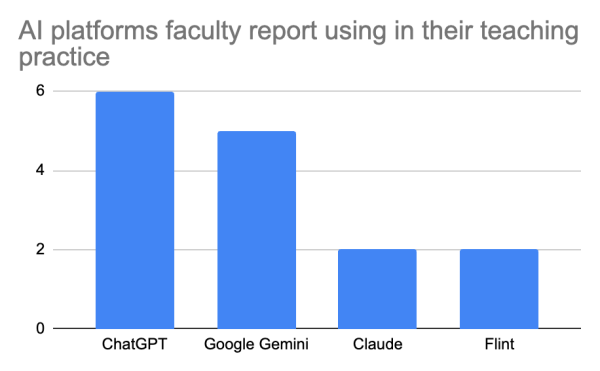
Collectively, out of a sample of 12 faculty members, multiple different AI platforms were used in teaching, though four faculty members reported not using any AI platforms in their teaching practice. Although faculty and staff have “full [Google] Gemini access through school accounts” , faculty have been innovating with other options, exploring ways to leverage AI to enhance student experiences as they see fit.
ChatGPT is the platform the majority of teachers use, with six teachers reporting using it, though Google Gemini is not far behind with five teachers reporting using it. Flint (an AI platform designed for teachers and education) and Claude are used by the least number of teachers with only two teachers reporting using each of them.
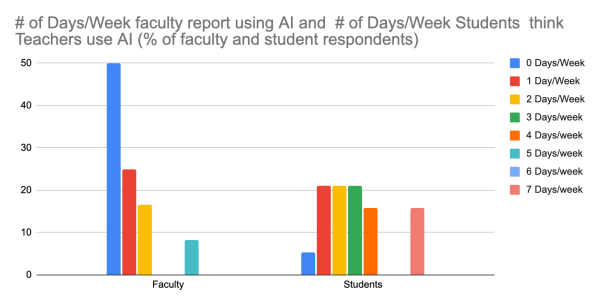
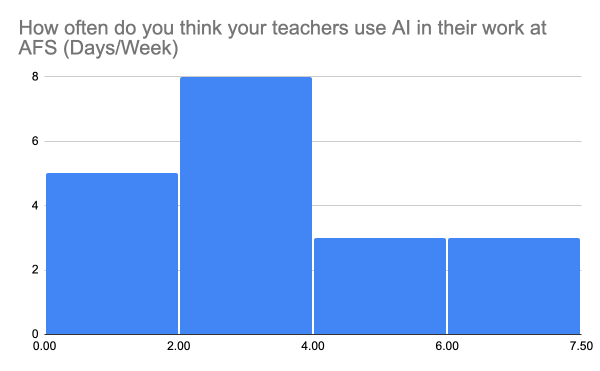
There is a clear discrepancy in the number of days students think teachers are using AI for their work as a teacher at AFS and how much teachers are actually using AI. On average students believed that faculty use AI three days per week while faculty reported only using AI an average of one day per week.
The sharp disconnect in how much teachers are using AI and how much students think they are using it is evidenced by only just over five percent of students saying they think teachers use AI zero times per week when 50% teachers report they use AI zero times per week. At the other extreme, 15.79% of students think teachers use AI daily, while zero percent of teachers actually reported using AI seven days per week.
Among faculty respondents there was a general mutual understanding that heavily using AI may decrease the quality of instruction and classes, which would certainly explain why faculty tend to use it much less than students might think.
As math and science teacher John Garnevicus said in reference to using AI in teaching, “Right now it feels like I can do something better than what it [AI] does and I think my students deserve that.”
| 0 Days/Week | 1 Day/Week | 2 Days/Week | 3 Days/week | 4 Days/week | 5 Days/week | 6 Days/week | 7 Days/week | |
| Faculty | 6 | 3 | 2 | 0 | 0 | 1 | 0 | 0 |
| Students | 1 | 4 | 4 | 4 | 3 | 0 | 0 | 3 |
Table displaying raw data of the number of faculty that report using AI a certain number of days a week on average and how many days per week students think faculty use AI
| 0 Days/Week | 1 Day/Week | 2 Days/Week | 3 Days/week | 4 Days/week | 5 Days/week | 6 Days/week | 7 Days/week | |
| Faculty | 50.00% | 25.00% | 16.67% | 0% | 0% | 8.33% | 0% | 0% |
| Students | 5.27% | 21.05% | 21.05% | 21.05% | 15.79% | 0% | 0% | 15.79% |
Table displaying how much faculty report using AI and how much students think teachers use AI
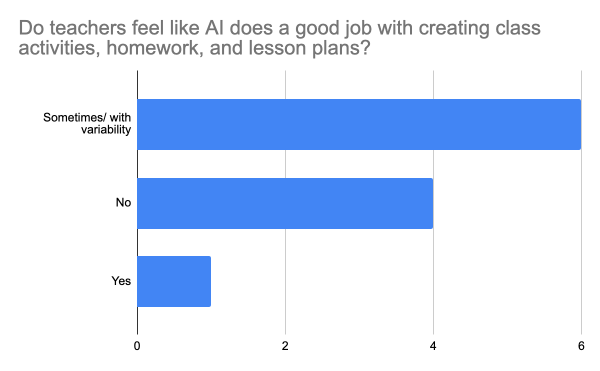
Quality of assignments and other curricular materials developed by or with AI seem to be delivering significantly worse instruction to students. The decreased quality of circular materials developed using AI is something faculty respondents came to unity on. Of the 11 faculty to respond to the question, “Do you feel like AI does a good job with creating class activities, homework, and lesson plans” only one teacher said “yes” with six saying “sometimes/witih variability,” and four saying “no.”
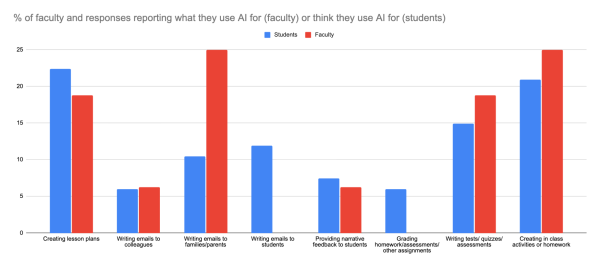
Students have a different view of what teachers are using AI for than what teachers have reported using it for. Zero percent of the total number of selections made by faculty in selecting all the things they use AI to do was represented by Grading, while grading made up 5.97% of student selections. Students also thought with much higher frequency that teachers were using AI to write emails to students (11.94% of student selections were represented in this category with 0 faculty selections for this category).
Many of the other categories of things teachers may use AI for boasted similar differences in percentages as the grading category.
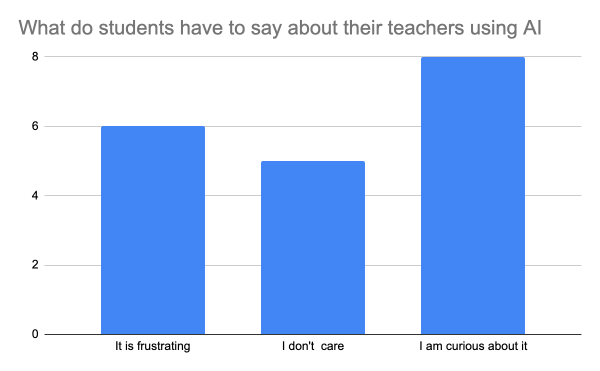
As with many shifts and changes in the educational landscape students may show some level of curiosity about what’s going on because these shifts can directly impact them. At AFS students show they are guided by the Upper School norm of “curiosity about learning and development” in how they are thinking about their teachers’ use of AI. Ultimately eight students said they were curious about their teachers’ use of AI while five students said they did not care and six students said it was frustrating.
Ultimately students do not think teachers should be allowed to use AI for creating assignments, grading, generating lesson plans, writing emails, and providing students with narrative feedback with six students saying teachers should be allowed to use AI and 13 saying they should not be allowed to use AI. While a large majority of students think that teachers should not be allowed to use AI, there are still definitely students who think teachers should be allowed to use AI.
Sam Calandra-Jayne ‘26 shared his perspective on teachers being allowed to use AI.
Calandra-Jayne said, “I think it is fine if they use AI to make HW assignments in something like math or history. I think if they do that they should just have to read through it to make sure it’s all questions we should be expected to know, nothing we are not expected to know. I don’t think they [teachers] should use it [AI] for grading or writing feedback.”

Wyatt • Feb 20, 2026 at 11:50 am
What surprised me in this article is that some teachers utilize more artificial intelligence than students while also being against the use of artificial intelligence. I was also surprised by the quote John said. Despite other teachers taking advantage of AI, he took a different approach, producing his own work and giving students what they deserve. I was aware of teachers using AI but, when they use the AI to make assignments, test, and more, they can get into a habit of using AI for more than just assignments. And its weird that we have all the meeting about AI, when the people who say to not use it, are using it.
carter • Feb 18, 2026 at 5:23 pm
I think this shows that Ai is already part of school, but people are still figuring out how to use it in a fair and helpful way. It surprised me that students think that teachers use AI way more than they actually do. That probably means there is not enough transparency about when Ai is being used and why. I understand why teachers are careful, because if AI makes worse assignments or lessons, that hurts learning. At the same time, Ai could still be useful for things like brainstorming ideas or saving time, as long as teachers check the work carefully. I also see why many students don’t want teachers using AI for grading or feedback. Those things feel personal and important, and students want real human responses. But completely banning AI might ignore some helpful benefits. A balanced approach makes the most sense, where AI is a tool but not a replacement for teachers judgment.
zhaoye wang • Feb 2, 2026 at 4:56 pm
Obviously, ai is just like a child now. Since its birth to now, there is less than 6 years. We should regard the ai as the view of development rather than refuse them like the horse rider refuse the cars.
Ai could do some boring, such as judge the multiple choices questions, do some jobs which is totally waste of time. People could save more time to do something valuable. As for teachers, they will have more time to foucus on designing the development of the whole class. With saying the general idea, ai will genarate the following instruction and fulfill the details. Teachers know what knowledge point is correct and which is not, they become the judge rather than people do the details. It will not only make teacher more productively but also let students get more knowledge than before.
Aila • Feb 2, 2026 at 1:58 pm
I have very mixed feelings on teachers using AI. If I am being penalized for using AI on an assignment, it feels counterintuitive to then be assigned a project entirely made by AI. I know teachers have a lot on their plates and I empathize with not always hvaing the time to complete everything you have to do. But if I’m going to get in severe trouble for using AI on an assignment, then the teacher shouldn’t use AI to make the assignment in the first place. Obviousl,y not all teachers use AI on their assignments, but sometimes it feels like I’m being taught not to do something while the person teaching me is doing exactly that. If I’m not getting in trouble for using AI to make a study guide for example, then I think the teacher can use it to. It seems unfair to get in trouble as a student for doing something teachers (sometimes) do too, when AFS preaches Quaker values and principles.
Avila Widestrom • Jan 31, 2026 at 2:40 pm
I thought the graphs throughout the article were helpful for illustrating what was happening without making empty claims, but I still feel there’s a disconnect between what students are experiencing and what teachers are saying. I’ve had teachers give me tests that were entirely ChatGPT, including ChatGPT-provided emojis for each question. I’ve also had emails that, not only on Saturday but also after being run through an AI detector, were 100% AI. I found this article interesting because it includes a percentage of the teachers’ use of AI. I still feel like it’s not an accurate representation of the entire teaching body.
Elise C • Jan 27, 2026 at 2:39 pm
In a time where artificial intelligence is circulating everywhere, I also think that its use can be taken into thought. In terms of when teachers use AI, I think that for grading it can be used as a companion but also with caution for scenarios that include e-mails and writing. In my math class, I have used an AI tool for assistance in some problems, and I found it useful for helping with homework and building concepts! So, overall, I believe AI use should continue at a smaller rate, focusing more on conceptual growth instead of essentially “doing the work for you” so that everyone (students and staff) can continue learning and pursuing their intellectual endeavors. 🙂