

















During English class just a few weeks ago, AFS students were given a small piece of paper asking the question of how students use AI in English class.
AI usage in the classroom has been on the rise, with an estimated 86% of students using AI for general use in the 2024-2025 school year, according to a survey by the Center for Democracy and Technology.
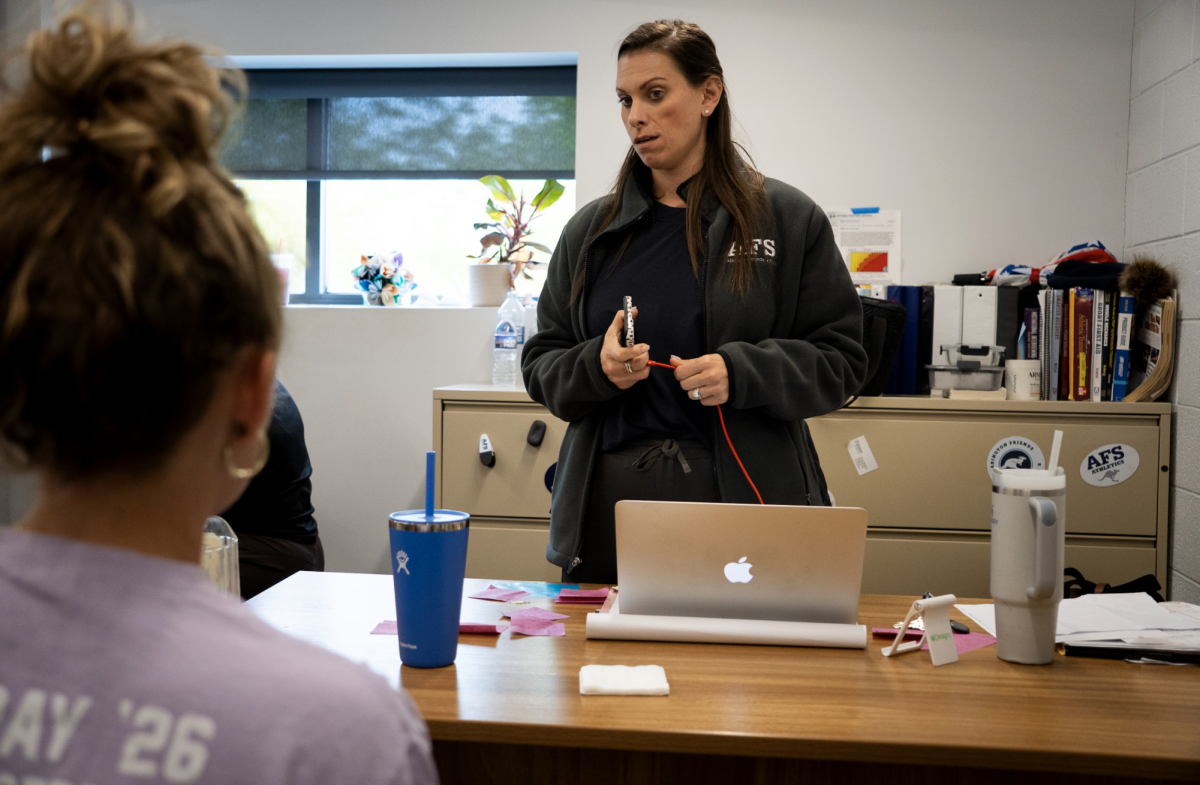
“We wanted to see what students were using AI for, because we interpreted that as a lack of confidence,” said English Department Chair Andrew Bickford. “We wanted to know… so that we could be better teachers, and teach students skills… that they were turning to AI for.”
Some students had a positive sense of AI usage in the AFS community. “I do think [students] use it for planning skills,” said Jarius Ford ‘26.
Sam Gillman ‘29 took a different opinion, saying, “Plagiarism, 100%. But it’s not just English… [it’s] history, science, math, it’s all now on [AI].
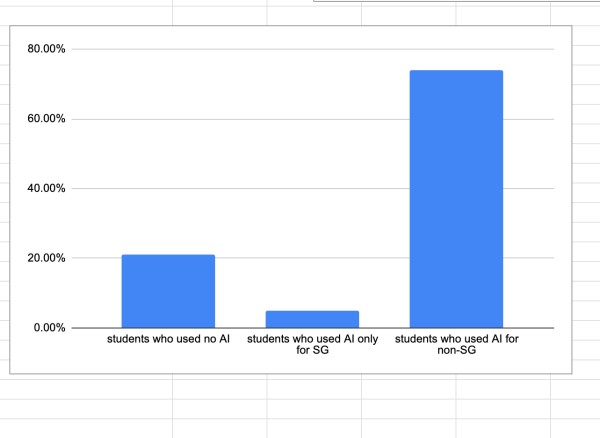
The results of the survey show that 74% of students use AI for what Bickford called “uses the English department finds problematic.”
According to a survey by Harvard, 51% of students who use AI said they did it for brainstorming. Bickford said that students’ answers to the survey showed “the two most common areas were brainstorming and outlining.”
Bickford said that the only acceptable use of AI was to make study guides, and not for things like brainstorming, outlining, or finding quotes. “Once you use AI to help frame your essay, it’s not ever going to get out of it. School is about practicing, and AI takes practice out of the students’ hands.”
Ford agrees, saying, “I think we should use our critical thinking skills,” but he added “there’s nothing wrong with [using AI to make outlines/similar uses], because [AI can be] a resource”.
An article from Duke University’s AI Ethics Learning tool kit warns that a heavy reliance on AI can lead to a lack of critical thinking skills in students. It also offers advice, saying “Students need to be aware of AI’s limitations, biases, and errors, ensuring they do not outsource their judgment to AI-generated content uncritically.”
“It would be naive to say… we’re going to lock AI out of the school, [that’s] not the English department’s intention,” said Bickford. “But… I want to see what students are thinking, and I want to understand their thought process… If everyone were to use AI, I would lose that human connection.”


Anthony Fountain • Feb 25, 2026 at 11:09 am
I feel that the news in this article about AI is actually really interesting because it is very common for AI to be used in schools now. It is kind of Crazy that 85% of students use AI. I was not very surprised that a lot of people use it. It also shows that AI isn’t just something a few people are trying; it is basically part of school culture now. think the numbers reveal that students might be using AI because they feel stressed or unsure about their writing skills. Like, if outlining and brainstorming are the most common uses, that probably means students struggle getting started. At the same time, I understand the teachers’ perspective because those are important skills we need to learn ourselves.
Calvin Cannon • Feb 20, 2026 at 10:14 am
I think the article makes a really good point about how AI is being used in school, and I can see both sides of it. I feel like AI can be helpful sometimes, especially when you are stuck and need help starting an idea or organizing your thoughts. It can make things less stressful and help you understand what to do. But I also agree with the teachers that using AI too much is not good, because then you are not really learning or practicing your own skills. If you always rely on AI, you might not get better at writing or thinking for yourself. I also think it is a problem if students use AI to cheat, because that is not fair and it defeats the purpose of school. At the same time, I do not think AI should be completely banned, because it is a tool that can be useful if used the right way. Overall, I think students should use AI in a smart and honest way so they can still learn.
Zachary Holloman • Feb 19, 2026 at 9:26 am
I am not surpirsed from any of the numbers in the article; they all make sense. I liked what Sam Gillman said in the article. I agree with him. I think the numbers do not reveal much of anything. Everyone knew most kids use AI for homework, classwork, or whatever. I think AI can be really helpful for learning and very detrimental. It knows a lot and can teach you a lot, but it does take away from the thinking. Sam Gillman said people use it for math, but it is not good at math, so I am not sure why someone would use it. I see a lot of my peers using it to do their work.
Amelia Terry • Feb 18, 2026 at 11:16 am
I think this article presents the issue of AI in a balanced way by including both student opinions and teacher concerns. I was surprised that 86% of students use AI and that 74% use it in ways the English department considers problematic, because those numbers show how common AI has become in school. They reveal that many students may see AI as a normal academic tool, even if teachers are worried about its impact. I agree with the perspective in “Learning in the Age of AI” that students should be careful not to rely too heavily on AI, since doing so could weaken critical thinking and writing skills. From what I see, many of my peers use AI for brainstorming, outlining, summarizing, or checking answers. While this can be helpful, the consequence may be that students become less confident in their own ideas and less prepared to think independently if they depend on it too much.
zhaoye wang • Feb 2, 2026 at 4:45 pm
When students’ homework could be done in 2 minutes and it used to cost them an hour. When the reading become shorter and shorter, people could read all the work of Shakespeare in one day. Will people refuse ai?
When employes’ work could be done in 20 minutes instead of a whole day, ai doesn’t need healthcare and rest, where is the Competitiveness of human? Will the boss refuse ai?
Without doubt, school emphasizes the connection between students and class, however, if school still remain in the past and refuse to welcome the new product-like the industry revolution, students who graduate from here will have difficulties in the society-others could use ai like using their mind, their one-day work worth those students’ one-month work, will students get a job? The answer is obvious like the pink on the paper.
Liam H • Feb 1, 2026 at 5:13 pm
I don’t use AI. Full stop. I used it maybe once, for a few messages, when ChatGPT was first making headlines, to see what all the hype was about, and I just thought it was an interesting novelty. Now, I’m actively opposed to it due to the numerous harmful impacts that I’m sure I don’t need to articulate. And, honestly, I thought that a lot of people would be in the same boat. As in, I thought that the majority of students would also be hesitant to use AI for much of anything. With the way it’s been affecting other industries in the technology world, I really was under the impression that the average person had come to hate AI for, if nothing else, its RAM cost. Evidently, though, I’m wrong.
E'vah M • Feb 2, 2026 at 10:35 pm
I am in the same boat. As of recently, it’s been eye-opening to see others’ perspectives on AI usage. I have never used AI. I don’t believe I ever will. Speaking with peers, classmates, and friends, it is frankly disappointing to see the number of people who acknowledge but don’t care or simply ignore the impacts AI has on the environment and on your brain. At this point, there is no lack of understanding or naivete; there’s acceptance and integration of AI into every part of daily life–regardless of the cons–for the sake of “easier living”.