





If there are three words that every American high school student has heard in their history class, those words are “freedom of speech.” Included in every lesson plan is the assurance that this baseline necessity for the satisfaction of Americans of any opinion remains an eternal, invincible guarantee gifted to us by our founding fathers.
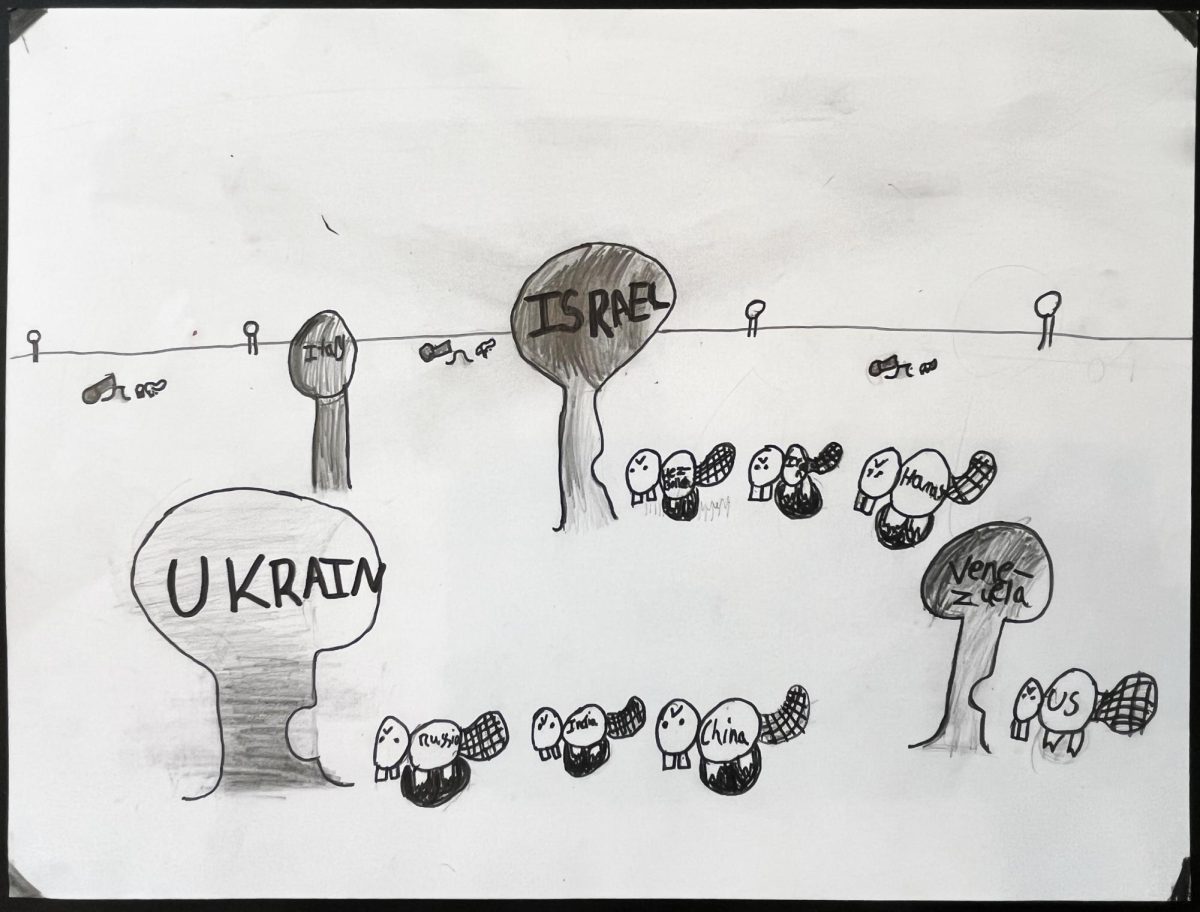
Recently, the controversy that has consumed Israel/Palestine discourse in America has threatened that gift. For young American students, the manifestations of this threat have included expulsion from university, police violence, and deportation–all responses to their use of free speech.
Secretary of State Marco Rubio admitted that he revoked over three-hundred visas on the basis of the pro-Palestinian stance of the visa-holders.
Student journalist Rumeysa Ozturk famously suffered violent consequences of decisions like these last March. She was seized by disguised officers from Immigration and Customs Enforcement (ICE) while walking to dinner as retaliation for a pro-Palestine opinion piece.
According to a study published in the Chronicle of Higher Education, 81% of college students feel pressure to avoid criticizing Israel’s actions. The message sent by arrests like Ozturk’s has seeped into the mindsets of students—including those at AFS.
Sage Solonynka ‘29 said, “I’ve always been really nervous. I mentioned it once to someone in my class, and there was… immediate backlash. With this topic, people…have such big opinions and … are not willing to listen to anything else…it’s just complete, utter ‘no.’”

Dean Sadowski ‘27 said, “I don’t feel comfortable say[ing] … any kind of negative speech on Israel. I feel like we should be able to critique any country. Why can’t I say this country is really doing some wrong stuff?”
However, Ash Cohen ‘26 says his free speech is jeopardized more due to his gender identity than his stance on Israel/Palestine.
Cohen said, “As a queer person supporting Palestine, people say: ‘why would you support Palestinians, they live in a country where being gay isn’t allowed?’ That’s frustrating, because the people [affected] aren’t necessarily [a reflection of] what the government says. I wish people could know that I’m not supporting anti-gay rhetoric— I’m supporting the people, ‘cause they’re people just like me.”
For high-school students, watching the turmoil that has surrounded college campuses throughout this conflict can raise unprecedented doubts about what will await them once they arrive at the institutions.
Cohen said that “as someone going to college next year,” they find the censorship “disgusting.”
Cohen said, “Colleges are meant to be spaces for students to … learn from each other. When we censor free speech and protests, it becomes dangerous. I’m freshly 18, so I know that I should be having access to more rights… It makes me nervous…that that’s being taken away. Also, as a trans person, I’m constantly advocating for myself to have access to the things that I need and having the right to do that is … important.”
Cohen’s connection between the suppression of free speech regarding Palestine and the role that free speech plays in his ability to receive care as a transgender American points to a concerning precedent that such censorship could set. If our government revokes the protection of the First Amendment for one perspective, can we trust that we are safe to hold any number of other perspectives?
Condemning the censorship of student activists, Addison Avant ‘28 said, “if … that can happen to people because that’s their perspective…that can happen to anybody.”
Solonynka, Cohen, and Sadowski hold defined stances on the conflict while Avant said she remains neutral, but all students interviewed could agree on one thing: the necessity of the preservation of freedom of speech regardless of one’s opinion.
Avant said, “Whether you support Israel or Palestine, you shouldn’t get kicked out [of] the country for that. Freedom of speech is…what makes America.”
Sammy • Nov 20, 2025 at 4:58 pm
As a left leaning student, I usually feel comfortable expressing my opinions on contentious topics at school. Most of the perspectives shared by other students here are very liberal, and so I know that if I do the same, I won’t receive backlash and it’s likely that most of the people around me will agree to some extent. But I imagine that if my views were very different, I wouldn’t feel the same level of safety when talking about what I think. In my experience, when politics are discussed it is usually in class, and there’s not a big variety of perspectives. I think that when these discussions are facilitated, teachers should make an effort to make space for students whose opinions don’t align with the majority of their peers. I think that discourse where everyone can share leads to greater understanding than when only one group of people talk. No growth happens from hearing people agree with you. But when there is a disagreement, people can learn new things and develop greater empathy.
Maya G • Nov 12, 2025 at 2:14 pm
I think schools, particularly schools like ours, should allow students to use their right to free speech, as long as they comply with school values of peace, integrity, equity, community, etc. As a Quaker school, I feel that we should uphold these values during times of global conflict. The FCNL is very vocal on these issues–they constantly advocate for a permanent ceasefire in Gaza, humanitarian aid for Palestinians, and the passage of the Block the Bombs Act (H.R. 3565). I believe that the school doesn’t have to make an official statement on current events but should support students’ free speech (as long as speech abides by community guidelines).
zara • Nov 12, 2025 at 11:52 am
I’ve tried to stay as tuned in on the controversy as possible, and what’s happening is sick. Their have been thousands of deaths, and the fact that criticizing Isreal or empathizing for everyone whose lost their lives because of what is happening can result in deportation, or expulsion goes against what we stand for as a country. Free speech is one of our countries founding priniciples, and it’s crazy that higher ups are trying to get rid of this. As people, our voice is extremely and the fact that our government is trying to go after that is really scary.
Emmett Kubersky • Nov 12, 2025 at 11:29 am
I think that it is an extremely tricky topic. Freedom of speech is something baked into the American way of life, and tot have that revoked is a corruption of your rights. I also think that context matters, so if you were to speak out against Israel in a synagogue, you will face backslash. Even of something is objectively correct, people are rooted int their ways, are are unlikely to change. I do think that being punished for speaking is unjust, especially being deported or expelled. When such a touch and sensitive topic like war arrives, people have very grounded places. I think that to speak out and to be punished is never okay, especially if it is something that you care very deeply about
Meadow Campuzano • Nov 9, 2025 at 4:46 pm
I have not really followed the events happening in Israel and Palestine. I personally am neutral because I simply do not know enough about the topic to have an opinion about it. However I do have a friend who lives in Israel and I just hope that she is ok. I feel comfortable saying why I am neutral on the subject but I can understand why people would feel uncomfortable to share their opinion because a lot of the times when people ask they only want to hear one answer and when they hear something else they get offended. I remember my friend from Israel asking me about my stance on it all and it was hard to give her an answer that wouldn’t offend her at all because she is from Israel. I had said that I didn’t really have an opinion on it because I didn’t know enough about it but your perspective can definitely shift when you actually know someone from one of those places. I think no matter what your take is you should be able to speak your mind, in a respectful way of course. I think schools should support students’ interest in global issues and should support their want to express themselves to try and help. Whether you are with Israel or Palestine there’s still lives being lost on both sides and someone who wants to help save lives by protesting or donating should be able to and supported.
Henry Goldstein • Nov 7, 2025 at 2:11 pm
Seeing the attacks on free speech by the current administration is very scary. The perspective shared in this article is mostly about the stances of pro-Palestinians and the risks they face sharing their opinions, but the free speech issue is bigger than just one specific issue. It encompasses everything anyone in America says that the administration doesn’t like. One of the clearest examples of this was when Jimmy Kimmel was taken off the air at ABC for his comments on the assassination of Charlie Kirk. This wasn’t some random occurrence. Brendon Carr, the FCC director, was very much involved in this decision, as remarks he made about Jimmy Kimmel and ABC pressured them into their decision to suspend the show. Personally, I don’t feel too scared sharing my own political opinions publicly, but this is due to my privilege. Many people do not have the same level of comfort as I do and face being fired from their jobs, prosecuted, or even deported. Although I wish this weren’t the case, I have been appalled by institutions of higher learning capitulating to the demands of Donald Trump because it is only making the crisis we are in worse. We can protect free speech, but only if we don’t succumb to pressure against it.
Joseph Lee • Nov 7, 2025 at 11:07 am
I love your article, especially the segment in which you asked the very good question – “If our government revokes the protection of the First Amendment for one perspective, can we trust that we are safe to hold any number of other perspectives?” It was the highlight of the piece for me. I don’t really follow politics because for a long time, I thought it was just a bunch of divisive nonsense coming from corrupt politicians. That’s an exaggeration, obviously, but I was afraid to give attention to current events because I felt as if it all simply led to stagnation and dissonance – a waste of time. However, articles such as this, along with my Politics and Protest class, have convinced me to stay up to date with the times. You implied a growing instability in the infrastructure of the government: how many fundamental American values can be broken until we fall into disarray? This made me think, well – holy crap! This really is one of the issues that we are facing right now. It would do a lot of good to keep up so that I can think critically as an informed citizen.
Sammy • Nov 7, 2025 at 9:57 am
As a left leaning student, I usually feel comfortable expressing my opinions on contentious topics at school. Most of the perspectives shared by other students here are very liberal, and so I know that if I do the same, I won’t receive backlash and it’s likely that most of the people around me will agree to some extent. But I imagine that if my views were very different, I wouldn’t feel the same level of safety when talking about what I think. In my experience, when politics are discussed it is usually in class, and there’s not a big variety of perspectives. I think that when these discussions are facilitated, teachers should make an effort to make space for students whose opinions don’t align with the majority of their peers. I think that discourse where everyone can share leads to greater understanding than when only one group of people talk. No growth happens from hearing people agree with you. But when there is a disagreement, people can learn new things and how to argue a point, and develop greater empathy.
Liam H • Nov 6, 2025 at 8:44 am
I’m not the most vocal individual in regards to this subject. I know I’m not. I try to show support where I can, but I sometimes get worried about the reaction in a similar way to what the interviewees in this article described. I’m not even sure why it’s this topic specifically because there are all sorts of controversial subjects I’m willing to throw my hat into the ring about, but it just worries me when it comes to Israel-Palestine. I don’t think any perspective on the subject should be punished, though, because it’s quintessentially antithetical to the principles that our country is built on. When it comes to literally any take, no matter how much I may disagree with the subject, I will always advocate for people to be able to say it without legal retribution because that’s our country’s foundation. Of course, freedom of speech does not mean freedom from social consequence, but I can’t in good conscience say that any opinion on any political issue should be barred from publication. Especially not in a newspaper like the Blue and White, which was founded on the principle of sharing every viewpoint.
Sammy • Nov 20, 2025 at 5:08 pm
I agree with you about worrying about other people’s reactions to your opinion on Israel and Palestine. I also feel comfortable talking about a lot of other contentious issues, but I think I feel less comfortable talking about this one because I know there is a wider array of perspectives among the people around me. With some other topics that are controversial, I know that most of the people in my life have similar political views about them and so I won’t be judged for what I say and I probably won’t upset many people. But when it comes to this subject, I have to be more careful. I am especially careful because on some occasions people criticizing the Israeli government have been accused of antisemitism and I don’t want people to misinterpret my thoughts and make judgements about me.