















Are all athletes at AFS experiencing sports in the same way? As an AFS student, I cannot understand nor see all that goes on behind the scenes of our athletics. However, as a student athlete, I’m also immersed in the environment of athletics, allowing me to gauge an understanding of the data presented in this report.
I completed a stratified sampling of 40 student athletes, 20 male athletes, and 20 female or non-binary athletes. With that, I completed a census sample of all 7 coaches who are also faculty members who teach in the Upper School. I selected my form recipients by referencing the athletic rosters for each season and sorting AFS students by male or female/non-binary.
Then, I used a name wheel to select 40 students, 20 from each category. I received a total of 37 AFS community members’ responses, 32 student athletes, and 5 US faculty members who coach. Additionally, I conducted further interviews in areas that were highlighted or unacknowledged in my data responses.
While no evidence pointed toward direct discrimination, there is a clear difference that surfaced from my data in how fair athletics are across sports and genders at AFS. This data demonstrates how some areas of athletics could benefit from slightly more attention and consistency.
Gender Differences in Reported Inequity
My strongest conclusion is that student athletes more frequently reported unfair treatment in female/non-binary sports than male sports. Now, in an attempt to uncover how differing gender identities perceive inequality, I dove into the results from one of my questions.
The question was, “Do any specific instances come to mind that represent strong inequity between genders?”
I sorted the responses on whether their scenario supported favoritism toward male or female/non-binary sports. Below is a graph comparing student perspectives with gender favoritism.
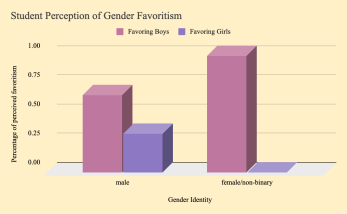
Figure 1: This graph shows the percentage of each gender group reporting favoritism toward boys and girls. Open-ended responses were sorted by gender identity and inequity that favors girls’ or inequity that favors boys’ sports.
Based on this graph, it is clear that all female/non-binary respondents only provided examples of inequity that favored boys. In contrast, the majority of male students acknowledged more favoritism toward male sports, with a small percentage leaning towards inequity that favors girls.
Anjali Holloman ‘26, a student athlete and a member of the golf team, said, “When I first started on the golf team, there were only two girls, and there were a couple of women’s uniforms, but as the team grew, we still only had a few uniforms despite there being a good amount of us.”
On the other hand, a few male varsity soccer players acknowledged inequity in which females were favored.
Emmett Kubersky ’29 said, “The middle school girls’ soccer was given the best soccer ball, while we, the boys varsity soccer team, were left with flat, poorly maintained balls.”
While some boys’ soccer members mention this ball favoritism, the overall trend of this graph demonstrates a higher favoritism toward male sports.
Student Versus Faculty and Their Perception of Fairness
My second conclusion is that the faculty responses were extremely more positive than the students’ opinions on inequity. A fairness scale was included in my survey, ranging from “Very Fair” to “Very Unfair.” All faculty responses fell under “Very Fair” and “Somewhat Fair.” Student responses included a higher range of reactions, but dominated in the “Somewhat Fair” and “Somewhat Unfair” categories, as shown in the graph below.
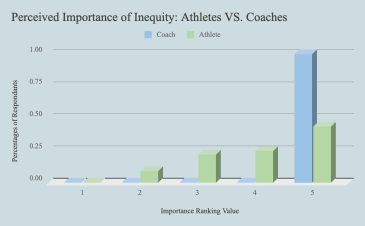
Figure 2: This graph compares fairness ratings by respondents’ position as “coach” or “student athlete.” Both respondent categories are highest in the “Somewhat Fair” category. This proves that students have a different opinion from the faculty, as a lot fewer athletes chose “very fair” and the majority fell in the “somewhat” region. Overall, this proves that students’ wider range of responses is likely due to factors such as their gender or what sport they play.
Additionally, I included an optional chance for faculty to answer, “Do you think student opinions will align with reality?”
Some teachers brought up the fact that students may rely on personal experiences without having the larger scope of program data.
Jeff Bond, Director of Athletics, said, “Probably not, because rumors and individual anecdotes can be more interesting and persuasive than data.”
Nathan Bridge, Upper School math teacher and girls’ tennis coach, said, “That’s a tough one. Sometimes I think students just don’t have all the information they need to form informed opinions.”
Bridge explained that when students aren’t involved in higher-level school decisions, it can be hard to see how challenging it is to actually get things done. Even when faculty want the same thing, that does not always mean it will be easy, or that they can make it happen in the end; there are so many factors to consider. We have to acknowledge that the institution is going to make the choice they will make, and know that it is in the best interest of our student body.
Figure 2 reflects these quotes directly, as while student opinions are more varied, the faculty responses remain more moderate.
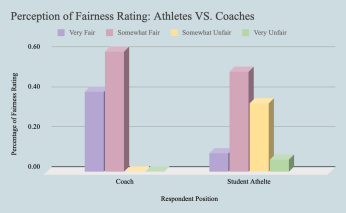
Figure 3: A graph comparing rankings on the importance of equality in AFS sports between student athletes and coaches. The respondents had the option to select a scale rating ranging from 1 to 5. They are sorted depending on the respondent’s position and the percentage for each importance ranking selected.
As a result of this graph, it is clear that all faculty rank the importance level a 5, while student opinions on the topic differ, ranging from 2 to 5. This could prove how different individuals understand the issue at different levels.
The Most Cited Issue: Field & Uniform Distribution
A third conclusion is that facility, field, and uniform distribution are the largest observed areas of inequity by student athletes. In the open-ended section, where I asked about areas of inequity in our sports, I sorted the responses based on their acknowledged area of inequity. The results are represented in the table below.
| Theme
Acknowledged |
Number of
Responses |
Percentage Value |
| Field/Facility space | 6 | 30% |
| Uniforms | 6 | 30% |
| Equipment | 4 | 20% |
| Turnout | 1 | 5% |
| Other | 3 | 15% |
Figure 4: I sorted each of the 20 answers I received for resurfacing ideas. Field/facility space and uniforms made up a combined 60% of reported issues. Making up more than half of the data responses field, facility, and uniform distribution are the higher areas of concern for many student-athletes.
Based upon survey responses from swim and female/non-binary ultimate frisbee members, I decided to collect further interviews.
Sophia Schwartz ’26 is a captain on the female/non-binary ultimate team, as well as a participant on the swim team. Schwartz pointed out a previous issue with the girls’ uniforms. Regarding the frisbee uniforms, before they were replaced, Schwartz said, “The girls were given old, sweat-stained boys’ soccer jerseys, and the boys [had] specific jerseys for ultimate.”
Additionally, the girls’ new swim uniforms posed an issue of discomfort for many of the girls; however, when they brought up the issue, they were quickly compared to the boys, who were doing just fine with their uniforms. The girls were forced to wear these suits for a while, despite continuously advocating for themself.
In terms of field space, the main area of concern was demonstrated in varsity field sharing between girls’ and guys’ varsity soccer.
Jona Malik ‘28 said, “I notice that the boys’ soccer team gets to play on the varsity field a lot more than the girls. There were times when it was split, and the girls’ team was able to play on varsity, but we played on the better field more than they did, and that’s unfair.”
Anna Lena Cassidy ’26 said, “The boys get the better field a lot of the time.”
These examples directly correlate with my table in Figure 4, as most of these responses are directed toward distribution issues, especially for uniforms and field space, accounting for 60% of acknowledgment. Not only does field space on the soccer field deem itself an issue, but the most noticeable area of acknowledgment was boys’ basketball in comparison to the girls’ basketball.
Basketball is the Most Mentioned Sport With Inequity
A fourth conclusion is that the sport with the most commonly acknowledged area of unfairness is between boys’ and girls’ basketball. A total of 6 people mentioned boys’ basketball being favored over the girls. Out of 20 answers, that is a total of 30%. Students mainly mentioned the favoritism that boys’ basketball receives.
While some student-athletes acknowledge recent improvements, they still point out noticeable differences.
Brendan Zhang ‘26 said, “Boys’ basketball games have more turnout compared to girls.”
Indie DuTot ’27 said, “Boys’ basketball is often favored compared to girls’ basketball or other girls’ sports in general. Boys’ basketball practices in Berman gym after school, while the girls’ team has had to go to the Triangle gym before.”
Caroline Timmer ’30 noted “How we focus ten times as much on boys’ basketball as we do girls.”
With no survey response from any basketball players themself, I turned to a former girls’ varsity player.
Nika Kim ’26 said, “I remember freshman year… all of the boys got gear, and the girls complained about it, and they had to talk to the boys’ coaches so that we’d get it as well.”
Kim said, “I feel like, following a loss, the girls would be talked down upon much more in contrast to the boys who lost as well.
Acknowledged Inequity Between Sports: It’s not Just a Gender Issue
An additional conclusion is that there is inequity between sports, not just gender. Some students noted how even sports of the same gender experienced unfair treatment in terms of equipment distribution.
Myles Griffin ’26 said, “Not necessarily between male and female sports teams, but there is definitely an inequality in the resource distribution between teams. For example, in basketball and wrestling, I remember asking one of the basketball players last year if they had to pay for their warmups, and they didn’t. By contrast, the wrestling team had to pay for our own warmups. Plus varsity jackets (when I was in 9th grade).”
The wrestling team did extremely well last year, which, if anything, should benefit their ability to receive equipment and resources. Therefore, many students picked up on these stark differences between sports, not always gender specifically.
Inconsistency that Needs Improvement
Lastly, there is a common trend of inconsistency within sports and genders, not necessarily discrimination, but these are areas that need improvement, and this can be achieved through conversation.
These examples of gender inequity in sports are ones to acknowledge and deserve more room for conversation. For instance, the female/non-binary ultimate team not being included in the yearbook was likely a mistake, but it also demonstrates an unseen and acknowledged area of our athletics. Many of these issues simply need to be addressed and talked about more, as some individuals may be unaware of them.
Eugene Feeley, math teacher and swim coach, said, “I was not aware that some students perceive gender inequity in AFS athletics. Students are often perceptive and can raise important concerns, and it’s valuable for the community to listen thoughtfully to those perspectives.”
Many students, as well as faculty, acknowledged how strong a community we are. That said, many students mentioned an equal sharing of the budget, better sharing of facilities, and more reflection on how we can improve in order to increase gender equity.
Anjali Holloman ’26 stated, “Maybe treat everyone the same! Fund all the programs.”
Sam Lopata ’26 said, “I think students banding together is always the best option. Especially in a community like AFS.”
Ultimately, we are a strong community, and conversation is the first step to addressing these areas of concern.