














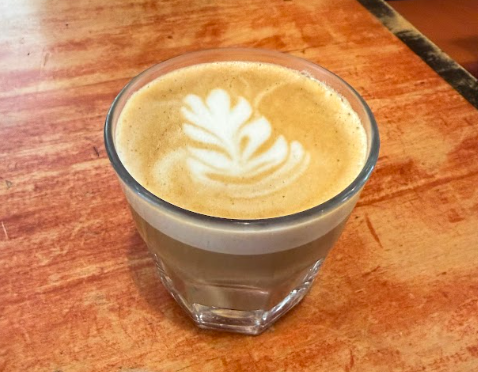
Whether it’s a morning coffee, an energy drink before practice, or even a B-12 boost, caffeine has somehow become a daily part of life for many teenagers and adults. This observation led me to the question: is it inevitable that we will rely on caffeine in one way or another?
To find just how common caffeine use is in our community, I conducted an online survey of 31 upperclassmen and 28 Upper School faculty. The goal: compare how students and teachers rely on caffeine, and understand what drives that dependence.
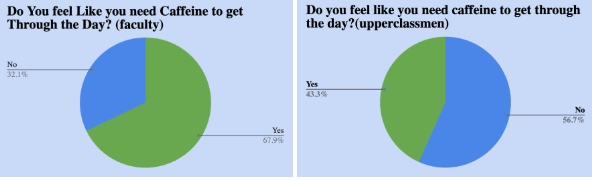
The results revealed a clear divide. Faculty members drink caffeine significantly more frequently than students and are additionally more consistent as a group with their frequency of consumption. While many students described caffeine as something they turn to periodically, faculty members were more likely to consume it daily. These results are shown below in the graph:
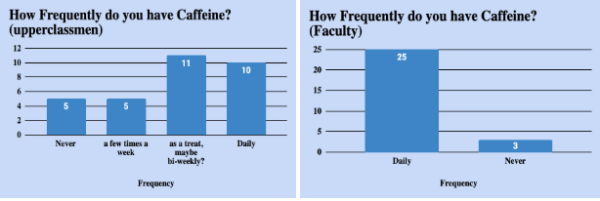
Among students, caffeine use varied widely. Some upperclassmen said they drink coffee or energy drinks multiple times a week, especially during busy academic periods. While others said they don’t use it at all, seeing no benefits to using caffeine as a booster.
In addition to the stark difference in the frequency of caffeine use, more faculty feel as though they require caffeine to get through their day in comparison to students.
The most common trend among students was the increase in caffeine use during busy academic periods. “I try not to drink it too often because I know it’s bad for me, but during stressful weeks I’ll definitely drink it more,” said Vic Moyer ’27. Like other involved students, Moyer described caffeine as a short-term solution rather than a daily habit.
A few students and faculty members, five students and two teachers, noted that they never drink caffeine. When asked why, the most common answer was health concerns, including increased anxiety and poor sleep quality.
Others said the reason was simpler: they just don’t like the taste or have ever felt the need to drink caffeine.
Interestingly, many faculty members noted that they didn’t begin drinking caffeine regularly until later in life. Several teachers said their caffeine habits developed alongside increased work and “adult” responsibilities.
Consistent with these results, students who reported frequent caffeine use were often heavily involved in school life. Reporting that upholding the AFS expectation of balancing academics with sports, clubs, the arts, and various other after-school activities requires the extra support that caffeine provides.
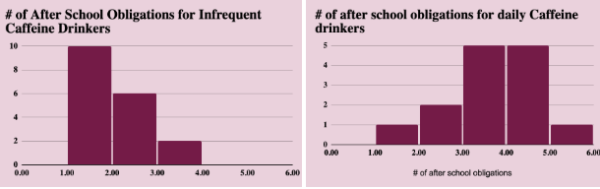
Students with a more frequent and consistent caffeine intake average having 3.5 after-school activities, while students who have a lower or less frequent caffeine intake average having 1.5 after-school activities.
A struggle noted particularly by many seniors was not having the energy to maintain typical responsibilities, academics, and the college application process. “I think I’ve definitely had caffeine more recently because of college apps,” said Una Davis ’26. Davis explained that when there is more to do and less time to sleep, caffeine quickly becomes something she relies on to stay productive.
Despite differences in frequency and reliance, both students and faculty who consume caffeine share a similar sentiment: it helps them get through hard days. It doesn’t matter if it’s an early class, a particularly long meeting, or late night study session, caffeine is used among all ages as a short-term solution to exhaustion.
Overall, the data suggests that while caffeine is reported to be more reliant on caffeine, students are quickly developing similar habits. As workloads increase and schedules grow more demanding, caffeine may become less of a choice and more of a coping mechanism.
Whether this dependence is inevitable remains unanswered, but one thing is certain: caffeine has firmly embedded itself in the rhythm of the AFS community.
Rael Santana • May 4, 2026 at 7:54 pm
Nowadays, caffeine is very romanticised in social media. All these new flavors, collecting and bedazzling of energy drink cans, flexing how many energy drinks one can consume in a small amount of time, etc. I believe that the final thing is the most impactful, since I feel that teenagers are always searching for things that may be risky, that may give them a bit of a thrill, or something they can say as a story. Drinks that taste good have also always been popular, so it makes sense for the kind that gives someone an energy boost with the good taste included.
caroline • May 4, 2026 at 12:38 pm
Yes I do think that the wide array of drink options makes caffeine seem more appealing to drink. I think social media also plays a huge role making drinks look more trendy and fun which can encourage more teens to drink it. As someone who actually does drink a coffee every morning, I don’t think I am entirely dependent on it and I don’t think social media plays a huge role in influencing me but it definitely does for lots of younger people.
Jada Downs • May 4, 2026 at 11:42 am
As someone who very rarely consumes caffeine, I think it’s important to collectively explore the why and alternative solutions to caffeine because it isn’t the healthiest. As the article said, many consume more when their responsibilities grow. Furthermore, this study was conducted within the AFS community, which largely consumes caffeine. So, how can we help as a community? Make class more engaging and hands-on to wake people up? Provide foods that give students energy? Or limit homework? Get more rest? I believe these are all very doable things to an extent if we give each other a little grace because, yes, Mondays are hard for most, and it’s easy to reach for an energy drink, but I think if we work together and support one another when we get tired, we can collectively lower our caffeine intake.
Elise C • Apr 29, 2026 at 12:24 am
Overall, I agree that coffee is not necessarily focused on just the caffeine benefits, although that is a large factor, but also for the way it tastes in modern day coffee shops. For example, whenever I feel I need an energy booster, I’ll drink a caffeinated beverage, though if it was not a sugary tasting drink, I would likely not indulge in them at all. Furthermore, I definitely agree that social media has romanticized getting drinks at popular coffee shop chains such as Starbucks and Dunkin’ for their delicious foamy flavors, although it has also made it more of a trending culture than rather a necessity. Whereas before getting coffee seemed like an essential part of a person’s day, now the act seems more of a fun “get-together” with friends or a spot where you can grab a delicious drink just simply because it’s delicious.
JW • Apr 28, 2026 at 2:18 pm
As someone who doesn’t really consume energy drinks or caffeine (except the spare cup of tea), I think caffeine is most certainly romanticized nowadays. Not to say you can’t have a cup of coffee now and then, but the super sweet and sugary lattes and drinks at Dunkin and Starbucks in my opinion are not supposed to be used for caffeination but rather just a sugar high. Alanis and Celsius intake is also interesting, I feel like I remember when I was younger, energy drinks were considered an “adults drink”, and not suitable for kids. But now seeing lots of highschoolers and even younger kids drinking them is a very interesting trend.
Amaya Goodwin • Apr 28, 2026 at 9:36 am
As an energy drink and coffee connoisseur, I think the wide range of different drink options with caffeine in them is definitely a contributing factor in the high consumption of caffeine by teens (including myself), specifically via energy drinks. Before I discovered I could add all sorts of sweeteners, syrups, and other additions to my coffee to make it less bitter, I mainly stuck to energy drinks because they provided the sweetness and surge of energy that coffee lacked. Although both are pretty popular online, coffee is usually the main caffeinated beverage that is romanticized.
paige • Apr 27, 2026 at 3:33 pm
As someone who grew up going to coffee shops with my dad and always getting one for myself, I never thought that I could find caffeine something that I could depend on. But as the school year got more stressful and I wasn’t sleeping as much as I should be, I started to lean on caffeine and energy drinks as a source of energy. As well as them being sold everywhere, them being easily available only fueled it more.
Natalia • Apr 26, 2026 at 10:50 pm
As a life long coffee drinker, the use of caffeine for students has always been an area of interest for me. At least for me, I didn’t have much of a choice when it came to drinking coffee. I was always given it as a kid since it’s a pretty big bonding thing in my culture (coffee for breakfast, coffee with dinner, coffee after dinner when everyone’s supposed to be leaving…), but I’m not much of an energy drink person. I don’t get much of an energy boost from regular coffee or even espresso, but the few times I’ve tried drinks like Celsius or Alani’s I’ve had a high that was kinda scary to me. It was a full on up-for-hours, bouncing off the walls, no sleep experience, and I think that’s pretty concerning considering that so many kids my age drink it. Though I’m not saying taking this much caffeine is good for anyone, especially teenagers, I can see why so many kids drink them. It can be hard to keep up if you’re low on energy, and already have a million other things taking up your free time so you can get the full eight hours of sleep that no one genuinely gets. For me, anything more than an occasional sip of an Alani is a no-go.
chloe • Apr 22, 2026 at 11:02 pm
I think these studies are very interesting, as even those who don’t like coffee have so many alternative options available now. The rise of the energy drink industry, including Celsius and Alani, comes with many side effects. There was a story on 6abc recently about a young, high school-aged girl who died after drinking too many Alani drinks every day and developing a heart condition that led to cardiac arrest. The family sued the company for improperly labeling the heart risks associated with the amount of caffeine. With so many young people relying on the higher levels of caffeine that energy drinks offer compared to coffee, it is important to teach them much greater caution when consuming these beverages and the risks associated with them.
Percy • Apr 22, 2026 at 9:38 pm
I definitely think that having different forms of caffeine has led to an increase in caffeine use overall, especially in high schoolers because energy drinks taste sweeter than coffee. I don’t think social media romanticizes it as much as it does make caffeine overuse “relatable” by saying that everyone drinks it. Which I mean, as shown by the graphs of this article, ring true. A few months ago though, a high schooler girl with a heart condition died from drinking too many Alanis (a type of energy drink that is popular) so I definitely think that while there is nothing wrong with people drinking caffeine – I think the effects of caffeine should be taught just as much (if not more!) than drugs or alcohol because caffeine is an addictive substance.
Josie • Apr 22, 2026 at 8:37 am
As somebody who doesn’t really enjoy the taste of bitter coffee, I find myself turning to canned drinks like Redbull, Celsius, and Monster. I think that a lot of the hype for energy drinks is just based on the looks. When I stare at a classic refrigerated shelf in Wawa or the drugstore, my eyes first turn to see those bright neon drinks instead of the more gloomy packaged coffee. I definitely depend on other types of drinks as well, like matcha and tea, but those colors really draw me in as well.
Henry Sylva • Apr 21, 2026 at 10:01 pm
The availability of different types of caffeinated drinks has definitely contributed to teenagers’ increased caffeine usage as many of these products are created with the intention of tasting better than coffee. Soft drinks, energy drinks, and flavored lattes have added sweetener and flavoring to cover any bitterness that might otherwise exist and have thereby made these drinks more appealing to drink often. In fact, many studies have shown that most teenagers consume caffeine from sources such as soda rather than coffee which indicates that how accessible these products are and what they taste like has an impact on whether a teenager will drink caffeine. Social media adds another layer of complexity to this issue. On social media platforms such as TikTok and Instagram, there are many images of drinks, especially aesthetically pleasing Starbucks orders or homemade lattes, as part of a “productive” or “put together” lifestyle, and therefore show caffeine in less of a drug context and more as an accessory item.
Helene • Apr 21, 2026 at 9:32 pm
This was really interesting to see through the data. For the majority of AFS, caffeine seems to be a direct response to being overextended and that is definitely true for me. I think that though maybe social media has made it seem “cool” to drink coffee, matcha, energy drinks, and the many other forms of caffeine, for the most part it is the exhaustion that is driving consumption. A classic example of this is the tv show Gilmore Girls, the main characters are both hardworking, constantly pulling all nighters, and so they drank coffee multiple times a day. Gilmore Girls was far before modern social media promoted drinking multiple caffeinated drinks a day and yet it had already become common practice.
Ruhi Patel • Apr 21, 2026 at 8:32 pm
As a daily coffee drinker, I think having additional caffeinated drinks doesn’t lead to more caffeine use; it just gives you more options. For people who rely on energy drinks purely because they think coffee is too bitter, they could just try a different method, like caffeine pills or caffeinated tea. So I don’t think having more types of drinks really affects, if anything, I think it’s good because it can give you a wide variety, and so if you’re drinking caffeine, you may as well enjoy it. I do think social media romanticizes caffeine a lot. Whether it’s coffees, Monsters, or Red Bulls, social media has promoted caffeine to the point where it introduces it to younger kids a lot earlier than before, and not only that, but it also makes caffeine something to be proud of. Social media doesn’t personally influence my caffeine use, but I can see how it would affect younger kids who want to be “cool” or “fit in”.
Sam • Apr 21, 2026 at 8:03 pm
I think social media has contributed a lot to the normalization of consuming large amounts of caffeine. I constantly see people drinking 3-5 monsters at a time, or adding energy drinks to pre-workout. I love energy drinks, not only for the caffeine, but also for the flavor. I don’t think drinking them in moderation is bad, but I do see the normalization of caffeine addictions, and I think that can be harmful. Some of my friends need to drink multiple in a day in order to not get headaches, or other caffeine withdrawal symptoms. Energy drinks are not bad, but like most things, an addiction to them is.