












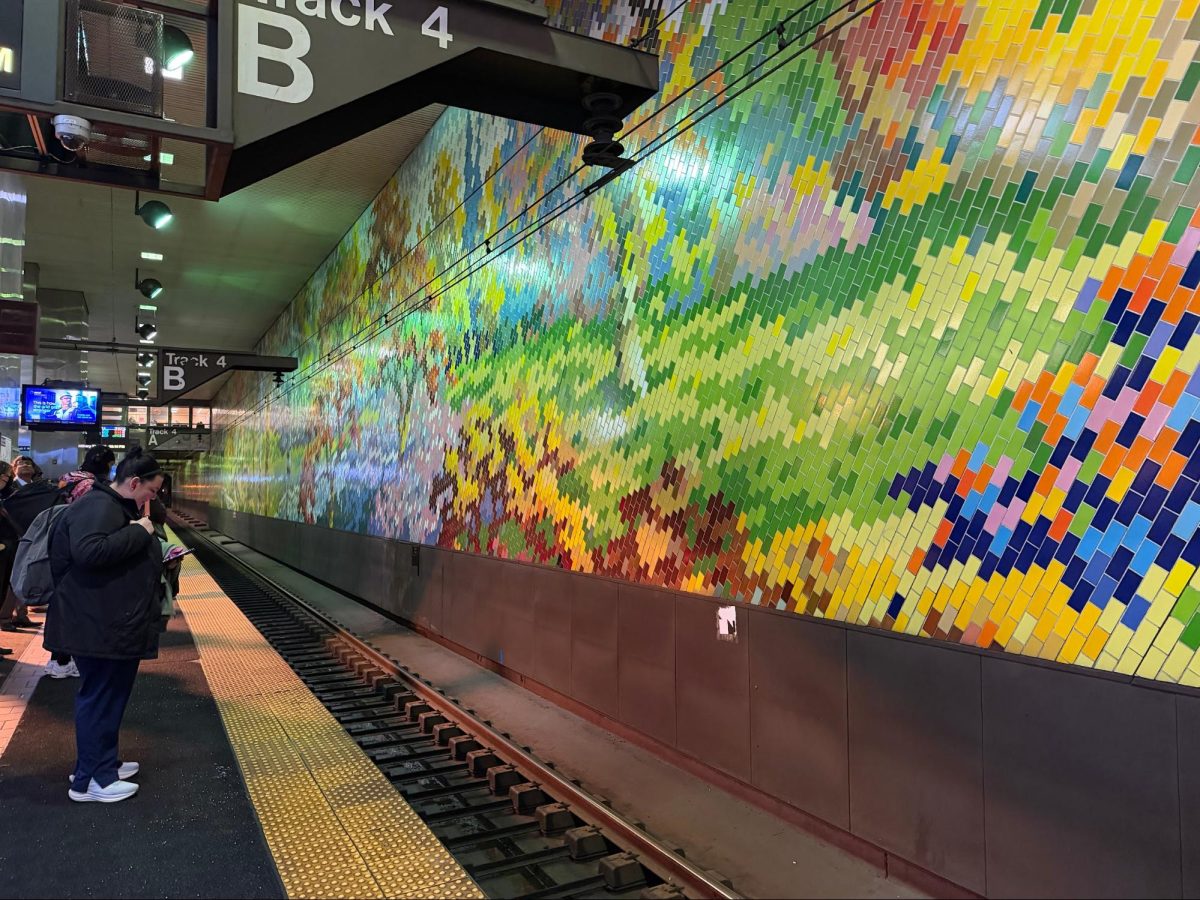
Every day, hundreds of thousands of commuters go through Philadelphia’s Regional Rail and subway stations. Many are going to school or to work and fail to notice the hidden beauty of these stations. Philadelphia’s subway and train stations feature mosaics, sculptures, and murals, serving as camouflaged museums.
The Philadelphia train and subway system is operated by Southeastern Pennsylvania Transportation Authority (SEPTA), which is the sixth-largest U.S. rapid transit system in America. Established in 1964 through the unification of several failed transit companies, SEPTA was created to help modernize public transportation in the Philadelphia region.
Over time, it has expanded to integrate public works of art as an effort to celebrate creative expression and beautify the Philly transit system. SEPTA’s stations act as public art exhibits that represent both cultural diversity and Philadelphia’s deep history.
One of the most well-known examples is the large, rainbow-tiled mosaic lining the walls of Jefferson Station. Installed when the station first opened in 1984, when it was previously named Market East Station, the ceramic tile art piece was designed by an architect named David Beck, who worked in collaboration with Verlin Miller. The two-block-long installation features a landscape with many trees, rolling hills, and clouds.
While it may appear as a simple rainbow upon first glance, it was meant to depict a stylized illustration of nature. This art piece shows the integration of art into architecture, as the mosaic was built along the concourse walls. Its vibrant colors help brighten the typical grey of the underground stations, inspiring and uplifting commuters.
Public art installations in Philadelphia stations are not limited to impressionistic designs. In 2021, an artist by the name of Tom Judd installed a large collage inside the 5th Street Station. Taking up over 3,000 square feet of space, Judd created a piece inspired by the early history of Philadelphia.
Some images in the collage depict Thomas Jefferson and George Washington, while others illustrate scenes of skeletons and birds, intending to show all aspects of revolutionary war era. Positioned near some of the most historic landmarks, such as Independence Hall and the Liberty Bell, Judd’s artwork inspires commuters to reflect on the historical events that shaped our city.
Other stations throughout the city also reflect their surrounding communities. Along the Dilworth Park South, City Hall, SEPTA, and Mural Arts helped create an exhibit entitled Philly Daydreams. This installation occurred in 2023 and featured interviews with SEPTA drivers, community members, activists, and artists.
In an effort to assimilate into the rapidly changing digitized landscape, this installation featured digital QR codes that activated art pieces and offered an interactive digital art experience. Mural Arts is a nonprofit organization dedicated to using accessible art as activism, justice, and neighborhood restoration.
Through projects such as Philly Daydreams, Mural Arts helped transform public transit spaces into creative, inspiring spaces for all. By incorporating art told by first-person narratives, SEPTA invites observers to take a more active role in creative development and observation.
Together, these art installations demonstrate how Philadelphia’s transit system is multifaceted, as it both serves as a network of trains and stations, as well as a reflection of the city’s vibrant culture and history. Through years of work and collaboration with local artists, SEPTA has transformed daily commutes into a celebration of Philadelphia’s identity.


Lauren Washington • Mar 9, 2026 at 8:35 am
Hi Leila, great article about a great topic! When I see subway art in Philly it makes me feel creative because I am seeing an artist’s thoughts and visions. Philly’s subway art makes train stations more special when compared to train stations in other cities. However, it does not classify as graffiti if the artist is told they can paint on said wall without getting in trouble. I hope subway art continues to be painted to make train stations unique and make its passenger feel inspired and comfortable.
Natalia • Mar 5, 2026 at 2:21 pm
As a kid who grew up going to the city more often than not, I see subway art more times than not. Personally, I think public art is a great way to help boost the overall “vibe” of a place, and especially a city. It’s a great opportunity to hire local artists, and represent the community that lives in the city. My favorite is when I see art in the subway that is personalized to Philly, whether it be some graffiti version of Griddy, or a commissioned piece of art that is on large display. They make it nice to sit around and just admire the time and work that’s gone into them, and maybe even make sitting in the usually dirty subway a bit worth it. In my opinion, there should be more of it.
Adalyn • Mar 5, 2026 at 8:50 am
When I take the train into the city, I do see the subway art, and I think that it’s really pretty and always makes the station feel brighter and just adds a wash of color where you least expect it. I think that it would be a huge benefit if more stations had artwork like Jefferson, specifically suburban stations, because I feel like most of them are just bland and dark, while they could be bright and colorful.
I think that graffiti does count as art because it’s used as a form of artistic expression in urban areas, and a lot of places in Philly have graffiti.
Kylie Firmin • Mar 4, 2026 at 7:45 pm
In the couple of times that I’ve been on the Regional Rail, something I’ve always noticed is the artwork. I think subway (station) art has become more common in general, but there’s something about Philly’s in particular. That may be my “native” bias coming through, but I feel that a big part of our city’s identity comes from its art and culture. And why wouldn’t that be a part of our train and subway system? Art and history are already such intrinsic parts of Philadelphia that it makes sense that we would see it in all aspects of our lives—including our commute. I’m glad art installations are being realized for the gift they are and hope to see more in a greater variety of places.
Solomon • Mar 4, 2026 at 3:06 pm
I have seen subway art in Philadelphia in SEPTA stations and also in other cities when using public transportation. The art in SEPTA stations is really incredible to see and is a simple thing that enhances the experience of commuters. I think generally below ground train, subway, and trolley stations can be a bit dreary and lacking in natural light, so having art displays can help address the lack of natural light that comes with a transit station being below ground. Expanding the art installations to more SEPTA stations would certainly enhance the transit experience for commuters across the transit system.