






















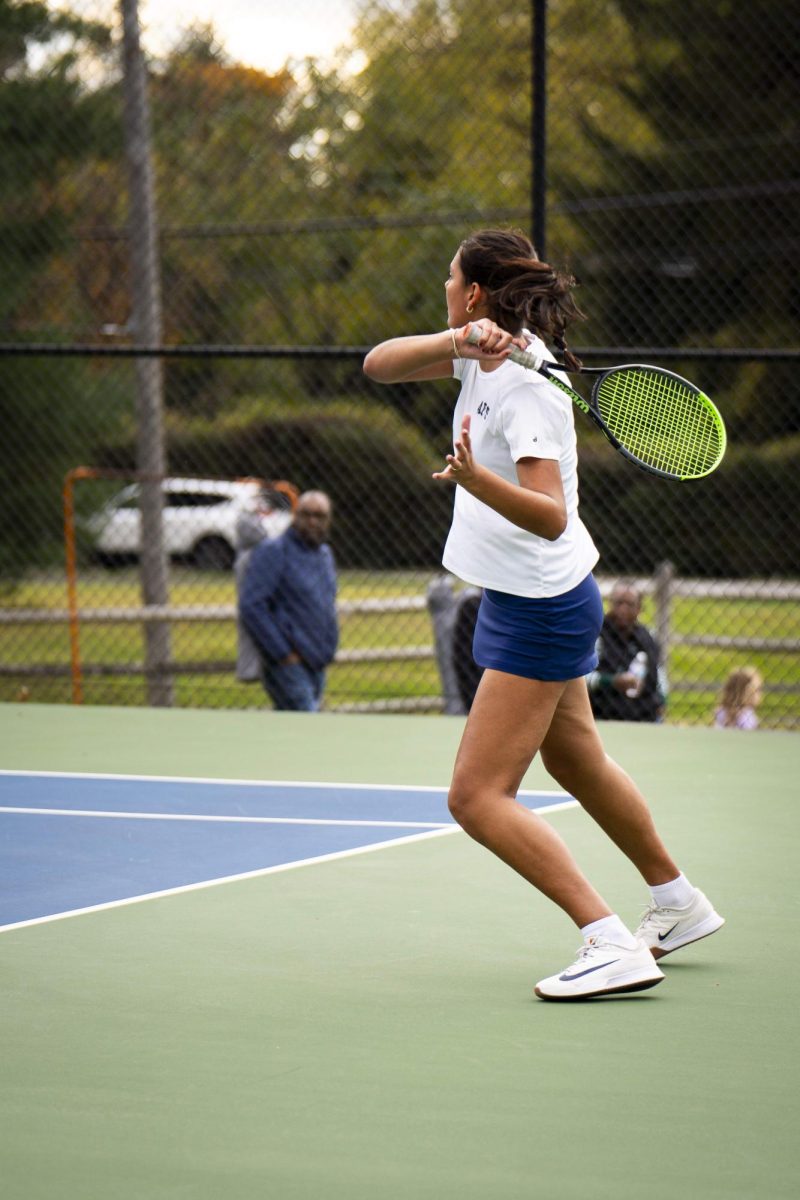
Crowds roared as tennis’s biggest early-season tournament delivered an unpredictable, yet rousing turn of events. The Australian Open marks the beginning of the professional tennis tour, hosted by the Association of Tennis Professionals and the Women’s Tennis Association.
Players like Carlos Alcaraz, Novak Djokovic, Elena Rybakina, and Arya Sabalenka had us all on the edge of our seats throughout the course of the tournament.
The Australian Open is one of four Major Grand Slam tournaments on the professional tennis tour. The other three tournaments consist of Roland Garros (the French Open, held in Paris, France), Wimbledon (held in London, United Kingdom), and the US Open (held in New York City, United States). Each of these tournaments runs for about two weeks, all consisting of high-level tennis matches, in which there are rivalries, friendships, and heartbreak.
This year’s Australian Open was no exception to the drama, whether that was smashing rackets, disputed medical timeouts, hindrance calls, or even theatrical press conferences. However, the many positive highlights—such as players reclaiming dominance, high-quality nail-biting match play, emotional farewells, and even world records being broken—must not be overshadowed by the drama of the event.
One particular moment in this year’s tournament captured how quickly athletes go from being untouchable to feeling like caged animals. Coco Gauff’s racket-smashing outburst was widely broadcast and critiqued. This caused many players in the tournament to raise questions about privacy policy in athletic spaces; Jessica Pegula was one of the first players to pose the question of athlete privacy.
She said in an article by the Entertainment and Sports Programming Network, that “it’s really an invasion of privacy…the only time you’re not being recorded is when you’re going to shower and going to the bathroom.”
The dispute over player privacy was only one piece of the puzzle at this year’s tournament, in which questions about fairness regarding medical timeouts were raised.
Alexander Zverev called out the organizers of the tournament for openly favoring Carlos Alcaraz, the world number one, mid-match.
During the semi-finals, Alcaraz suffered what appeared to be a cramp due to the harsh Australian heat. Normally, a player is not allowed to take a medical timeout for a cramp; however, Alcaraz did. This timeout is what many people believed led him to win the match and move on to the finals.
“He [Alcaraz] has cramps. What else should it be…That is unbelievable. That can not be. You can not be serious. You protect both of them [Carlos Alcaraz and Jannik Sinner, world number one and two]. It’s unbelievable,” Zverev said of the supervisor (in German) in an article for the New York Times.
The frustration around medical rulings was only the beginning. People became abuzz with a situation involving Naomi Osaka and Sorana Cîrstea.
In the second round match-up in the women’s draw, things got heated when Cîrstea did not like Osaka’s self-motivational techniques, which involved her yelling things like “come on” and overall celebrations that are typical in tennis. These sorts of celebrations involving yelling are permissible during matches by the players, with the exception of mid-point or when either one is serving to start the point.
Cîrstea stopped in the middle of a point to ask the umpire if Osaka’s self-motivation was allowed. The umpire agreed that it was. This led to a post-match war in various press conferences.
“I guess that emotions were very high for her. I also want to apologize…I think the first couple of things that I said on the court were disrespectful. I don’t like disrespecting people. That’s not what I do.” Osaka said in an interview with Forbes.
Amid these clashes of opinion, the tournament also showcased players who were able to rise above and come out on top. One of these players is Elena Rybakina.
Rybakina was able to pull through a very difficult match in the Semi-finals against Iga Świątek, of which she was not favored to win. Once she made it through to the finals, she had to face off against Arya Sabalenka, the world number one. Rybakina was able to pull through a very difficult final match with a score of 6-4, 4-6, 6-4.
The Australian Open title became Rybakina’s second Grand Slam title in her career and a momentous moment for her and her family.
Rybakina’s victory stood as one of the tournament’s most defining moments, yet the Australian Open and everyone at home watching witnessed a historical moment in the men’s final. Carlos Alcaraz became the youngest player in tennis history to win all four Grand Slam titles at twenty-two years old.
Alcaraz’s run at this tournament was massively successful, not having dropped a single set in a match until the Semi-finals. He had to battle it out for the Grand Slam title against the oldest player to ever play a Grand Slam final, Novak Djokovic, ultimately defeating him, 2-6, 6-2, 6-3, 7-5.
Despite the controversy that made its way through this year’s Australian Open, the tournament reminded fans why tennis is one of the most addictive sports in the world.
From Rybakina’s unexpected victory to Alcaraz’s record-breaking achievement, the event displayed the duality of sports, being tense and brilliant.
The Australian Open once again proved its ability to capture athletic triumph, while not shying away from showcasing the human side of athletics. This tournament left fans feeling like they witnessed history being made, a show of notable events and unforgettable talent.
RC • Mar 9, 2026 at 10:44 pm
Sports at the highest level often bring so much pressure to the athletes. Not only do athletes put pressure on themselves to succeed but they also have to bear the brunt of the criticism from audiences of sometimes millions of people around the world. We as members of the audience need to acknowledge that and remember that professional athletes are still very much human and often suffer from the same issues as us. If we as fans are compassionate and can relate to the athletes we support and even those we don’t, the professional environment can come to feel a lot safer for everyone. Too many professional athletes retire early or face mental struggles due to the opinions of their fanbase. I firmly believe that even though the entire premise of professional leagues and matches is to generate revenue, the athletes involved should still have the space to love their sport and get the support they need to grow and succeed. While it can be important to recognize when an athlete is in the wrong, we as an audience shouldn’t go out of our way to make the athlete’s life miserable. While we will have our own opinions and beliefs, we need to keep them at a respectful distance so that they won’t cause any harm.
Kate • Mar 9, 2026 at 7:19 pm
The article captures the excitement of the Australian Open by highlighting unpredictable moments, like Coco Gauff smashing her racket, Naomi Osaka’s self-motivational celebrations, and many more. These moments make readers feel the intensity and emotion of a live match, showing both triumph and controversy. Cheating or sports controversies, like disputes over medical timeouts, should be solved fairly and transparently, with consistent rules applied to all players to maintain trust. Sports impact mental health by creating stress, pressure, and emotional highs and lows for athletes, as seen with players handling public criticism and intense competition. While public criticism is common, focusing on an athlete’s performance rather than personal life respects their privacy and mental well-being, especially when they are under constant media attention.
Ruhi Patel • Mar 9, 2026 at 7:17 pm
I think sports controversies are super common in professional sports, and when they do appear, one side will always get hated on more. Penalities are given that can majorly affect a teams or athelete’s season. However, something I feel like we can all learn is separating the penalties from the athelete/team and refs. One controversy doesn’t define the skill or the personality of a player/ref. Not to mention, this can be harmful to an athlete’s mental health. When an athlete is persecuted or attacked through social media or, in rare cases, physically, this can affect their mental health. Person(s) involved can be led to believe that the controversy is completely their fault and that they don’t deserve whatever achievement they have accumulated, and that they’re completely defined by the controversy that occurred, which can lead to severe mental health problems down the line. I personally believe it is unfair for the public to criticize the personal actions of athletes since one action does not define someone. We should treat them with respect, just as we do anyone else. Think about it this way: would you like to be criticized and/or defined by one action? Would you like to be judged by those around you for one mistake? Place yourself in the athlete’s shoes for a minute and think about how you would feel.
Joseph Lee • Mar 5, 2026 at 9:01 am
We all know that professional athletes are essentially objectified by us, their fans. You know how when a sports team wins a game, we say, “Yeah, we won”? And then, when they lose, we say, “Yeah, they lost”? Notice that when they do well, we are more likely to identify with them, but when things don’t go in a positive direction, we choose to distance ourselves from “our” team. The fans pick and choose when to loan their support. The same thing happens when a player errs in their personal life or is found to have other flaws. In fact, we’ll go even further and make a public sensation out of it, posting on social media, discussing it with our friends, and the like. The message is this: “We own you. You need to do what’s right in our eyes”. As Serafina said in her comment, we need to treat athletes with grace and respect; they are still members of our society, though ones who are perpetually in the public eye. We have a responsibility to uphold our athletes’ dignity as much as they do.
[email protected] • Mar 5, 2026 at 8:32 am
As an avid watcher of professional tennis, I enjoyed this year’s Australian Open. The drama was not unexpected, as almost all large tournaments have some kind of big story coming out of it. Certain players are practically surrounded by drama, like Nick Kyrgios or Danil Medvedev. I think that it is unfair to solely judge an athlete during a high-pressure time, where they are under immense pressure to perform. Coco Gauff, while generally level-headed, is still human, and should not be criticized for moments of weakness. However, athletes are still role models and exist in the public eye. The career they chose makes it virtually impossible to remain private. Therefore, I think there needs to be both respect and grace from the public as well as an understanding from the athletes that they are being scrutinized on a large stage.